Language is supposed to be society’s most reliable contract. When people hear a word, they generally expect it to mean the same thing to everyone in the conversation. Democracy, Diplomacy, economics, journalism and even everyday life depend on that shared understanding.
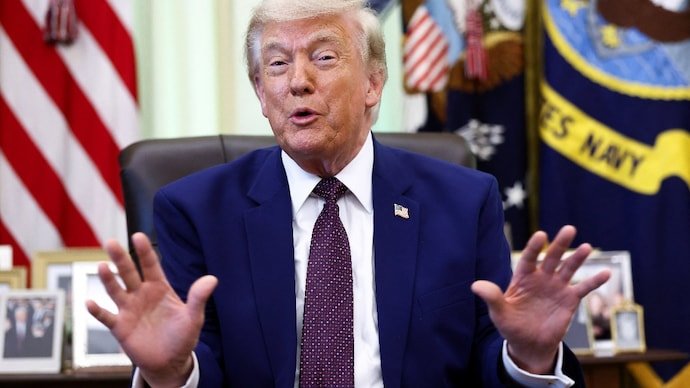
Yet modern politics increasingly revolves around a different battle: the fight to control definitions. Few political leaders have demonstrated this more dramatically than US President Donald Trump, whose public statements have often sparked debates not merely about policies but about the meanings of words themselves.
For critics, Trump’s greatest political skill is not deal-making, campaigning or governing. It is linguistic engineering—the ability to take familiar words, remove their traditional meaning and refill them with a definition that better serves his narrative.
Supporters see this as challenging establishment language and breaking through political correctness. Critics see it as a deliberate attempt to blur reality. Either way, Trump’s relationship with language has become one of the defining political stories of the modern era.
The result is a fascinating phenomenon that can be described as “linguistic Inflation“—a process where words are printed so heavily into political discourse that their original value begins to decline.
What Is Linguistic Inflation?
In economics, inflation occurs when money loses purchasing power. A currency that once bought a full meal eventually buys much less.
The same principle can apply to language.
When political leaders repeatedly stretch words beyond their traditional meanings, those words gradually lose precision. They become less useful for understanding reality because their definitions constantly change depending on who is speaking and what they are trying to achieve.
Trump’s critics argue that he has mastered this process.
Words that once had relatively stable meanings often emerge from Trump’s speeches transformed into political slogans, campaign weapons or branding exercises.
The spelling remains unchanged. The meaning does not.
Inflation: A Word That Became a Political Tool
One of the most interesting examples is inflation itself.
Economically, inflation refers to a sustained rise in the prices of goods and services across an economy. It is measured through data, monitored by central banks and analyzed by economists.
Politically, however, inflation has become something different. It has become a symbol of success or failure.
During periods when inflation falls, leaders celebrate victory. When it rises, explanations quickly follow.
The debate is often less about economics and more about narrative control.
Trump’s public comments on inflation over the years illustrate how political language can evolve according to circumstances. Depending on the moment, inflation can be defeated, dangerous, temporary, misunderstood or even desirable.
The changing descriptions highlight a broader reality of modern politics: economic terms increasingly function as political branding tools rather than purely technical concepts.
The Curious Transformation of Tariffs
If one word occupies a special place in Trump’s political vocabulary, it is “tariff.”
Trump has repeatedly described Tariffs as one of the most powerful tools available to governments.
Traditionally, economists define tariffs as taxes imposed on imported goods. The debate generally centers on who ultimately pays those costs and whether the economic benefits outweigh the consequences.
Trump’s framing often shifts the discussion away from taxation and toward national strength, economic independence and trade leverage.
As a result, tariffs become more than an economic instrument. They become a symbol of sovereignty.
| Traditional Definition | Political Interpretation |
|---|---|
| Tax on imported goods | Tool for protecting national interests |
| May increase consumer costs | May encourage domestic manufacturing |
| Trade policy mechanism | Economic patriotism |
| Revenue-generating measure | Negotiating weapon |
This illustrates how language can fundamentally reshape public understanding of policy. The underlying policy may remain unchanged, but the words surrounding it transform how people perceive its purpose.
When Every Negotiation Becomes a Historic Deal
Few words are more closely associated with Trump than “deal.”
After all, his public image was built around deal-making long before entering politics.
Traditionally, a deal means an agreement reached between parties after negotiations conclude.
In modern political communication, however, the term has expanded dramatically.
Framework agreements become deals.
Negotiations become deals.
Discussions become deals.
Potential agreements become historic breakthroughs before signatures ever appear.
This reflects a broader trend across global politics where perception often matters as much as formal outcomes.
In the age of Social Media, the announcement of a deal can generate headlines long before a deal actually exists.
The political reward comes immediately, while the practical details often arrive much later.
War, Peace and the Language of Power
Language becomes even more important during international conflicts.
Governments rarely describe military actions using neutral terminology.
Instead, words are carefully chosen to influence public opinion.
A military operation may be described as:
- National defence
- Strategic deterrence
- Counter-terrorism
- Peace enforcement
- Security operations
Opponents may use entirely different language to describe the same events.
The struggle is not simply over territory or resources. It is also over narrative.
A ceasefire, for example, traditionally means a halt in hostilities. Yet modern conflicts often reveal how flexible political interpretations can become.
Military pressure can be described as a path to peace. Escalation can be presented as deterrence. Economic restrictions can be framed as diplomacy.
The words matter because public support often depends on them.
The Rise of “Fake News” and the Battle Over Truth
Perhaps no phrase better captures the transformation of political language than “Fake News.”
Originally, fake news referred to deliberately fabricated information designed to appear as legitimate journalism.
Over time, the phrase evolved.
Today, it is frequently used to criticize media organizations, challenge reporting or dismiss unfavorable coverage.
Trump played a major role in popularizing the phrase globally.
For supporters, the term exposed media bias and elite narratives.
For critics, it weakened trust in independent journalism.
The result has been a growing divide in public perception.
Different groups increasingly operate within separate information ecosystems, each with its own sources, interpretations and definitions of truth.
This may be one of the most significant consequences of linguistic inflation: when words lose shared meanings, societies struggle to maintain shared realities.
Patriotism and Political Ownership
Patriotism traditionally means love of one’s country.
Historically, it has served as a unifying concept capable of bringing together citizens with different political views.
In modern politics, however, patriotism has increasingly become contested territory.
Political movements across the ideological spectrum often claim to represent the “true” patriots while portraying opponents as insufficiently loyal.
The word becomes less about national identity and more about political identity.
This transformation demonstrates how language can shift from describing values to enforcing group membership.
Once a word becomes tribal, its meaning changes.
The Psychology Behind Redefining Words
Why do these linguistic shifts work?
Political psychologists point to several factors.
- Simple messages are easier to remember than complex explanations.
- Emotional language spreads faster than technical language.
- People naturally prefer information that confirms existing beliefs.
- Repeated phrases gradually become familiar and persuasive.
Successful political communicators understand these dynamics.
By repeatedly attaching new meanings to familiar words, they can influence how audiences interpret events.
The process does not require universal agreement. It only requires enough people to adopt the revised definition.
Social Media Accelerated the Process
Trump’s rise coincided with the explosion of social media platforms that reward brevity, emotion and viral engagement.
Traditional political speeches allowed room for nuance and detailed explanation.
Modern platforms reward slogans.
Complex ideas are compressed into short posts, headlines and viral clips.
In such an Environment, words become brands.
A phrase repeated often enough can shape public perception regardless of its original meaning.
This phenomenon extends far beyond Trump. Politicians around the world increasingly compete not just over policies but over vocabulary itself.
A Historical Perspective: Trump Is Not the First
Although Trump’s communication style receives extraordinary attention, the practice of reshaping language is not new.
Governments throughout history have redefined wars, economic crises, surveillance programs and political movements.
What makes the modern era different is speed.
A new political phrase can travel around the world within minutes.
A slogan introduced during a television interview can dominate international discussion before the day ends.
The digital age has dramatically increased the power of linguistic framing.
The Hidden Cost of Linguistic Inflation
The greatest risk may not be political polarization but declining trust.
When words constantly change meaning, citizens become less confident about what is true.
If every Investigation becomes a witch hunt, every criticism becomes fake news, every negotiation becomes a historic deal and every political setback becomes a victory, language gradually loses precision.
Without precision, meaningful debate becomes more difficult.
Public trust in institutions, journalism, expertise and democratic processes can weaken.
This challenge extends beyond one politician or one country.
It is increasingly becoming a defining issue for democracies worldwide.
The Real Insight: Politics Is Now a Battle of Definitions
The most important lesson from Trump’s relationship with language is that modern politics increasingly revolves around definitions.
Control the definition, and you often control the debate.
Control the debate, and you influence public perception.
Influence public perception, and political power often follows.
This explains why language itself has become one of the most valuable political resources of the twenty-first century.
Conclusion: Why Words Still Matter
Donald Trump’s political career offers a remarkable case study in how language can shape economics, diplomacy, media narratives and public opinion. Whether discussing inflation, tariffs, deals, patriotism or international conflicts, he has repeatedly demonstrated that controlling definitions can be nearly as powerful as controlling policy.
The broader lesson extends far beyond Trump. In an age of social media, instant communication and constant political competition, words are increasingly contested territory.
The future of democratic debate may depend not only on which leaders win elections but also on whether societies can preserve shared meanings in a world where language is constantly being stretched, repackaged and redefined.
After all, inflation does not only affect currencies. It can affect words as well. And when meanings become devalued, citizens are left trying to navigate a marketplace where every term is worth a little less than it was yesterday.
For breaking news and live news updates, like us on Facebook or follow us on Twitter and Instagram. Read more on Latest World on thefoxdaily.com.



COMMENTS 0