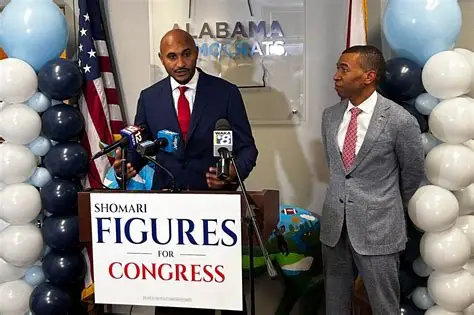
Alabama’s reshaped congressional map has produced its first major electoral test, with Democrats Shomari Figures and Terri Sewell advancing from Tuesday’s special primaries in districts redrawn after a series of legal battles over voting rights and race.
Both Democrats were unopposed in their respective primaries, meaning they will now turn their attention to the November general election. Figures faces the more competitive contest after Republicans altered the boundaries of the 2nd Congressional District to make it more favorable to their party. Sewell, who represents the 7th District, is considered to have a stronger path to retaining her seat.
The elections are taking place against a complicated legal backdrop. Alabama lawmakers redrew congressional boundaries after a US Supreme Court ruling involving race-based redistricting in Louisiana. The resulting map has changed the political character of several districts and created a new battleground for control of a House seat.
Figures and Sewell move toward November contests
Figures and Sewell are the only two Democrats in Alabama’s seven-member congressional delegation. Their advancement through the special primaries ensures that both will represent the Democratic Party in November, but the political circumstances surrounding their districts are markedly different.
Figures is now preparing for a Republican challenge in a district that was deliberately reshaped to improve Republican prospects. Six Republicans are competing for the nomination to face him, including State Representative Rhett Marques, who has received an endorsement from President Donald Trump.
Marques has openly framed the contest as an opportunity for Republicans to reclaim the seat. At a recent candidate forum, he argued that Figures would have significant financial and organizational advantages but said Republicans could win if their voters turn out.
The Republican contest also includes Hampton Harris, Christian Horn, former US Department of Agriculture official David Matthews, former US Army Green Beret Joshua McKee and former Marine James Richardson.
For Democrats, the central question is whether Figures can retain a district whose geographic and demographic profile has changed substantially since he first won it.
Why Alabama’s 2nd District was redrawn
The history of Figures’ district is closely tied to litigation under the Voting Rights Act.
Figures won the 2nd Congressional District in 2024 after years of legal challenges to Alabama’s congressional map. A federal court had previously ordered a new district after determining that the Republican-controlled state Legislature had intentionally diluted the voting power of Black residents.
Black residents account for about 27 per cent of Alabama’s overall population. The court concluded that the state needed a second congressional district in which Black voters were a majority or close to a majority.
The resulting configuration helped produce a historic outcome in 2024, when Figures became one of two Black representatives from Alabama in congress. Sewell was the other.
That arrangement has now changed following the latest redistricting process.
The new 2nd District looks very different
The congressional district that Figures won in 2024 stretched from Mobile across Alabama’s Black Belt to the Georgia border. The new map places the 2nd District in the southeastern part of Alabama and changes the communities that will determine the election.
It now includes Montgomery and Tuskegee, two communities with strong Democratic traditions and deep connections to the civil rights movement. At the same time, the district includes rural agricultural communities and areas with a substantial military presence.
The new boundaries include an Air Force installation in Montgomery and an Army installation in Dale County, giving the district a mixture of urban, rural and military interests.
The demographic change is equally important. The Black voting-age population in the district has fallen from 48 per cent under the earlier configuration to 40 per cent under the new map.
That does not automatically determine the outcome of an election, but it changes the political environment in which Figures must campaign. He now has to build support across communities that differ in geography, economic interests and political preferences.
Republicans see an opportunity to flip the seat
Republicans have made Figures’ district a priority because they believe the new boundaries provide a realistic opportunity to gain a seat in the House.
The broader contest is taking place in a closely divided national political environment, where individual congressional districts can have consequences for House control. A seat that might once have been considered safer for Democrats can become strategically important when its boundaries are redrawn.
Marques has argued that Figures will have access to substantial campaign resources and an advantage from having already represented part of the new district. But he believes Republican turnout can overcome those advantages.
At a forum in Dothan, Republican candidates discussed national and local issues ranging from the Iran War and Data Centres to the needs of their communities. Much of the conversation, however, focused on the November contest and the possibility of defeating Figures.
Christian Horn, the only Black candidate among the Republican contenders, argued that the party needs a candidate capable of competing throughout the district rather than relying only on traditional Republican strongholds.
The comments illustrate the central strategic challenge for Republicans: the district is not uniformly conservative, even after being redrawn in their favor.
Montgomery and Tuskegee could be critical
The inclusion of Montgomery and Tuskegee gives the new district a different political identity from the one Figures originally represented.
Both cities have major historical connections to the civil rights movement, making voting rights and representation particularly significant issues for many residents.
Montgomery also adds a larger urban population and a different set of political concerns to a district that includes rural farming communities and military areas.
Figures has sought to make his previous record in the district part of his argument for re-election. Speaking at a community gathering at Beulah Baptist Church near the route of the historic Selma-to-Montgomery voting rights march, he said Republicans would not be able to make the district impossible for him to win.
His argument is straightforward: although the boundaries have changed, he has already represented more than half of the new district and has had an opportunity to establish relationships with voters there.
That existing familiarity could become important in a campaign in which voters are being introduced to a newly configured congressional district.
The Supreme Court decision behind the new map
The redistricting battle in Alabama is connected to a broader legal debate over the use of race in drawing congressional districts.
In April, the US Supreme Court struck down a majority-Black congressional district in Louisiana, describing it as an unconstitutional racial gerrymander. The ruling prompted Alabama Republicans to move quickly on their own congressional boundaries.
Alabama lawmakers passed legislation cancelling the results of ongoing primaries and replacing them with special primaries under a map previously drawn by the Legislature.
The Supreme Court subsequently allowed Alabama to switch to the new map in June.
The result was a rare electoral reset. Instead of continuing with congressional contests under the existing boundaries, Alabama voters in four affected districts were asked to participate in special primaries based on the newly approved map.
Race remains central to the Alabama redistricting fight
The dispute over Alabama’s congressional districts cannot be separated from the state’s history of racial voting patterns and the Voting Rights Act.
The earlier litigation argued that Black voters had been concentrated or dispersed in ways that reduced their ability to elect candidates of their choice. The federal court’s intervention eventually led to the configuration that helped Figures win in 2024 and gave Alabama two Black members of Congress for the first time.
The new map has changed that political calculation. The reduction in the Black voting-age population of the 2nd District is one of the clearest measurable changes, but the political consequences will depend on turnout, candidate appeal and the distribution of voters across the new boundaries.
The competing interpretations of the map also demonstrate why redistricting disputes can continue long after a court decision. Supporters of the new boundaries describe them as a lawful correction following the Supreme Court’s ruling, while critics see the changes as an effort to maximize Republican opportunities in Congress.
Voters see the new district differently
The political divide is evident among residents in the newly configured district.
Tom Heisner, a 79-year-old retired air traffic controller who attended the Dothan forum, said the Republican Party was closer to his views on issues including border control. He expressed confidence that the Dothan area would support the Republican candidate, while acknowledging uncertainty about how Montgomery voters might respond.
Maggie Walker, an 80-year-old retired educator from Montgomery, viewed the redistricting process differently. She characterized the Supreme Court decision as part of an effort to increase the number of Republicans in the House but remained optimistic about Figures’ chances.
The contrasting views underscore the unusual political geography of the new district. Voters in southeastern Alabama do not share a single political outlook, and the November campaign will have to bridge significant differences between communities.
Sewell faces a different political landscape
While Figures is at the centre of the competitive contest, Sewell enters the next phase from a stronger position.
She is Alabama’s other Black Democratic representative and has already secured her party’s nomination without opposition. Although the redistricting process altered her district as well, the source material indicates that her route to re-election is considered more favorable than Figures’ path.
The contrast between the two Democratic incumbents is important. Alabama’s redistricting process has not affected every Democratic seat in the same way. The changes have produced different political calculations depending on the communities included in each district.
For Democrats, holding both seats would preserve their existing representation. For Republicans, flipping Figures’ district would provide an opportunity to strengthen their position in the House.
Why the November election matters
The November contest in the 2nd District will be watched well beyond Alabama because it brings together several national political questions.
- Voting rights: The district’s boundaries emerged from years of litigation involving the Voting Rights Act.
- Race and representation: The proportion of Black voting-age residents changed significantly under the new map.
- Redistricting: The contest demonstrates how changes to district boundaries can transform an incumbent’s electoral prospects.
- House control: Republicans view the seat as a potential pickup as both parties compete for congressional seats.
- Local interests: The new district combines Montgomery and Tuskegee with rural agricultural communities and military areas.
That combination makes the race more complicated than a simple Democratic-versus-Republican contest. Candidates will need to appeal to voters whose priorities may differ sharply depending on where they live.
What could determine the Figures-Republican race
The November outcome will depend on factors that cannot be determined from the redistricting map alone.
Turnout will be especially important. Republicans are clearly seeking to mobilize their voters in areas where the party has traditionally performed well, while Figures will need strong support from Democratic communities, including Montgomery and Tuskegee.
Candidate selection will also matter. Six Republicans are competing for the nomination, and the eventual nominee will determine the tone and priorities of the general-election campaign.
Figures, meanwhile, can point to his existing record and relationships with voters in a substantial portion of the newly drawn district. His ability to expand that support into communities that are less familiar with him will be a central challenge.
Alabama’s redrawn districts set up a broader political test
The special primaries have moved Alabama’s redistricting battle into its next stage. Figures and Sewell will carry the Democratic banner into November, while Republicans are working to select a challenger capable of turning the new 2nd District into a pickup.
The legal fight that produced the map has already reshaped Alabama’s congressional landscape. Now voters will determine what those boundaries mean in practice.
For Figures, the task is to demonstrate that a district made less favorable to Democrats can still be won through an established local presence, strong turnout and support across its newly assembled communities. For Republicans, the challenge is to convert a more favorable map into an actual victory.
The result will also carry symbolic weight. Figures’ 2024 victory gave Alabama two Black members of Congress for the first time in the state’s history. The November election will test whether that representation can be maintained under the new boundaries.
What to watch before November
The most important developments will be the Republican nominee for the 2nd District, campaign spending, voter turnout efforts and how the candidates position themselves on issues that matter across the district.
Montgomery, Tuskegee and the rural southeastern counties are likely to receive particular attention because the new district combines communities with different political traditions.
The outcome will ultimately show whether the new map has produced the Republican advantage its architects sought or whether Figures can overcome the changed boundaries through his existing political base.
For Alabama, the race is another chapter in a long-running struggle over congressional representation. For national Democrats and Republicans, it is also a test of how redistricting, turnout and candidate strength can interact in the fight for control of the US House.
For breaking news and live news updates, like us on Facebook or follow us on Twitter and Instagram. Read more on Latest World on thefoxdaily.com.





COMMENTS 0