Meta faced criticism after temporarily suspending the No Kings Coalition’s Instagram account during nationwide demonstrations in the United States on Saturday, raising concerns about online censorship at a time when organizers were encouraging Americans to vote early ahead of the midterm elections.
The account remained inaccessible for several hours while protests focused on voter participation were taking place across the country. The temporary shutdown frustrated organizers, who questioned why their communications platform had been restricted during a major day of political activity.
Meta apologized for the incident, attributing the suspension to an automated system designed to flag accounts that post, share or comment at unusually high frequencies. The company acknowledged that the action had been taken in error and said access had been restored.
However, the explanation did little to settle the dispute. The No Kings Coalition said its members had published only a handful of posts and livestreamed to thousands of viewers, challenging the suggestion that unusually frequent activity had triggered the restriction.
The incident also drew criticism from Senator Bernie Sanders, who linked the suspension to concerns about billionaire ownership of media platforms. With the No Kings movement urging greater participation in the electoral process, the episode intensified debate over the role of privately owned Social Media companies in political communication.
Why Meta suspended the No Kings Instagram account
According to Meta, the temporary suspension resulted from an automated enforcement action intended to respond to accounts displaying unusually high levels of activity. The system is triggered when accounts post, share or comment at very high frequencies, the company said.
Meta spokesperson Andy Stone addressed the incident on X on Saturday, acknowledging that the restriction had been applied incorrectly.
“Unfortunately, that automated action was clearly taken in error,” Stone wrote. “Everything is now working as it should and we sincerely apologize.”
The company’s explanation suggested that the suspension was a technical or moderation error rather than a deliberate decision to silence the protest movement. Meta said the account was functioning normally again after the temporary restriction.
Nevertheless, the timing became a central point of concern. The account went dark while No Kings organizers were holding demonstrations and promoting early voting, making it more difficult for the coalition to communicate with supporters through a major social media channel.
For political organizations, social media accounts can serve as essential tools for sharing event information, coordinating volunteers, livestreaming demonstrations and directing supporters towards campaign activities. Even a temporary loss of access can disrupt those functions when events are already underway.
The incident also highlights the limitations of automated moderation systems. Platforms use automated processes to identify activity that may violate their rules or resemble spam, but such systems can make mistakes. When an account associated with a large political movement is restricted, the consequences can extend beyond the account holder to the people relying on it for information.
Meta apologized and restored access, but the available information did not establish precisely which activity triggered the system or why the automated process incorrectly restricted the No Kings account.
No Kings Coalition demands an explanation from Meta
Although the coalition regained access to its Instagram account, organizers said the restoration did not resolve their concerns about the suspension.
In a statement published on Instagram on Sunday, the No Kings Coalition said Meta still owed it an explanation and argued that restricting communications about voting during an election period was unacceptable.
“We have regained access to our accounts, but Meta still owes us an explanation,” the coalition said.
The group also questioned Meta’s claim that unusually frequent activity had prompted the automated restriction. According to the organizers, members had “posted only a handful of times and livestreamed to thousands”.
The disagreement centres on whether the suspension was an understandable mistake by an automated system or a restriction that warrants a more detailed account from the platform. Meta attributed the incident to an erroneous automated action, while the coalition said its own description of its activity did not appear to fit the company’s explanation.
The available statements do not independently establish what triggered the suspension. Nor do they demonstrate that Meta deliberately targeted the movement because of its political views.
However, the incident has raised a broader question about how social media companies handle political accounts during major public events. Organizers depend on digital platforms to reach large audiences quickly, while companies must enforce their policies without unnecessarily restricting legitimate political speech.
For the No Kings Coalition, the concern was not simply that the account became unavailable. It was that the restriction occurred during demonstrations focused on voting, when timely communication could be particularly important to organizers and participants.
Bernie Sanders raises concerns over billionaire ownership of media
Senator Bernie Sanders also weighed in on the controversy on Sunday, expressing concern about the suspension in a post on X. Sanders linked the incident to what he described as the consequences of billionaire ownership of media.
His criticism placed the dispute within a wider debate over the influence of wealthy owners and large technology companies on public communication. Social media platforms have become important channels for political campaigns, civic organizations and protest movements, giving their moderation decisions significant consequences for how information reaches the public.
Sanders’ comments reflected concern about the concentration of control over communications platforms. However, his criticism did not establish that Meta had intentionally suspended the No Kings account to interfere with the protests.
The distinction is important because the available explanation from Meta was that an automated system had acted incorrectly. The company apologized and said normal access had been restored, while the coalition continued to seek further clarification.
The episode nevertheless illustrates why mistakes involving political accounts can generate immediate controversy. When a platform restricts an organization during a major demonstration or election-related campaign, questions about technical enforcement can quickly become questions about political neutrality, transparency and accountability.
For social media companies, the challenge is to ensure that automated moderation can respond to suspicious activity without inadvertently disrupting legitimate civic engagement. For campaigners, the incident reinforces the risks of depending on platforms whose enforcement systems they do not control.
Protests continue despite temporary account shutdown
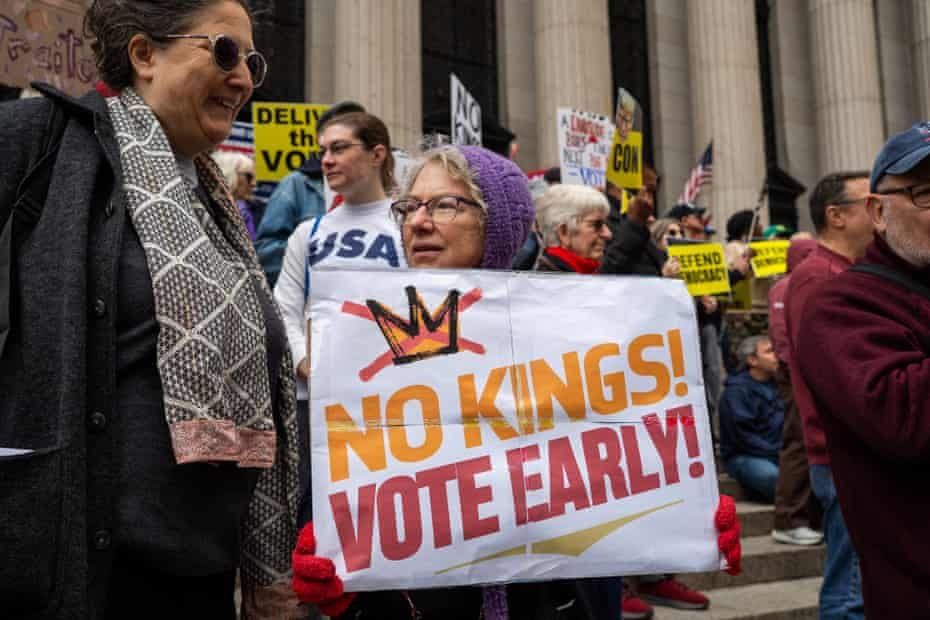
Despite the Instagram disruption, hundreds of planned events went ahead across the United States on Saturday. Demonstrators gathered in several cities, combining calls for greater voter participation with broader concerns about government policy and the direction of the country.
At the Lincoln Memorial in Washington, a band played for a crowd of a few hundred people. Many participants wore caps and coats, danced to the music and carried signs urging people to vote early or opposing what they viewed as interference with Voting Rights.
Signs reading “VOTE EARLY” and “HANDS OFF MY VOTE!” reflected the day’s emphasis on electoral participation. The gathering connected the immediate activity of encouraging voters to a wider concern about protecting access to the democratic process.
In Atlanta, city councilman Michael Julian Bond addressed demonstrators and emphasised the importance of voting.
“The constitution gives you one power, right? That is the power to vote. Are you gonna use that power?” Bond asked the crowd.
His remarks echoed the movement’s effort to turn demonstrations into participation in the electoral process. Rather than focusing exclusively on expressing opposition to government policies, organizers were also encouraging supporters to take practical steps ahead of the midterm elections.
In downtown Los Angeles, protesters carried umbrellas to shield themselves from the heat as a band followed the march on a rolling stage, according to The New York Times. The crowds cheered calls to abolish Immigration and Customs Enforcement, or ICE, and support California’s proposed billionaire tax.
The scenes reflected the range of issues represented at No Kings events. While voting was a central theme of Saturday’s demonstrations, participants also raised concerns about immigration enforcement, wealth inequality and federal policy.
The continuation of events despite the account suspension showed that the disruption did not prevent the planned demonstrations from taking place. However, it did raise concerns about the reliability of digital channels used to communicate with supporters during politically significant events.
What is the No Kings movement?
The No Kings movement began in the summer preceding the reported protests, emerging in response to a broad set of concerns about the Trump administration. These included federal layoffs, immigration enforcement and foreign wars, according to the supplied report.
The movement has since addressed a range of political issues and has generally drawn on opposition to President Donald Trump and his administration. Its demonstrations have brought together participants concerned about different aspects of federal policy under a shared pro-democracy message.
The coalition behind the protests includes progressive organizations and other groups involved in mobilizing demonstrators. Indivisible, a progressive organization that helps organize No Kings events, has played a role in coordinating activity.
Leah Greenberg, Indivisible’s co-executive director, previously told The Guardian that organizers planned to recruit volunteers at Saturday’s events to mobilize in the event of what they called “election sabotage”.
The stated plan suggests that organizers wanted to establish a volunteer network capable of responding to potential challenges to the electoral process. The phrase reflected their concerns about the integrity of elections, rather than establishing that election sabotage had occurred.
The movement’s broad agenda also helps explain why its demonstrations have attracted attention beyond a single policy dispute. Concerns about public services, federal employment, immigration and foreign policy can appeal to different groups, even when participants do not share identical priorities.
Why voting rights are central to the latest demonstrations
Saturday’s demonstrations placed particular emphasis on voting ahead of the US midterm elections. According to the report, this focus was partly influenced by the Supreme Court’s weakening of the Voting Rights Act and concerns that Trump could again challenge election results without a factual basis.
The Voting Rights Act has historically served as a central federal law protecting access to voting and addressing racial discrimination in elections. The report’s reference to the Supreme Court’s actions reflects organizers’ concern that changes in the legal landscape could weaken voting protections.
The supplied material does not specify which Supreme Court ruling it refers to, so the precise legal implications cannot be established from the report alone. The broader concern among organizers, however, is that protections surrounding voting rights and election administration could face further challenges.
The movement is also responding to fears that election results could be challenged through unsupported claims of fraud or irregularities. Such concerns have remained part of the political debate since the 2020 presidential election, when Trump repeatedly made false claims about the result.
By encouraging early voting and recruiting volunteers, No Kings organizers appear to be pursuing two related objectives: increasing participation before election day and preparing supporters to respond to potential disputes over the electoral process.
The Instagram suspension occurred against this backdrop. For a movement attempting to coordinate political activity, the loss of access to a major communications platform during voting-related events raised questions about whether technical errors could interfere with outreach efforts.
What the Meta controversy means for political communication
The temporary suspension of the No Kings Instagram account highlights the growing importance of social media companies in political communication. Platforms such as Instagram allow organizers to distribute information, reach supporters, livestream public events and coordinate activity across different locations.
That reach can make them valuable tools for civic participation, but it also creates dependence on systems controlled by private companies. An automated moderation error can temporarily interrupt communications even when an organization believes its activity is legitimate.
Meta’s apology acknowledged that the suspension was made in error, but the coalition’s demand for an explanation highlights a continuing concern: restoring access does not necessarily explain how the mistake happened or how similar incidents might be prevented.
Political organizations may therefore face a practical challenge in relying on a single platform to communicate with supporters. Maintaining multiple communication channels can reduce the risk that one account restriction will disrupt an entire campaign, although it cannot eliminate the broader questions about platform governance and moderation.
The incident also demonstrates the need to distinguish documented facts from allegations about political censorship. The account was temporarily suspended, Meta attributed the action to an automated error, and the company apologized. The coalition questioned the explanation, while Sanders criticised the influence of billionaire ownership over media.
The available evidence does not establish that Meta intentionally targeted the No Kings movement or suspended its account to suppress voting-related messages. At the same time, the timing of the error explains why organizers demanded greater transparency.
Meta apologizes, but questions remain
The No Kings Instagram account was restored after several hours, allowing the coalition to resume using the platform. Meta said its automated system had acted incorrectly and offered an apology, but organizers continued to seek an explanation for why the restriction occurred during their demonstrations.
Meanwhile, protests continued across the country, with participants calling for early voting and raising concerns about immigration enforcement, wealth inequality and the Trump administration’s policies.
The immediate disruption appears to have been temporary, but the dispute has exposed a broader tension between automated platform enforcement and the needs of political organizations communicating during major public events.
For the No Kings Coalition, the central issue is whether it can rely on social media to reach supporters during a critical period leading up to the midterm elections. For Meta, the episode highlights the importance of making moderation systems accurate, transparent and responsive when legitimate accounts are mistakenly restricted.
Although the company has acknowledged the error, the cause of the suspension remains unclear in the available reporting. The controversy is therefore likely to remain part of the wider debate over social media accountability, political speech and the role of privately controlled platforms in democratic participation.
For breaking news and live news updates, like us on Facebook or follow us on Twitter and Instagram. Read more on Latest World on thefoxdaily.com.




COMMENTS 0