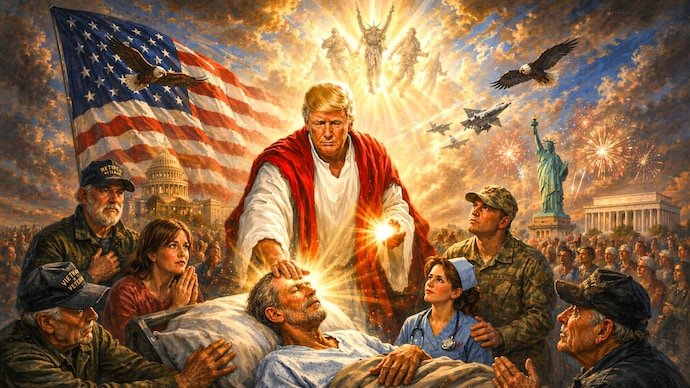
A rare and highly public confrontation has emerged between US President Donald Trump and Pope Leo XIV, the spiritual leader of the Catholic Church, amid escalating tensions linked to the Iran war. The clash intensified after Trump criticized the Pope as “weak on crime” and “terrible for foreign policy,” while also briefly sharing an AI-generated image portraying himself as a Christ-like figure. The Pope, without directly naming Trump initially, responded with strong warnings against war, misuse of religion, and what he described as the “delusion of omnipotence.”
This unusual standoff playing out across political speeches, Social Media, and global media raises key questions: Why is Trump targeting the Pope? What does each leader stand for? And what are the broader implications of this ideological and symbolic clash?
The Core Issue: A Clash of Ideologies
At the heart of the Trump–Pope conflict lies a fundamental ideological divide particularly on war, leadership, and the role of religion in Politics.
Pope Leo XIV’s Position: Peace and Restraint
Pope Leo XIV has consistently advocated for peace, Diplomacy, and humanitarian considerations, especially in the context of the Iran conflict. His messaging has focused on:
Ending violence and preventing escalation
Promoting dialogue between nations
Highlighting the human cost of war
Opposing the use of religion to justify military action
“Too many people are suffering… someone has to stand up and say there’s a better way,” the Pope said during a recent address.
He has also made it clear that he will continue speaking out, stating he is “not afraid” to challenge global powers when moral principles are at stake.
Donald Trump’s Approach: Strength and National Security
In contrast, Donald Trump has framed the Iran conflict as a necessary show of strength and deterrence. His administration has emphasized:
National security priorities
Military readiness and assertiveness
Strategic dominance in global conflicts
Trump has portrayed criticism of these policies as weakness, directly targeting the Pope’s stance.
Donald Trump
“Pope Leo is WEAK on Crime, and terrible for Foreign Policy,” Trump wrote on social media.
This sharp rhetoric underscores a broader disagreement over how global leadership should respond to conflict.
Religion Enters the Battlefield
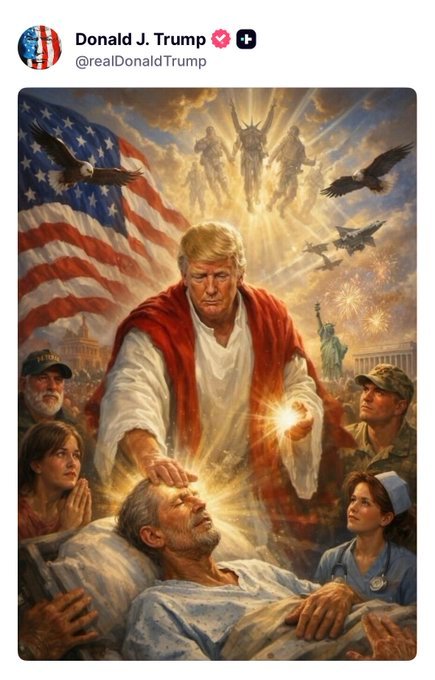
The conflict took a dramatic turn when Trump shared an AI-generated image depicting himself as a Christ-like figure wearing robes, surrounded by divine light, and appearing to “heal” a man. The image quickly sparked backlash from religious communities and political observers alike.
Although the post was later deleted, it added a symbolic dimension to the feud, raising concerns about the blending of political authority with religious imagery.
The Vatican’s response, while measured, was pointed. Pope Leo warned against using religion to justify war or project personal power.
This moment marked a shift from policy disagreement to a deeper debate about faith, leadership, and moral authority.
Why Trump Is Targeting the Pope
Several strategic and political factors may explain Trump’s unusually direct criticism of the Pope.
1. Countering a Powerful Global Voice
The Pope is not just a religious figure he is a global moral authority with influence over millions of Catholics worldwide. His criticism of war and US Foreign Policy carries weight on the international stage.
By challenging the Pope, Trump may be attempting to neutralize a prominent critic whose message resonates beyond political boundaries.
2. Reinforcing a Strong Leadership Image
Trump’s political identity has long been built around strength, defiance, and decisiveness. Criticizing the Pope allows him to reinforce this image, especially among supporters who value assertive leadership.
In this context, the Pope’s calls for restraint may be framed as incompatible with Trump’s approach to governance.
3. Domestic Political Calculations
Religious voters, including Catholics, play a significant role in US Elections. Analysts suggest that Trump’s remarks could be aimed at consolidating support among certain segments while challenging others.
At the same time, some experts warn that alienating moderate Catholic voters could carry political risks.
“He has to remember that it’s moderate Catholics who helped him win elections,” noted a political analyst.
4. Reaction to Growing Vatican Influence
There is also a perception that the Vatican, under Pope Leo XIV, is becoming more vocal and influential in global affairs. This may be seen as a challenge to traditional political power structures.
Trump’s criticism could reflect discomfort with that growing influence, particularly when it contradicts US policy positions.
Escalation Beyond Policy: A Rare Public Feud
Disagreements between Washington and the Vatican are not new. However, the current situation stands out for its intensity and public nature.
Aspect
Traditional Approach
Current Situation
Diplomatic Tone
Measured and private
Public and confrontational
Religious Involvement
Limited
Central to the debate
Political Messaging
Indirect
Direct and personal
The use of social media, strong language, and symbolic imagery has made this conflict more visible and more polarizing than past disagreements.
Global and Religious Implications
The Trump–Pope clash is not just a personal or political dispute it has wider implications for Global Diplomacy and religious discourse.
Impact on International Relations
Strained US-Vatican relations
Complications in global peace efforts
Increased polarization on international issues
Impact on Religious Communities
Debate over the role of religion in politics
Concerns about misuse of religious symbolism
Divisions among Christian groups globally
The controversy also raises deeper questions about how faith leaders and political leaders should interact in times of conflict.
Conclusion: A Conflict Beyond Politics
The ongoing clash between Donald Trump and Pope Leo XIV highlights a profound divide not just in policy, but in philosophy. On one side is a vision of leadership rooted in strength, deterrence, and national interest. On the other is a moral framework emphasizing peace, dialogue, and humanitarian values.
The addition of religious symbolism and public rhetoric has elevated the conflict to an unprecedented level, making it one of the most unusual confrontations between a US president and a Pope in modern History.
Looking ahead, the situation underscores the growing intersection of politics, religion, and global influence. Whether this conflict escalates further or gives way to dialogue remains to be seen. But one thing is clear: when two powerful voices with fundamentally different worldviews collide, the impact is felt far beyond their immediate spheres.
FAQs
Why is Donald Trump clashing with Pope Leo XIV?Toggle
The clash stems from major ideological differences, with Trump supporting strong military action while the Pope advocates peace and diplomacy.
Thefoxdaily.com is a news website dedicated to providing our audience with in-depth reporting, insightful opinions, and thorough analysis. We champion the principles of free people, free markets, and diversity of thought, offering an alternative to the left-leaning narratives prevalent in today’s news landscape.



COMMENTS 0