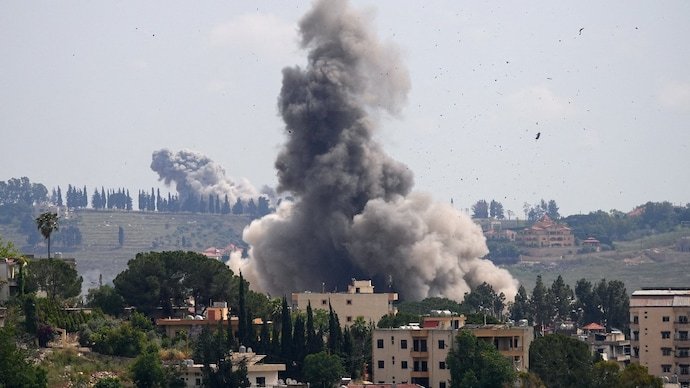
Just weeks after hopes emerged for a broader ceasefire in the Middle East, Israel and Hezbollah are once again exchanging attacks, underscoring how difficult it remains to contain one of the region’s most dangerous conflicts.
Israeli forces continued airstrikes and artillery operations across southern Lebanon, while Hezbollah announced fresh Military operations against Israeli forces. The renewed violence comes despite direct intervention from US President Donald Trump, who reportedly urged Israeli Prime Minister Benjamin Netanyahu to avoid strikes on Beirut in an effort to prevent a wider regional escalation.
While diplomatic channels remain active, events on the ground suggest that the conflict has entered a new phase where military pressure and political negotiations are unfolding simultaneously.
What Triggered the Latest Escalation?
The current conflict traces its roots to a broader regional confrontation involving Israel, Hezbollah, Iran, and the United States.
After months of escalating tensions, both sides had appeared to move toward a limited ceasefire framework. However, continued military operations, cross-border attacks, and mutual accusations of violations have repeatedly undermined attempts at de-escalation.
The latest crisis intensified after Israel threatened strikes against Beirut’s southern suburbs, commonly known as Dahiyeh, Hezbollah’s traditional stronghold.
Trump’s intervention reportedly helped prevent an immediate large-scale strike on Beirut, but it did not halt Israeli military operations elsewhere in Lebanon.
As a result, the ceasefire has effectively become partial rather than comprehensive.
Why Southern Lebanon Remains the Conflict’s Main Battlefield
Southern Lebanon has historically served as the primary zone of confrontation between Israel and Hezbollah.
The region’s geography, proximity to the Israeli border, and Hezbollah’s military infrastructure make it strategically critical for both sides.
Israeli military planners view southern Lebanon as a launch point for rocket attacks and cross-border operations. Hezbollah, meanwhile, considers the area central to its deterrence strategy against Israel.
This strategic importance explains why even when diplomatic progress occurs elsewhere, military operations often continue in southern Lebanon.
| Strategic Factor | Importance |
|---|---|
| Border Proximity | Direct access to northern Israel |
| Hezbollah Infrastructure | Operational and logistical presence |
| Civilian Population Centers | Humanitarian and political implications |
| Military Positioning | Control of key defensive zones |
| Regional Influence | Linked to wider Iran-Israel rivalry |
The Trump Factor: Can Washington Prevent a Wider War?
Donald Trump’s direct involvement highlights the growing concern in Washington that a prolonged Israel-Hezbollah conflict could destabilize the wider region.
Historically, US administrations have played a central role in mediating crises involving Israel and Lebanon.
However, the current situation is particularly complex because it intersects with broader tensions involving Iran, nuclear negotiations, regional alliances, and ongoing security concerns across the Middle East.
The fact that both Israel and Hezbollah reportedly responded to messages conveyed through intermediaries demonstrates that diplomatic channels remain open. Yet military actions on the ground continue to test those diplomatic efforts.
The challenge facing Washington is that neither side appears willing to abandon its core strategic objectives.
Iran’s Expanding Role in the Crisis
No analysis of the Israel-Hezbollah conflict is complete without examining Iran’s role.
Hezbollah remains Tehran’s most powerful regional ally and one of the most influential non-state military organizations in the world.
Iran has increasingly linked developments in Lebanon to broader negotiations with the United States.
Recent statements from Iranian officials suggest that any long-term diplomatic settlement involving Tehran may require progress toward a sustainable ceasefire in Lebanon.
This connection effectively transforms the Lebanon conflict from a localized confrontation into part of a much larger geopolitical struggle involving sanctions, nuclear Diplomacy, regional security arrangements, and strategic influence.
Why Hezbollah Matters Beyond Lebanon
Founded during Lebanon’s civil war era, Hezbollah has evolved into one of the most powerful armed groups in the Middle East.
Unlike many non-state actors, Hezbollah possesses sophisticated military capabilities, extensive political influence within Lebanon, and deep regional connections.
Over the years, the organization has developed:
- Advanced missile and rocket capabilities
- Extensive intelligence networks
- Political representation within Lebanon
- Regional alliances across the Middle East
- Significant social and welfare infrastructure
This combination of military and political power makes Hezbollah fundamentally different from many other armed groups operating in conflict zones.
The Human Cost of the Conflict
Beyond military calculations and diplomatic negotiations lies a growing humanitarian crisis.
Millions of civilians on both sides of the border continue to live under the threat of sudden escalation.
In Lebanon, repeated displacement has become a defining feature of daily life for many communities.
Families who return home after ceasefire announcements often find themselves forced to leave again when hostilities resume.
The psychological impact of this uncertainty is profound.
Children experience interrupted education, businesses struggle to operate normally, and local economies suffer as investment and tourism decline.
The conflict demonstrates how even limited warfare can impose enormous long-term social costs.
The Economics of War: A Growing Burden on Lebanon
Lebanon entered the conflict already facing one of the most severe economic crises in modern history.
Years of financial instability, currency depreciation, and political paralysis had weakened the country’s resilience.
The renewed conflict risks deepening these challenges.
Infrastructure damage, business disruptions, displacement costs, and reduced foreign investment all place additional pressure on an already fragile Economy.
For Lebanon’s government, achieving a sustainable ceasefire is therefore not merely a security objective but also an economic necessity.
What Washington Talks Could Achieve
Diplomatic discussions between Lebanese and Israeli representatives in Washington represent one of the most significant political developments since the conflict intensified.
Reports suggest negotiators may explore phased ceasefire arrangements involving specific geographic zones where hostilities would cease and military forces would gradually reposition.
Such arrangements are often used in complex conflicts where a comprehensive agreement is politically difficult to achieve immediately.
The strategy allows trust-building measures to develop incrementally while reducing violence in selected areas.
However, success will depend on whether both sides view these measures as serving their long-term security interests.
Historical Lessons from Previous Israel-Hezbollah Wars
History offers important insights into the current conflict.
Israel and Hezbollah have fought multiple confrontations over the past several decades, including major conflicts that significantly reshaped regional politics.
One recurring lesson is that military victories alone rarely resolve underlying political disputes.
Past ceasefires have often reduced violence temporarily but failed to address deeper issues related to border security, regional influence, deterrence, and political legitimacy.
This pattern suggests that any lasting solution will likely require both military restraint and meaningful political agreements.
The Bigger Geopolitical Picture
The Israel-Hezbollah conflict is increasingly becoming a proxy battleground for broader regional rivalries.
At stake are questions involving:
- Iranian regional influence
- Israeli security doctrine
- American diplomatic credibility
- Lebanese sovereignty
- Middle East power balances
- Future regional security arrangements
The outcome could influence not only Lebanon and Israel but also the strategic calculations of governments throughout the Middle East.
Could a Larger Regional War Still Be Avoided?
Despite continued attacks, there are reasons for cautious optimism.
All major actors appear aware of the potentially devastating consequences of a full-scale regional war.
Diplomatic channels remain active, indirect communications continue, and efforts to reinforce ceasefires have not completely collapsed.
At the same time, the situation remains highly volatile.
A single large-scale strike, miscalculation, or unexpected escalation could rapidly alter the trajectory of the conflict.
History shows that wars often expand not because leaders intend them to, but because events on the ground outpace diplomatic efforts.
Conclusion: A Fragile Peace Tested by Strategic Realities
The latest exchange of attacks between Israel and Hezbollah highlights the enormous gap between ceasefire announcements and lasting peace.
While diplomatic initiatives led by Washington continue, military operations reveal that fundamental disagreements remain unresolved.
The conflict is no longer merely a border confrontation between Israel and Hezbollah. It has become intertwined with regional power struggles, Iranian-American tensions, Lebanese political realities, and broader questions about Middle Eastern security.
The coming weeks may prove decisive. If Washington talks produce meaningful progress, they could lay the foundation for a broader ceasefire framework. If they fail, the region could once again find itself confronting the risk of a much larger and more dangerous conflict.
For now, the Middle East remains caught between diplomacy and escalation, with millions of lives affected by the outcome.
For breaking news and live news updates, like us on Facebook or follow us on Twitter and Instagram. Read more on Latest World on thefoxdaily.com.





COMMENTS 0