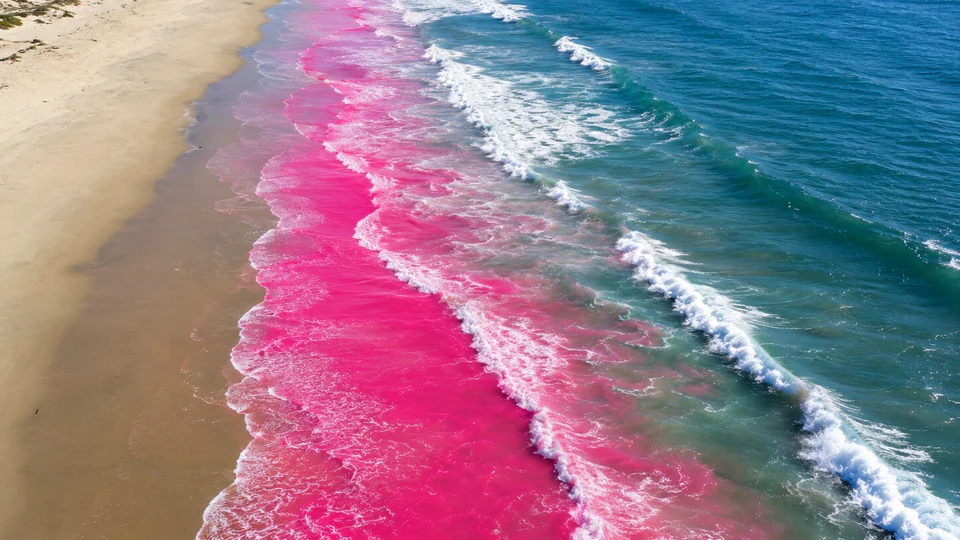
In 2015, scientists released bright pink fluorescent dye into the ocean off Southern California to understand how water and potential pollution move along the coast. The unusual experiment made an invisible process easier to observe, revealing how waves and currents can carry material through the surf zone and toward other coastal areas.
Researchers conducted three experiments near Imperial Beach, using non-toxic dye as a stand-in for pollution. According to Scripps Institution of Oceanography, the dye moved north through the surf zone at nearly eight miles per day during a strong south swell, following a coastal route toward the entrance of San Diego Bay.
The experiment was part of a scientific effort to understand how water moves between the surf zone, where waves break and swimmers spend time, and deeper water farther offshore. These exchanges can influence where pollution travels, how long it remains near a beach and how its concentration changes over time.
A detailed account of one dye release was published in 2021 in the Journal of Geophysical Research: Oceans by researchers Derek Grimes, Falk Feddersen and Sarah Giddings. Their findings showed that the dye did not simply travel north in a single, uninterrupted stream. Different currents carried water in different directions, while exchanges with deeper water helped spread and recirculate the dye.
Why Scientists Turned the Ocean Pink
Tracking pollution in the ocean can be difficult because many contaminants are invisible once they enter the water. Scientists need to understand where water travels, how quickly it moves and how material spreads, but direct observations of these processes can be challenging.
Fluorescent dye offers a visible way to follow the movement of water. Researchers can detect the dye using instruments in the ocean and imaging equipment mounted on an aircraft, allowing them to observe how a plume changes as it moves along the coast.
The 2015 work was conducted under the Cross-Surfzone/Inner-shelf Dye Exchange project, known as CSIDE, which was funded by the National Science Foundation. The project examined how water is exchanged between the surf zone and the inner continental shelf, the relatively shallow region extending offshore.
Understanding this exchange is important because the surf zone and deeper coastal water do not always move in the same direction. Water carrying a contaminant may travel along the beach, move offshore or return toward the shoreline, depending on the currents and conditions at the time.
Using dye allowed researchers to observe these movements under real coastal conditions rather than relying entirely on theoretical calculations. The resulting measurements helped scientists examine how waves and currents interact to determine the direction and concentration of material moving through the coastal ocean.
Inside the 2015 Dye Release Experiment
The 2021 scientific study examined a dye release conducted on October 8, 2015, approximately 0.6 miles north of Imperial Beach. Researchers pumped about 30 gallons of dye solution into the water over roughly four hours.
After the release, the team tracked the dye for approximately 30 hours. Instruments covered about four miles of coastline, enabling researchers to measure how the plume travelled and how its concentration changed at different locations.
The leading edge of the dye crossed the monitored stretch of coast in roughly 11 hours. This observation gave researchers a way to compare the actual movement of the plume with the transport expected from the incoming waves.
The study was not simply an exercise in making the ocean look different. Its purpose was to collect detailed measurements of water movement in an Environment where currents can change over short distances and where the surf zone interacts continuously with water farther offshore.
The dye release also provided a practical way to examine how long a substance could remain near the coast. Rather than disappearing as soon as the main plume passed, some of the dye remained in deeper water and later returned toward the shoreline.
How Waves Carried the Pink Dye North
Waves played a major role in determining the direction of the dye’s movement. When waves approach a beach at an angle, they can generate a current that flows parallel to the shoreline. This process, known as a longshore current, can transport water and material over considerable distances.
During the experiment, the dye moved north through the surf zone, consistent with the direction predicted from the incoming waves. Scripps Institution of Oceanography reported that the movement reached nearly eight miles per day during a strong south swell.
That rate helps explain why material released into coastal water does not necessarily remain close to its original location. Under suitable conditions, waves can carry water along the shoreline, spreading a plume beyond the beach where it first entered the ocean.
However, the dye did not move uniformly throughout the coastal environment. The researchers found that water in the surf zone travelled north while currents beyond the breaking waves moved more slowly south.
This difference meant that the dye’s path depended on where it was located. Material within the surf zone could be carried rapidly along the beach, while some of the dye transported farther offshore encountered currents moving in the opposite direction.
The contrast between these currents is central to understanding the experiment. A coastal pollution plume cannot always be described by a single direction or speed because water movement varies across the nearshore environment.
Why the Dye Concentration Dropped Along the Coast
Although the dye travelled north, its concentration declined sharply with distance from the release point. The study recorded a strongest surf-zone reading of about 90 parts per billion near the release location. Approximately four miles farther along the coast, the concentration was below five parts per billion.
The decline reflected the movement of dye out of the surf zone, including through rip currents. These relatively narrow, fast-moving currents can carry water away from the beach and into deeper water, transferring some of the dye away from the area where waves break.
The researchers estimated that water in the surf zone was exchanged with deeper water approximately every 2.3 hours. This exchange helps explain why the concentration within the surf zone decreased even as the plume continued to travel along the coast.
For scientists studying coastal pollution, this distinction matters. A falling concentration near a beach does not necessarily mean that all the material has disappeared from the surrounding ocean. Some of it may have moved into deeper water, where currents can carry it along a different route.
The measurements therefore provided insight into two processes occurring at the same time: the northward transport of dye through the surf zone and the transfer of some of that dye into water farther offshore.
How Deeper Water Returned Dye to the Shore
One of the more important findings was that dye transported out of the surf zone could later return. The researchers found evidence that some dye remained in deeper water, where it drifted south more slowly than the surf-zone current carried water north.
After the main plume had passed, some of this stored dye could re-enter the surf zone. The study described this process as recirculation, showing that coastal transport can involve repeated movement between nearshore and offshore waters rather than a single journey away from the release point.
Recirculation also helped explain why dye readings at locations farther along the coast could show long, fading tails. Even after the main concentration had moved past a monitoring point, smaller amounts of dye could continue to appear as water from deeper areas returned to the surf zone.
This process complicates efforts to predict when a coastal area will be free of a contaminant. The passage of the most visible or concentrated part of a plume may not mark the end of its presence in nearby water.
For pollution monitoring, the finding highlights the importance of considering both the immediate movement of water along the beach and the longer exchanges taking place offshore. Measurements taken only at the shoreline could miss some of the processes that influence how long material remains in the coastal environment.
What the Experiment Means for Beachgoers
The exchange of water between the surf zone and deeper coastal areas can reduce the amount of dye remaining in the surf zone. Because this is where many beachgoers enter the water, the process may reduce the concentration of material carried downstream within the nearshore zone.
However, the experiment should not be interpreted as proof that pollution becomes harmless when it moves offshore. The researchers used dye to understand water transport, and the findings describe how the dye moved under the conditions observed during the study.
Different pollutants can behave differently depending on their physical and chemical properties. The movement of a dye plume can help scientists understand coastal circulation, but it does not establish how every contaminant will spread, persist or affect human health and marine life.
The research nevertheless offers a useful foundation for understanding why pollution can travel beyond the location where it enters the sea. Waves may move material along the coastline, while rip currents and deeper-water circulation can alter its route and concentration.
Scripps researchers have also highlighted the need for additional studies and improved modelling to forecast where pollution is moving in real time around beaches in San Diego, Imperial Beach and Coronado.
Why More Coastal Pollution Studies Are Needed
The 2015 experiment provided detailed observations, but its findings have limits. The scientific study examined a particular dye release under a specific set of coastal conditions. The authors noted that similar long-range observations are needed to test whether the model applies in other locations and circumstances.
Wave direction, current strength and the exchange of water between the surf zone and deeper areas can vary. A plume moving north under one set of conditions may behave differently when the waves, currents or coastal environment change.
That variability makes real-time forecasting challenging. Researchers need observations from different conditions and locations to determine how reliably models can predict the direction, speed and persistence of pollution plumes.
More accurate forecasts could help coastal authorities understand where a pollution event may travel and identify areas that may require closer monitoring. But the dye experiment alone does not establish a complete forecasting system or guarantee that every pollution event can be predicted accurately.
What Scientists Learned From California’s Pink Ocean
The bright pink plume created off Southern California in 2015 made normally invisible coastal processes easier to observe. By tracking the dye over time, researchers showed how waves can transport water north along the beach while currents beyond the surf zone move in a different direction.
The measurements also demonstrated that dye can leave the surf zone, enter deeper water and return later through recirculation. These exchanges help explain why concentrations may decline near the release point while traces of a plume remain detectable farther along the coast.
The experiment does not mean that every pollution event will travel nearly eight miles per day or follow the same route toward San Diego Bay. That reported speed occurred during a strong south swell, and the detailed study examined one release under specific conditions.
Instead, the research illustrates why coastal pollution is difficult to track and why scientists need to account for more than the visible movement of a plume. Waves, rip currents and deeper-water circulation can all influence where material travels and how long it remains near a beach.
By turning the water pink, researchers gained a clearer view of a complex system that usually remains hidden. Their findings provide a basis for further work on coastal circulation and pollution forecasting, while underscoring the need for additional observations before the results can be applied confidently to other beaches and conditions.
For breaking news and live news updates, like us on Facebook or follow us on Twitter and Instagram. Read more on Latest World on thefoxdaily.com.






COMMENTS 0