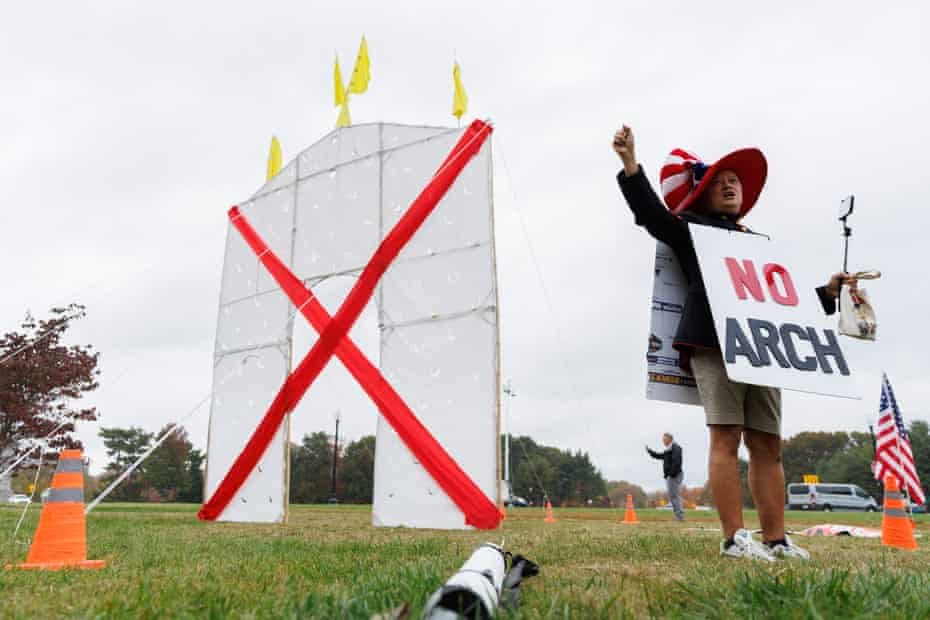
A federal judge has blocked construction of US President Donald Trump’s proposed “triumphal arch” in Washington DC, ruling that the project lacks a sufficient legal basis. The injunction, issued on Friday during a hearing in Alexandria, Virginia, prevents construction from moving forward while the legal challenge proceeds.
The proposed monument is one of Trump’s high-profile architectural projects and is intended to create a prominent landmark in the US capital. However, the court’s intervention raises questions about the authority to approve the structure, the legal process behind the plan and the use of prominent public spaces for presidential projects.
The latest ruling represents a second judicial setback for the project. Earlier in November, US District Judge Tanya Chutkan separately ordered a temporary halt to construction in a case brought by Washington DC and Virginia. The new decision from Brinkema adds another legal obstacle as the administration attempts to move ahead with the proposed monument.
Why the Virginia Judge Opposed the Proposed Trump Arch
Judge Leonie Brinkema raised concerns about the federal government’s assessment of the project’s economic and environmental consequences. During the hearing, she questioned whether officials had adequately examined the potential effects of building such a large structure at a sensitive location near major transport infrastructure and historic landmarks.
One of the central issues involved the proposed arch’s proximity to Ronald Reagan Washington National Airport. The structure is planned approximately 3,000 feet from the airport, placing it within the airport’s main approach and departure corridor.
Brinkema said the government’s analysis did not sufficiently explain the project’s impact on airport operations. She criticised the speed of the review process, describing it as a rushed effort that had failed to address important questions.
The judge’s concerns indicate that the dispute is not limited to the monument’s appearance or political significance. The legal challenge also examines whether federal agencies properly evaluated the consequences of the project before approving it.
Airport Safety Concerns Add Another Challenge to the Project
The proposed arch’s location near Reagan National Airport has become an important part of the legal dispute. Because the structure would stand within a major aircraft approach and departure corridor, its height, lighting and visibility requirements have attracted attention from aviation authorities and experts.
In September, the Federal Aviation Administration determined that the arch would not pose a hazard to aircraft. However, the agency required an illuminated feature on top of the structure, described as an eternal flame, along with floodlight projectors directed towards the monument so that pilots could see it.
These requirements have raised additional questions about how the monument would affect the surrounding aviation environment. Although the FAA’s determination did not identify the structure as an aircraft hazard, Brinkema said the federal government’s wider assessment of the project’s effects was inadequate.
The dispute therefore involves more than whether the arch can physically be constructed. It also concerns whether the administration properly considered the consequences of introducing a 250-foot structure into an area with significant aviation, transport and historical importance.
Judge Questions Legal Authority Behind Trump’s Monument
Another major issue concerns whether the Trump administration has the legal authority to build the arch without specific approval from Congress.
Government lawyers reportedly relied on a 1925 federal statute to support the project’s legal basis. The administration argued that the century-old legislation provided authority for the proposed construction at the selected location.
Brinkema rejected that interpretation during the hearing, questioning how the government could use the historical statute to justify the project. She told government lawyers that the proposal lacked congressional approval and warned that relying on the 1925 law was damaging their credibility before the court.
The question of congressional authorisation is central to the broader legal battle. Critics of the project argue that federal agencies cannot simply rely on an old law concerning a different infrastructure project to authorise a new monumental structure in the nation’s capital.
The administration’s legal position will therefore face scrutiny over whether the legislation actually covers the proposed arch or whether additional approval from Congress is required before construction can proceed.
Trump’s 250-Foot Arch Is Planned Near Arlington National Cemetery
The proposed triumphal arch is planned for Memorial Circle, near Arlington National Cemetery and across the Potomac River from central Washington DC. The location sits within one of the most historically significant areas of the American capital, surrounded by major national memorials and landmarks.
At approximately 250 feet tall, the proposed structure would become a prominent addition to the capital’s landscape. Its planned location is close to the Lincoln Memorial and Arlington National Cemetery, places associated with American history, military service and national remembrance.
The monument is intended to commemorate the United States’ 250th anniversary. However, its scale and location have generated debate over whether the project is appropriate for the surrounding landscape and whether it could alter the area’s established visual character.
Opposition has also focused on the potential impact of construction and the completed structure on the nearby cemetery and memorial sites. Critics have questioned whether a new monumental arch should be introduced into an area whose existing landmarks already carry considerable historical and symbolic importance.
Second Judge Issues a Separate Legal Setback for the Project
The Virginia hearing follows an earlier order by US District Judge Tanya Chutkan, who temporarily blocked construction of the arch in a separate case in Washington DC.
Chutkan’s intervention came earlier in November after the National Capital Planning Commission voted to approve the project’s plans. The commission’s 8-4 decision had appeared to clear an important federal planning hurdle, potentially allowing the administration to begin construction-related work.
However, Chutkan issued a temporary restraining order preventing the government from starting construction while legal challenges were considered. The order followed lawsuits involving the District of Columbia, Virginia and opponents of the project.
On November 18, Chutkan extended the temporary restriction for another 14 days, keeping the construction halt in place until December 3 or until the court makes a further decision on the request for a preliminary injunction.
Brinkema’s decision to move towards a separate preliminary injunction adds another layer to the legal dispute. The two cases raise overlapping questions about the administration’s authority, the approval process and the potential consequences of building the monument at Memorial Circle.
White House Faces Questions Over Its Washington Construction Projects
The legal challenges surrounding the triumphal arch form part of a wider dispute over President Trump’s plans to reshape prominent locations in Washington DC during his second term.
Other projects that have attracted legal or public scrutiny include a proposed White House ballroom, renovation work involving the Lincoln Memorial Reflecting Pool and plans for a championship-level golf course near the White House.
These projects have raised questions about presidential authority, federal property, historic preservation and the procedures government agencies must follow before making major changes to public landmarks.
For the triumphal arch, the central issue is whether the administration followed the legal and regulatory requirements before moving towards construction. The court proceedings are examining the government’s authority as well as the quality of its environmental, economic and other assessments.
The White House and the Federal Aviation Administration did not immediately comment on the latest development reported from the Virginia hearing.
What Happens Next in the Trump Triumphal Arch Case?
The immediate next step will be the formal legal action following Brinkema’s announcement that she would issue a preliminary injunction. Such an order would prevent construction from proceeding while the underlying legal challenge continues, subject to the terms set by the court.
The administration may continue defending its approvals and arguing that the existing legal authority is sufficient. However, the judge’s concerns over congressional approval, environmental review and the airport’s proximity create significant issues that the government will need to address in the proceedings.
The separate case before Judge Chutkan also remains important. Her temporary restraining order has already prevented the administration from beginning construction, and its extension means the project faces restrictions in addition to the latest development in Virginia.
Neither judicial intervention should be confused with a final ruling permanently cancelling the monument. The legal proceedings concern whether construction can lawfully proceed under the approvals and authority currently relied upon by the administration.
Legal Battle Puts Trump’s Proposed Monument on Hold
Trump’s proposed triumphal arch has moved from a presidential architectural plan into a significant legal dispute involving federal authority, environmental review, aviation considerations and the preservation of Washington’s historic landscape.
The latest development in Virginia strengthens the legal obstacles facing the project, with Judge Leonie Brinkema questioning both the government’s assessment of its potential impact and the statutory basis for construction. An earlier order from Judge Tanya Chutkan had already halted work while a separate challenge was examined.
For now, the proposed 250-foot monument remains at the centre of an unresolved legal battle. Its future will depend on how the courts assess the administration’s authority and whether federal officials can demonstrate that the required legal and regulatory procedures were properly followed.
For breaking news and live news updates, like us on Facebook or follow us on Twitter and Instagram. Read more on Latest World on thefoxdaily.com.




COMMENTS 0