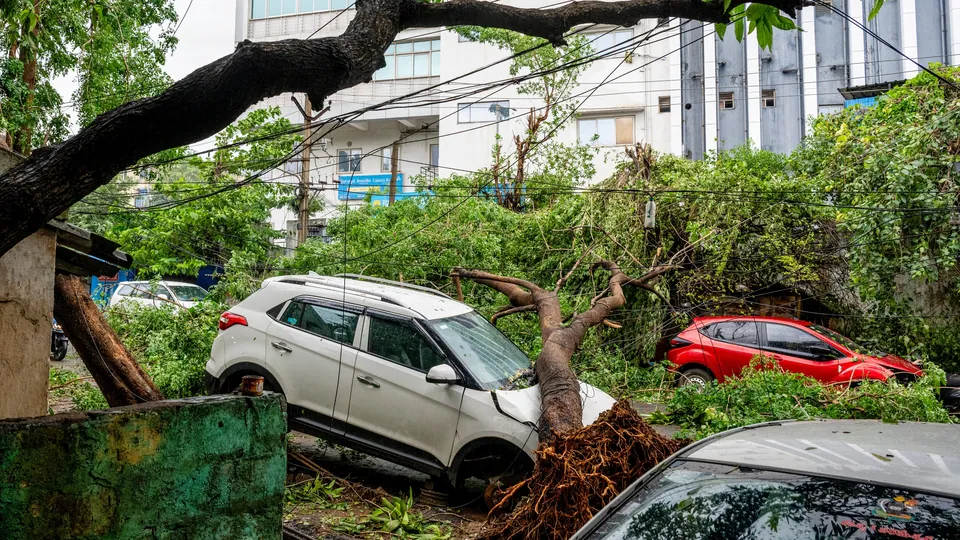
Severe Cyclone Arnab crossed the Andhra Pradesh coast early Wednesday, bringing powerful winds and heavy rainfall that caused fatalities, damaged agricultural land and disrupted public infrastructure across coastal districts. Chief Minister N Chandrababu Naidu confirmed five deaths and announced financial assistance for the affected families, farmers and households as the state began assessing the full extent of the destruction.
Speaking to reporters after reviewing the situation at the Real Time Governance System (RTGS) centre at the state secretariat, Naidu said three people died in Visakhapatnam district after electric poles and trees fell. One death each was reported in Anakapalli and Bhimavaram.
The chief minister expressed condolences to the bereaved families and announced ex gratia compensation of ₹5 lakh for the family of each deceased person. He also sought continued support from the Centre, including assistance from the National Disaster Response Force (NDRF) and an early visit by a central team to assess the damage.
The cyclone’s impact extended beyond loss of life. Preliminary estimates indicated that approximately 15,000 electricity poles had been uprooted, while standing crops across 2,24,489 hectares in 14 districts were inundated or damaged. The government warned that the figures remained provisional as assessment teams continued their field surveys.
Cyclone Arnab makes landfall along the Andhra Pradesh-Yanam coast
According to the India Meteorological Department (IMD), Cyclone Arnab crossed the Andhra Pradesh-Yanam coast between 2 a.m. and 8 a.m. Wednesday as a very severe cyclonic storm. Before weakening, the system carried maximum sustained winds of 125–135 kmph.
The cyclone weakened into a severe cyclonic storm around 8:30 a.m., with maximum sustained wind speeds falling to 110–120 kmph. Although the reduction in wind speed marked a change in the storm’s intensity, heavy rainfall, flooding and infrastructure damage remained major concerns across affected districts.
The IMD expected the system to move north-northwestwards over the following two days, gradually weakening into a cyclonic storm and then a deep depression. The forecast indicated that it would move towards Chhattisgarh after passing across parts of southern Odisha.
The storm’s movement meant that its effects were not confined to Andhra Pradesh. Odisha also faced heavy rainfall, strong winds and the threat of flooding and landslides, prompting evacuations and the deployment of emergency-response teams.
The cyclone’s landfall and subsequent movement placed disaster-management authorities under pressure to restore essential services, clear roads, assist displaced residents and monitor areas vulnerable to further rainfall.
Five deaths reported as Andhra Pradesh announces compensation
Naidu confirmed that five people had died in incidents associated with the cyclone. Three fatalities occurred in Visakhapatnam district due to falling electric poles and trees, while Anakapalli and Bhimavaram each reported one death.
The state government announced compensation of ₹5 lakh for each bereaved family. The assistance is intended to provide immediate financial support to households affected by the loss of a family member during the disaster.
The chief minister also directed attention towards wider relief and recovery efforts, including assistance for people whose homes had been damaged and farmers whose crops had suffered losses. District administrations were tasked with coordinating response activities and assessing the needs of affected communities.
The government’s response included the deployment of medical teams, ambulances, power restoration crews, road-clearance personnel and relief supplies. District collectors were overseeing operations on the ground, while response teams were expected to remain deployed until the threat from rainfall and storm surge had passed.
Around 15,000 electricity poles uprooted across the state
One of the most significant infrastructure impacts reported by Naidu was the damage to the electricity network. Preliminary estimates indicated that around 15,000 electricity poles had been uprooted across Andhra Pradesh.
The scale of the damage raised concerns about power restoration in affected districts. Fallen poles and damaged electrical infrastructure can disrupt electricity supplies to homes, businesses and essential services, while repair crews must also work around fallen trees, waterlogging and unsafe conditions.
The government said power restoration teams had been positioned in affected areas. Their work formed part of a wider effort to restore essential services and help communities recover from the cyclone’s immediate impact.
Road infrastructure also sustained damage, particularly in coastal areas. Naidu said more than 220 trees had fallen on state roads, with over 170 cleared by Wednesday afternoon. Fire and emergency services personnel responded to more than 220 emergency calls, many involving the removal of fallen trees.
Clearing roads was an important priority because fallen trees and other debris can obstruct access for ambulances, relief vehicles and utility crews. Keeping transport routes accessible also helps authorities reach affected communities and carry out damage assessments.
About 180 houses were reported damaged, mostly in Konaseema district. Four wards in Visakhapatnam were inundated, adding to concerns about local flooding and the need to support residents in affected neighbourhoods.
Crops damaged across 14 districts, affecting 3.45 lakh farmers
Agriculture was among the sectors hit hardest by Cyclone Arnab. Naidu said preliminary estimates indicated that approximately 3.45 lakh farmers had been affected, with standing crops inundated or damaged across 2,24,489 hectares in 14 districts.
The reported damage covered agricultural and horticultural crops, including paddy. The extent of the losses could have important financial consequences for farmers whose livelihoods depend on the successful harvest and sale of their produce.
Heavy rainfall can inundate fields, damage standing crops and delay harvesting or other agricultural operations. Strong winds can also harm plants and infrastructure used for farming. The actual financial impact depends on the type of crop, the stage of growth and the severity of damage in each location.
Naidu said that preliminary estimates identified agricultural and horticultural crop damage across approximately 70,900 hectares, including paddy, while crops covering about 10,450 hectares had been reported inundated or damaged in the assessment he cited. These figures were presented alongside the broader estimates of affected farmers and crop damage, and further verification was expected.
The government said assessment teams would continue inspecting fields and verifying losses. The final figures could change as officials collected more information from affected districts.
CM Naidu announces financial assistance for affected farmers
The state government announced financial assistance for farmers whose crops were damaged by the cyclone. The amount will vary according to the crop and the extent of the loss under the government’s relief framework.
The announced assistance includes ₹25,000 per hectare for cotton and sugarcane, ₹15,000 per hectare for banana plantations and ₹25,000 for tomato crops, according to Naidu’s statement. Farmers cultivating other crops will receive assistance according to the relevant categories under the state’s relief framework.
The support is intended to help affected farmers manage some of the financial pressure caused by crop losses. However, the extent to which assistance covers individual losses will depend on the verified damage, the applicable eligibility requirements and the final assessment conducted by the authorities.
Accurate field assessments are particularly important when relief is distributed across multiple districts and crop categories. Officials must establish which fields have been affected and determine the extent of damage before final compensation calculations can be completed.
Naidu said the figures were provisional and that the state government would submit a detailed damage assessment to the Centre after verification. He also wrote to Union Home Minister Amit Shah, highlighting the damage to crops and infrastructure and seeking continued support.
Godavari delta and coastal districts among the worst-affected areas
Naidu said the cyclone’s impact was particularly concentrated along the Godavari delta coast. The affected areas included Konaseema, Kakinada, East Godavari, West Godavari, Krishna and Anakapalli districts.
The coastal location of these areas made the effects of heavy rainfall and strong winds especially important for local authorities monitoring flooding and infrastructure damage. The impact varied across districts, with reports covering crop losses, damaged houses, fallen trees and disruption to electricity and roads.
Visakhapatnam also experienced localised inundation, with four wards reported to have been affected. The district recorded three deaths associated with falling trees and electric poles, according to the chief minister.
The government deployed disaster-response teams across 14 districts to assist with emergency operations. Their responsibilities included clearing roads, supporting evacuations, helping affected residents and restoring essential services.
Naidu said the administration had mobilised its disaster-response machinery throughout the night. Sixteen NDRF teams and 11 State Disaster Response Force (SDRF) teams were deployed across the affected districts.
The deployment was intended to ensure that response personnel could address emergencies while the state continued to assess the damage and prepare for the possibility of further rainfall.
More than 28,000 people moved to relief shelters
As a precautionary measure, more than 28,000 people were moved to relief shelters in Andhra Pradesh, according to Naidu. The evacuations were part of the state’s efforts to reduce the risk to residents in vulnerable locations during the cyclone.
Authorities also brought all fishing boats back to harbour. Keeping fishing vessels ashore during dangerous weather conditions is an important safety measure, helping protect fishing communities from the risks associated with high winds and rough seas.
Medical teams, ambulances and relief supplies were positioned in affected districts. Power restoration crews and road-clearance teams were also deployed to support recovery operations and ensure that essential services could resume as quickly as conditions allowed.
The administration’s immediate priorities included assisting displaced families, supporting households whose homes had been damaged and maintaining access to essential services. Officials were also monitoring rainfall and flooding risks as the storm moved inland.
Naidu thanked Amit Shah for the Centre’s continued support and said the state would remain alert to the possibility of further rainfall and flooding. The government also sought the early deputation of a central team to assess the damage and help determine the extent of assistance required.
Odisha evacuates more than 30,000 people as cyclone moves inland
The cyclone also affected Odisha, where the state government evacuated more than 30,000 people and placed districts in the southern part of the state on high alert.
Odisha Disaster Management minister Suresh Pujari said evacuations from low-lying and landslide-prone areas were continuing. He described the next 24 hours as critical as the effects of the cyclone intensified across vulnerable locations.
The state deployed 313 response teams to areas considered vulnerable. These included 60 Odisha Disaster Rapid Action Force (ODRAF) teams, nine NDRF teams and 244 fire and emergency services teams.
Pujari said all 19,143 fishing boats had returned to shore. Authorities also introduced preventive measures, including temporary road closures in areas vulnerable to landslides, to reduce the risks posed by heavy rainfall and unstable terrain.
The evacuation effort and deployment of emergency teams reflected concerns that continued rainfall could lead to flooding, landslides and transport disruption even as the cyclone weakened.
Heavy rainfall triggers red alert in several Odisha districts
The IMD issued a red alert for extremely heavy rainfall in Nabarangpur, Rayagada, Koraput, Malkangiri, Gajapati and Ganjam districts of Odisha. The alert also covered winds of 50–70 kmph.
Rainfall reports showed that Mahendragarh in Gajapati district recorded 249.9 millimetres, the highest among the locations listed. Pottangi in Koraput recorded 188 mm, Mohana in Gajapati received 168.8 mm, and Similiguda in Koraput recorded 143.1 mm.
Such rainfall can increase the risk of flooding, waterlogging and landslides, particularly in areas with vulnerable slopes or limited drainage. The IMD’s alert signalled the need for residents and authorities in the affected districts to remain cautious and follow official safety instructions.
Odisha Special Relief Commissioner Rajesh P Patil said trees had been uprooted in some southern districts. He added that there were no reports of major damage or casualties in the information provided at that stage.
The state’s emergency response continued as authorities monitored rainfall and worked to protect people living in low-lying and landslide-prone areas.
Rail and air services monitored amid weather disruption
The cyclone’s impact also required transport authorities to monitor operations in Andhra Pradesh and Odisha. Railway Minister Ashwini Vaishnaw said the situation was being closely monitored to maintain safe and smooth train services.
Vaishnaw said he had reviewed the ground situation with senior officials. In a post on X, he reported that minor disruptions, including fallen trees at 10 locations, had been addressed promptly.
Railway operations can be affected by fallen trees, waterlogging and damage to infrastructure during severe weather. Clearing obstructions and checking affected sections are important steps in ensuring that trains can operate safely.
At Bhubaneswar airport, director Prasanna Pradhan said flight operations were mostly normal despite one flight cancellation. He added that flights travelling from Chennai and Hyderabad to Bhubaneswar were taking an alternative route over Raipur to avoid the affected Visakhapatnam airspace.
These measures illustrated how the effects of the cyclone extended beyond the areas experiencing the strongest winds. Transport operators had to adjust operations and monitor conditions to reduce the risk of further disruption.
Damage assessment and relief operations to continue
Andhra Pradesh’s immediate response is focused on restoring electricity, clearing roads, assisting displaced residents and assessing damage to agricultural land and public infrastructure. The scale of the reported destruction means that relief operations will require coordination across multiple districts and government departments.
The state government has announced compensation for the families of those killed and financial assistance for farmers whose crops were damaged. The final allocation of relief will depend on verified assessments and the applicable government framework.
Naidu said the current figures were preliminary and could change as field surveys were completed. The state plans to submit a detailed damage assessment to the Centre after verification and has sought continued support from central agencies.
In Odisha, authorities are continuing evacuation and emergency-response efforts as heavy rainfall remains a concern in several districts. The deployment of disaster-response teams, return of fishing boats to shore and temporary road closures are among the measures taken to reduce risks to residents.
Cyclone Arnab has caused fatalities and significant disruption across parts of Andhra Pradesh, while also bringing heavy rain and emergency-response challenges to Odisha. With damage assessments still underway, the full impact on farmers, homes, electricity infrastructure and transport networks will become clearer as officials complete their surveys and recovery operations progress.
For breaking news and live news updates, like us on Facebook or follow us on Twitter and Instagram. Read more on Latest India on thefoxdaily.com.






COMMENTS 0