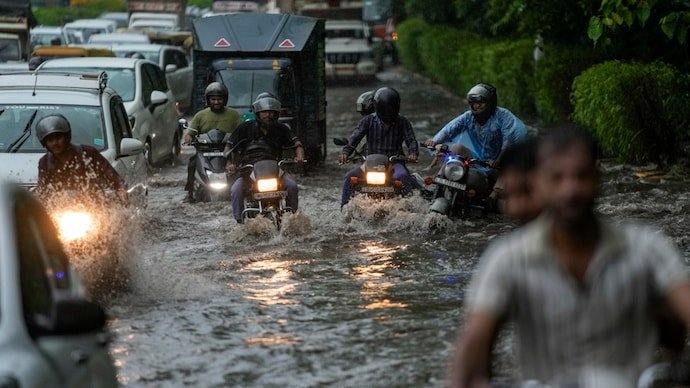
Heavy rain battered large parts of Chhattisgarh on Friday, flooding homes, roads and low-lying areas, cutting off villages in the Bastar region and disrupting traffic on key routes. Authorities shut schools in eight districts as rivers and local streams swelled, while rising reservoir levels in Dhamtari prompted officials to release water from the Gangrel dam.
Jagdalpur and several other parts of Bastar were among the worst affected, with floodwater entering residential colonies and portions of National Highway-30 becoming submerged. The disruption affected movement between Raipur and Jagdalpur, while residents in vulnerable areas were warned to stay away from swollen rivers and water bodies.
One rain-related death was also reported from Kondagaon, where a 40-year-old farmer drowned after falling into a flooded drain while attempting to catch fish in a partially submerged paddy field, officials said.
Flooding Disrupts Bastar as NH-30 Goes Under Water
Incessant rainfall caused local streams and rivers to swell across several parts of the state, with the impact particularly severe in the Bastar region. Low-lying areas were inundated as water accumulated rapidly in residential and roadside areas.
In Jagdalpur, floodwater entered houses in several low-lying colonies, forcing residents to deal with rapidly changing conditions. Parts of National Highway-30 were also submerged, severely affecting vehicle movement along the important road connecting Raipur and Jagdalpur.
The flooding of the highway created additional difficulties for people travelling between different parts of the state. With water flowing across sections of the road, authorities and police were required to monitor traffic and manage movement in affected areas.
An alert was issued for low-lying and riverside areas along the Indravati river, which flows alongside Jagdalpur. The Bastar district administration directed officials and the Home Guards commandant to remain in the field and closely monitor the situation.
The focus on riverside settlements reflects the heightened risk created by the combination of persistent rainfall, swollen water bodies and runoff from surrounding areas.
Villages Cut Off in Sukma and Bijapur
The effects of the heavy rain extended beyond major towns. In Sukma and Bijapur districts, floodwater cut off several villages, disrupting connectivity and making movement more difficult for residents of remote settlements.
Local administrations appealed to residents not to approach swollen rivers, streams and other water bodies. People were also asked to report emergencies to district disaster control rooms so that assistance could be coordinated where necessary.
The disruption in Bastar highlights the particular vulnerability of remote settlements during intense rainfall. When roads and smaller connecting routes become flooded, communities can quickly lose access to normal transport links and essential services.
District authorities have therefore been monitoring water levels and road conditions while keeping emergency personnel prepared to respond to incidents.
Schools Shut in Eight Chhattisgarh Districts
The weather conditions also affected Education across the state. District administrations declared a holiday for government and private schools in Dantewada, Bijapur, Kondagaon, Kanker, Bastar, Gariaband, Dhamtari and Durg.
The decision was taken as heavy rain and waterlogging created concerns about the safety of students travelling to and from schools. In affected Government Schools, quarterly examination papers scheduled for Friday were also postponed.
The school closures demonstrate how the impact of the rain has extended beyond flooding and road disruptions. With several districts experiencing difficult Travel conditions, authorities opted to suspend normal school operations in areas facing the heaviest weather-related disruption.
The postponement of examinations also prevents students from being placed in difficult circumstances when transport and local conditions have been affected by flooding.
One Death Reported in Kondagaon
A rain-related fatality was reported in Kondagaon district amid the severe weather. Officials said a 40-year-old farmer drowned after falling into a flooded drain while catching fish in a partially submerged paddy field.
The incident illustrates the dangers created when familiar agricultural and rural areas become inundated. Flooded drains and submerged fields can make it difficult to identify the depth and flow of water, increasing the risk of accidents.
Authorities have urged residents to exercise caution around swollen water bodies and avoid entering flooded areas. Such warnings have been particularly important in districts where continued rainfall is causing rivers, streams and drainage channels to rise.
Gangrel Reservoir Reaches 98% Capacity
In Dhamtari district, continuous rainfall led to a sharp rise in water levels at several major reservoirs. The situation prompted authorities to release water from the Gangrel reservoir to manage incoming flows.
Official data showed that as of 8 am, Gangrel was at 98.14 per cent of its capacity. Murumsilli reservoir had reached 100 per cent, while Dudhawa stood at 97.21 per cent and Sondhur at 88.18 per cent.
With reservoirs receiving continued inflows, authorities opened 10 gates at Gangrel. A total of 54,950 cusecs of water was released, with 48,950 cusecs flowing into the Mahanadi river and another 6,000 cusecs being released into a canal through the Rudri barrage.
Officials said additional water could be released if inflow levels increased further.
The reservoir situation is being closely monitored because continued rainfall can rapidly alter storage levels. Controlled releases are used to manage the amount of water entering reservoirs when inflows rise, but downstream areas can also experience increased water levels as releases enter rivers and canals.
Orange Alert Areas See Continuous Rain
Several districts in the central part of Chhattisgarh also experienced persistent rainfall. Rajnandgaon, Mohla-Manpur-Ambagarh Chowki and Khairagarh-Chhuikhadan-Gandai had been receiving continuous rain since Thursday morning under an orange alert.
Waterlogging affected traffic in several locations. Near Chandandih, water accumulation along the Kumhari overbridge on the Raipur-Durg National Highway slowed vehicle movement, prompting police to divert traffic to alternative routes.
Raipur also experienced significant waterlogging in areas including Sundar Nagar, Mahadevghat Road and the old Vidhan Sabha Road.
Urban waterlogging can quickly create traffic problems even when major roads remain technically open. Accumulated water slows vehicles, restricts movement through low-lying stretches and can force authorities to redirect traffic to prevent congestion and safety risks.
Rainfall Across Chhattisgarh Remains Near Normal
Despite the intensity of the current spell, the overall monsoon rainfall received by Chhattisgarh remains within the normal range, according to data from the Revenue and disaster management Department.
Between June 1 and September 25, the state recorded average rainfall of 1,082.4 mm. That represents 100.1 per cent of the state’s 10-year seasonal benchmark of 1,081.5 mm.
The figures show that the state’s cumulative rainfall is almost exactly in line with its long-term seasonal average. However, state-level averages can mask significant differences between individual districts and short periods of intense rainfall.
In the 24 hours preceding the latest assessment, Chhattisgarh received average rainfall of 52.8 mm.
Balrampur recorded rainfall equivalent to 169.4 per cent of its seasonal average, with cumulative rainfall of 1,527.7 mm. Narayanpur recorded the highest cumulative rainfall at 1,600.4 mm.
At the same time, several districts remained below their respective seasonal averages. Surguja had received 606.6 mm, equivalent to 75.5 per cent of normal rainfall, while Jashpur recorded 828.7 mm or 79.7 per cent.
Kabirdham received 672 mm, representing 82.2 per cent of normal rainfall. Bemetara recorded 597.1 mm or 74.5 per cent, while Kanker had received 1,110.7 mm or 75.9 per cent of its seasonal average.
Mohla-Manpur-Ambagarh Chowki had received 74.7 per cent of normal rainfall, while Bijapur stood at 78.7 per cent.
District Rainfall Patterns Vary Widely
The rainfall data also shows that the current flooding is occurring despite considerable variation in cumulative rainfall between districts.
Bastar, Dantewada, Bijapur, Sukma, Korba, Janjgir-Champa, Durg and Rajnandgaon were described as having rainfall close to normal. Yet some of these districts have still experienced significant local flooding and waterlogging during the latest spell.
This difference is important when assessing the impact of heavy rain. Flooding can depend not only on seasonal rainfall totals but also on the intensity and duration of individual rain events, local drainage, river levels, terrain and the amount of water flowing into low-lying areas.
As a result, a district can have near-normal cumulative rainfall while still facing serious short-term disruption when a concentrated spell of heavy rain occurs.
Authorities Monitor Rivers, Roads and Reservoirs
With rainfall continuing, district authorities are monitoring vulnerable locations, including riverbanks, low-lying settlements, roads and reservoirs.
In Bastar, officials have been directed to remain in the field, particularly in areas affected by flooding around Jagdalpur and along the Indravati river. In Sukma and Bijapur, residents in villages affected by floodwater have been warned against approaching swollen water bodies.
Road conditions are also being watched closely because submerged routes can become hazardous and can disrupt connectivity between major towns and remote settlements. The situation on NH-30 is particularly important because the highway is a key road link between Raipur and Jagdalpur.
In Dhamtari, reservoir levels remain another major focus. The release of water from Gangrel is being adjusted according to inflows, with officials indicating that further releases could become necessary if rainfall continues and water levels rise.
More Rain Forecast Over the Next 24 Hours
The weather situation is not expected to ease immediately. The Meteorological Centre in Raipur has forecast light to moderate rain in most parts of Chhattisgarh over the next 24 hours.
Heavy showers and thunderstorms are also likely at isolated places, meaning some districts could continue to experience intense rainfall even if conditions vary across the state.
For communities already dealing with waterlogging and flooding, continued rain could prolong disruptions and place additional pressure on drainage systems, roads and reservoirs.
The authorities are therefore continuing to monitor rainfall, river levels and reservoir inflows while maintaining emergency arrangements in affected districts.
For residents in low-lying and riverside areas, the immediate priority remains avoiding flooded roads and swollen water bodies and following instructions issued by local administrations.
Chhattisgarh Braces for Continued Weather Disruption
The latest spell of heavy rain has produced a combination of flooding, road disruption, school closures and rising reservoir levels across Chhattisgarh. Bastar has faced some of the most visible impacts, with homes flooded in Jagdalpur, villages cut off in Sukma and Bijapur and sections of NH-30 submerged.
The death reported in Kondagaon has also highlighted the risks associated with entering flooded agricultural areas and approaching swollen drains.
At the same time, Dhamtari’s reservoirs are being managed amid rapidly rising water levels, while traffic authorities are responding to waterlogging on highways and urban roads in other parts of the state.
Although the state’s cumulative monsoon rainfall remains close to its long-term normal, the latest concentrated spell demonstrates how intense rainfall over a short period can create significant local disruption.
With more rain forecast over the next 24 hours, authorities across Chhattisgarh remain focused on monitoring vulnerable areas, managing water levels and maintaining connectivity wherever conditions permit.
For breaking news and live news updates, like us on Facebook or follow us on Twitter and Instagram. Read more on Latest India on thefoxdaily.com.






COMMENTS 0