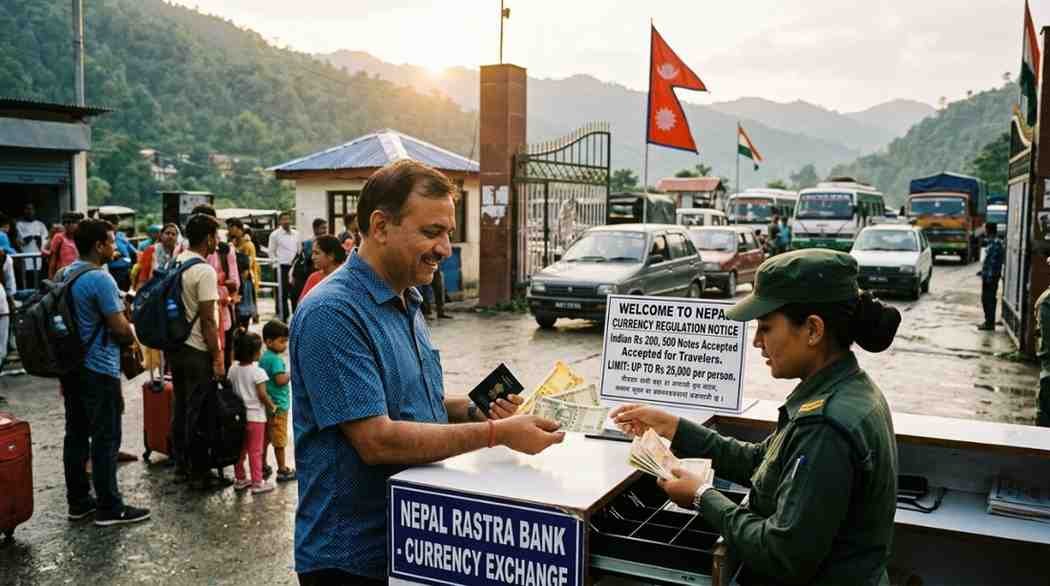
Nepal has officially relaxed one of its most significant currency restrictions by allowing Indian and Nepalese nationals to carry Indian ₹200 and redesigned ₹500 banknotes into and out of Nepal. The updated regulation, announced by the Nepal Rastra Bank (NRB), restores the use of commonly circulated Indian currency denominations that had effectively been barred since India‘s 2016 demonetisation.
The revised policy retains the existing limit of ₹25,000 per person while permitting post-November 9, 2016-issued ₹200 and ₹500 notes. The move is expected to improve Travel convenience, reduce currency exchange difficulties, and support businesses operating across the India-Nepal border. For millions of travelers, traders, pilgrims, and transport operators WHO frequently move between the two countries, the change removes a practical hurdle that has existed for nearly a decade.
What Has Changed Under Nepal’s New Currency Rule?
Under the latest regulations issued by the Nepal Rastra Bank, both Indian citizens and Nepalese nationals are now permitted to carry Indian currency notes in the following denominations:
- ₹200 notes issued on or after November 9, 2016
- Redesigned ₹500 notes issued on or after November 9, 2016
- Total value must not exceed ₹25,000 per traveler
The regulation effectively reverses the practical restriction that had limited travelers to carrying Indian notes of ₹100 or lower despite the monetary limit remaining unchanged.
However, the prohibition on old pre-demonetisation ₹500 and ₹1,000 notes continues to remain in force.
Quick Overview of the New Rules
| Rule | Current Provision |
|---|---|
| Maximum Indian currency allowed | ₹25,000 per traveler |
| Allowed denominations | ₹200 and redesigned ₹500 notes (post-November 9, 2016) |
| Old ₹500 and ₹1,000 notes | Not permitted |
| Eligible travelers | Indian and Nepalese nationals |
| Foreign currency without declaration | Up to USD 5,000 equivalent |
| Customs declaration required | Above USD 5,000 equivalent |
Why Nepal Had Restricted Indian ₹500 Notes After 2016
The restriction dates back to India’s demonetisation announced on November 8, 2016, when the Government of India withdrew the legal tender status of existing ₹500 and ₹1,000 notes. The policy aimed to curb counterfeit currency, black money, and terror financing while introducing redesigned ₹500 notes and later ₹2,000 notes.
Since Nepal widely accepts Indian currency in many commercial areas, authorities imposed restrictions on higher denomination Indian notes to prevent confusion over invalid currency and to protect the country’s financial system during the transition.
Although the official carrying limit remained ₹25,000, travelers were effectively restricted to ₹100 notes because larger denominations were not recognized.
Why the Policy Matters Now
The decision reflects the normalization of India’s currency system years after demonetisation. The redesigned ₹500 notes have become the country’s most widely circulated high-value denomination, while ₹200 notes have also become common in everyday transactions.
Allowing these notes significantly improves payment convenience for visitors crossing the open India-Nepal border.
Instead of carrying hundreds of ₹100 notes, travelers can now use fewer banknotes while staying within the legal limit.
Benefits for Indian Tourists Visiting Nepal
Nepal remains one of the most popular international destinations for Indian tourists because Indian citizens can enter the country without a visa. Popular destinations include Kathmandu, Pokhara, Lumbini, Janakpur, Chitwan National Park, and numerous Himalayan trekking regions.
The updated regulation offers several advantages:
- Simplifies everyday purchases.
- Reduces dependence on currency exchange counters.
- Makes hotel, restaurant, and transport payments easier.
- Improves convenience during road travel.
- Reduces the need to carry bulky bundles of lower-value notes.
The move is particularly helpful for families, religious pilgrims, and road travelers entering Nepal through multiple land border checkpoints.
Positive Impact on Nepalese Businesses
India is Nepal’s largest trading partner and one of its biggest sources of tourists. Thousands of Nepalese businesses rely on Indian visitors throughout the year.
Businesses expected to benefit include:
- Hotels and guesthouses
- Restaurants and cafés
- Taxi and transport operators
- Retail shops
- Tour operators
- Border market vendors
- Pilgrimage service providers
Easier acceptance of commonly used Indian currency can help reduce payment delays and encourage higher spending by visitors.
What the Rules Say About Nepalese Nationals
The Nepal Rastra Bank has clarified that Nepalese citizens cannot transport Indian currency into Nepal from countries other than India.
Similarly, Nepalese nationals are not allowed to carry Indian currency from Nepal to a third country. Indian currency may only move between Nepal and India under the revised rules.
This restriction helps maintain regulatory oversight while allowing legitimate travel and business activities between the two neighboring countries.
Foreign Currency Declaration Rules Remain Unchanged
The revised notification also reiterates Nepal’s customs regulations for foreign currency.
Travelers entering Nepal may carry foreign currency equivalent to USD 5,000 without submitting a customs declaration.
If the amount exceeds this limit, customs authorities must be informed upon arrival.
The rule applies regardless of whether the funds are held in US dollars or another foreign currency, subject to Nepal’s foreign exchange regulations.
How This Decision Supports India-Nepal Economic Relations
India and Nepal share one of the world’s most open international borders, with extensive movement of people for tourism, education, employment, healthcare, Trade, and family visits.
The two economies are closely connected through:
- Cross-border retail trade
- Agricultural commerce
- Energy cooperation
- Infrastructure projects
- Religious tourism
- Daily commuting in border districts
Currency compatibility plays an important role in ensuring smooth economic activity. Restoring the acceptance of modern Indian denominations aligns financial regulations with current market realities.
Comparison: Before and After the Rule Change
| Category | Previous Rule | New Rule |
|---|---|---|
| Maximum carrying limit | ₹25,000 | ₹25,000 |
| Usable denominations | Mostly ₹100 notes | ₹200 and redesigned ₹500 notes allowed |
| Travel convenience | Limited | Significantly improved |
| Cross-border payments | Less practical | More efficient |
| Business transactions | Often required exchanges | Expected to become smoother |
Expert Insight: A Small Regulatory Change with Large Practical Benefits
Although the revision may appear minor because the ₹25,000 limit remains unchanged, its practical impact is substantial. Most cash transactions in India now rely heavily on ₹200 and ₹500 notes, making the earlier restriction increasingly inconvenient.
The updated policy modernizes Nepal’s currency regulations without increasing financial risk or altering capital movement controls. It reflects confidence in the stability of India’s redesigned currency system while preserving safeguards against unauthorized cash transfers.
For border economies where cash transactions remain common despite the growth of digital payments, easier circulation of recognized currency can improve market efficiency and reduce transaction friction.
What Travelers Should Keep in Mind
- Carry only redesigned ₹200 and ₹500 Indian notes issued after November 9, 2016.
- Do not exceed the ₹25,000 carrying limit.
- Avoid carrying old demonetised ₹500 or ₹1,000 notes.
- If carrying foreign currency above the equivalent of USD 5,000, complete the required customs declaration.
- Nepalese nationals should remember that Indian currency may only be transported directly between Nepal and India.
Will the Rule Encourage More Tourism?
The policy is expected to make travel between India and Nepal more convenient, especially for visitors who prefer cash payments or are traveling to areas where digital payment acceptance may be limited.
While electronic payment systems continue to expand in both countries, cash remains widely used in local markets, transportation services, pilgrimage routes, and rural tourism destinations. Easier access to accepted Indian currency could contribute to smoother travel experiences and potentially encourage additional short-term tourism and shopping trips.
Future Outlook
The updated regulation demonstrates Nepal’s effort to align its currency policies with current economic realities while maintaining financial oversight. As trade, tourism, and infrastructure cooperation between India and Nepal continue to grow, further modernization of cross-border payment systems and financial regulations may improve economic integration even more.
Digital payment partnerships, interoperable banking services, and enhanced financial cooperation could become the next areas of focus, complementing the latest currency reforms and making cross-border transactions faster and more convenient.
Conclusion
Nepal’s decision to once again permit Indian ₹200 and redesigned ₹500 notes marks an important step toward easing travel and strengthening economic ties with India. Although the ₹25,000 carrying limit remains unchanged, allowing commonly used denominations removes a significant inconvenience that travelers and businesses have faced since 2016.
By restoring practical usability while preserving customs safeguards and currency regulations, Nepal has created a more traveler-friendly framework that supports tourism, border trade, and everyday financial transactions. The change highlights the evolving financial relationship between the two neighboring countries and is likely to benefit millions of people who cross the India-Nepal border each year for business, tourism, education, religious travel, and family visits.
For breaking news and live news updates, like us on Facebook or follow us on Twitter and Instagram. Read more on Latest World on thefoxdaily.com.





COMMENTS 0