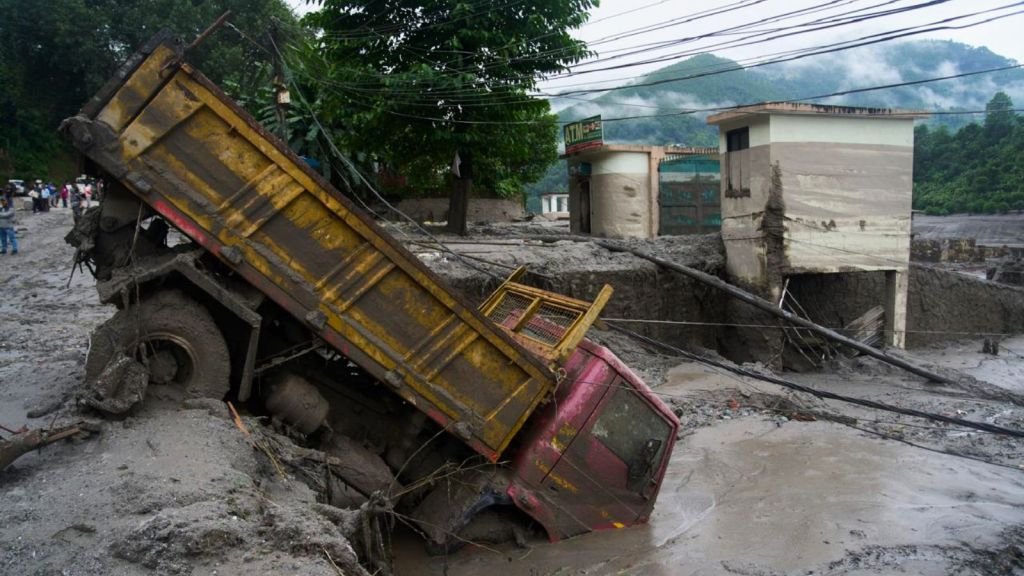
Nepal is facing a fresh flood threat after the embankment of a barrier lake formed by debris from Wednesday’s catastrophic Flash Floods along the Nepal-china border in Rasuwa gave way. Authorities warned rescue workers, Security personnel and residents to move to safe locations as the water level continued to rise.
The development has complicated an already desperate rescue operation in one of the areas worst affected by the disaster. Hundreds of people have died, hundreds more remain missing, and thousands have been displaced after floodwaters and debris swept through communities in northern Nepal and adjoining Tibet.
The temporary lake formed after the initial mudslide blocked the flow of water and accumulated behind the debris. Chinese authorities had previously warned that a breach could send another surge downstream, potentially triggering additional flooding and landslides in areas already devastated by the first disaster.
Why the barrier lake is creating a second emergency
Barrier lakes can form when landslides, mudslides, rockfalls or other debris suddenly obstruct a river valley. Water continues flowing into the blocked section, gradually filling the newly created reservoir.
The danger increases when the natural barrier is unstable. If water overtops the obstruction or erodes it from within, the barrier can collapse rapidly, releasing a large volume of stored water downstream.
That is the concern facing Rasuwa. The lake developed in the debris left behind by the initial mudslide on Wednesday. Chinese authorities had warned that a breach could produce another round of flooding, while Nepalese officials urged everyone involved in relief operations to remain alert.
The warning reflects the unpredictable Nature of a disaster in mountainous terrain. Roads and river channels may already have been altered by the first flood, meaning areas previously considered relatively safe can suddenly become exposed to new flows.
Rescue operations were temporarily halted
The emerging lake threat forced authorities to interrupt rescue activity. China paused rescue efforts in Tibet after the risk of a lake breach was identified, with officials also warning of possible landslides.
On the Nepalese side, rescue operations in Rasuwa were also suspended temporarily as the dammed lake began overflowing. Helicopter operations were halted for a period, while residents moved towards higher ground.
The interruption is particularly significant because access to the affected region is already difficult. Helicopters are among the most important tools available when roads have been destroyed or blocked, but worsening Weather and the threat of sudden flooding can make aerial rescue operations unsafe.
The result is a difficult balance for emergency teams: rescuers need to reach people who may be trapped or injured, but sending personnel into an unstable flood zone can create additional casualties.
Hundreds remain missing on the Tibetan side
The disaster has caused heavy casualties on both sides of the border. More than 550 people remained missing on the Tibetan side according to the information provided, while Nepal has reported hundreds of deaths following the flooding.
The scale of the missing-persons crisis is particularly difficult because communications and transportation links in the affected region have been severely disrupted. Floodwater, mud and debris can also make it difficult to establish where people were swept away or whether they managed to reach safer locations.
For families waiting for information, rescue operations therefore involve more than simply evacuating survivors. Authorities must identify people who have been rescued, search damaged settlements and roads, and determine the whereabouts of those whose communication has been lost.
Nepal Army rescues hundreds, including foreign nationals
Despite the worsening conditions, rescue teams have managed to evacuate hundreds of people from the worst-hit districts.
The Nepal Army has rescued around 900 people from Rasuwa and Nuwakot, according to the information provided. Among those rescued were 92 Indian nationals and 27 people from other countries.
The presence of foreign travellers has added an international dimension to the disaster. Indian tourists and pilgrims were among the largest groups of foreign nationals caught in the affected region, with many travelling through northern Nepal in connection with the Kailash Mansarovar pilgrimage.
Nepal Army spokesperson General Rajaram Basnet said the rescued people were hospitalised. Their evacuation provides an important measure of relief amid a situation in which many roads, settlements and travel routes have been affected.
Bad weather is making the rescue harder
Continued poor weather is hampering rescue efforts. In a mountainous disaster zone, persistent rain or cloud can affect helicopter operations while also increasing the possibility of additional landslides and flooding.
This creates a cascading problem. The original disaster damages infrastructure, the damaged infrastructure makes rescue harder, and additional rainfall can make the terrain even less stable.
For emergency agencies, the priority is therefore shifting between rescue, evacuation and risk management as conditions change.
How the lake formed after the first flood
The barrier lake was not a normal geographical feature. It emerged as a consequence of the initial mudslide and flooding that struck the region on Wednesday.
When a large quantity of earth, rock and ice enters a narrow Himalayan valley, it can temporarily block a river. Water then begins accumulating behind the debris, creating what is commonly known as a landslide-dammed or barrier lake.
The size of such a lake can change rapidly. Continued inflow from upstream can increase the pressure on the debris barrier, while erosion can gradually weaken it. If the barrier fails, the accumulated water can move downstream as a sudden surge.
This explains why authorities can issue a second flood warning even after the main flood has already passed. The original event may create a new hazard that does not become apparent until hours later.
The reported death toll shows the scale of the disaster
The disaster has already become one of the most serious recent flood emergencies in the region. The supplied report puts the confirmed death toll in Nepal at 475, while large numbers of people remain unaccounted for.
However, casualty figures in a rapidly developing disaster can change as rescue teams reach isolated communities and authorities reconcile reports from different locations.
The number of missing people is particularly important because it cannot automatically be treated as the final death toll. People may be unable to contact relatives because of damaged communications, may have moved to evacuation centres, or may be receiving medical treatment away from their usual locations.
That distinction will become increasingly important as rescue and identification operations continue.
What triggered the original Nepal flash floods?
The exact chain of events behind a major Himalayan flood can involve several interacting processes rather than one isolated cause.
The supplied material attributes the catastrophe to a major glacial collapse and ice avalanche near Langtang Lirung in the Himalayas. It says a large mass of ice and rock broke away and descended into the valley, generating a powerful shock.
Earlier reports also pointed to the possibility of an earthquake or seismic activity contributing to an avalanche and subsequent flooding in the region. Establishing the precise trigger requires geological and hydrological investigation, particularly because avalanches, landslides and sudden river blockages can occur in rapid succession.
The key point is that the flooding was not simply a conventional river overflow. A sudden movement of ice, rock and debris can dramatically alter the behaviour of a mountain river within minutes.
Why the geography of the Himalayas magnifies the danger
Mountain valleys can act like natural channels for enormous quantities of water and debris. When a sudden release occurs high above a settlement, the material can gain speed as it moves downhill.
Unlike ordinary flooding, debris-laden flows can carry boulders, trees, mud and broken infrastructure. This increases their destructive power and can destroy roads and buildings rather than merely inundating them.
The narrow valleys also make evacuation challenging. Communities may have limited routes to higher ground, while roads can be cut off by landslides or collapsed bridges.
That geography is one reason why the formation and subsequent failure of a barrier lake is being treated as an immediate emergency rather than a secondary environmental development.
Indian pilgrims caught in a dangerous border corridor
The disaster has particular significance for Indian travellers because northern Nepal has become an important route for people undertaking the Kailash Mansarovar pilgrimage.
The route through Rasuwa connects travellers to the China border and has become increasingly important for private pilgrimage operations. But the same geography that makes the route useful also exposes travellers to the hazards of Himalayan terrain.
For pilgrims, the immediate challenge is not simply reaching their destination. They must also navigate border checkpoints, mountain roads, changing weather and high-altitude terrain. A sudden disaster can strand large groups far from major urban centres and medical facilities.
The rescue of 92 Indians from Rasuwa and Nuwakot provides some relief, but the continuing uncertainty around other travellers means the search remains urgent.
What happens if the lake continues to rise?
The immediate concern is whether the remaining barrier can safely contain the water accumulating behind it. If water continues to enter the lake faster than it escapes, pressure on the natural embankment could increase.
A further breach could send another surge through downstream areas, potentially affecting communities already damaged by the first flood.
That does not mean another catastrophic wave is inevitable. The outcome depends on the size and stability of the debris barrier, the amount of water entering the lake, weather conditions and how quickly authorities can assess and manage the situation.
The critical requirement is reliable monitoring. Authorities need to know whether the lake is expanding, whether the barrier is eroding and which downstream settlements could be exposed if the structure fails.
Why early warnings matter
In a rapidly changing Himalayan disaster, even a short warning can give residents time to move uphill or away from river channels. It can also allow rescue teams to withdraw from exposed areas before conditions become dangerous.
The latest alerts demonstrate how disaster management can shift from rescue to evacuation within minutes. Once a barrier lake begins overflowing, protecting rescuers and residents can become the first priority.
A disaster that is still evolving
The breaking of the barrier lake’s embankment does not mark the end of the Nepal flood emergency. Instead, it introduces another phase of uncertainty.
Authorities are simultaneously dealing with the consequences of the original flash flood, searching for missing people, treating rescued survivors and monitoring the possibility of additional landslides and flooding.
The rescue of hundreds of people, including Indian and other foreign nationals, shows that large-scale evacuations are continuing despite difficult conditions. But the high number of deaths and missing people demonstrates how much work remains.
For residents and travellers in the affected region, the immediate message is clear: the danger has not necessarily passed simply because the first floodwaters have receded. Mountain disasters can create secondary hazards long after the initial surge, and the newly formed barrier lake is a stark example.
The next stage of the response will depend on close monitoring of the lake, weather conditions, access to isolated areas and the ability of rescue agencies to operate safely. Until those risks are better understood, authorities are likely to remain on high alert across the vulnerable stretches of Rasuwa and surrounding areas.
For breaking news and live news updates, like us on Facebook or follow us on Twitter and Instagram. Read more on Latest World on thefoxdaily.com.





COMMENTS 0