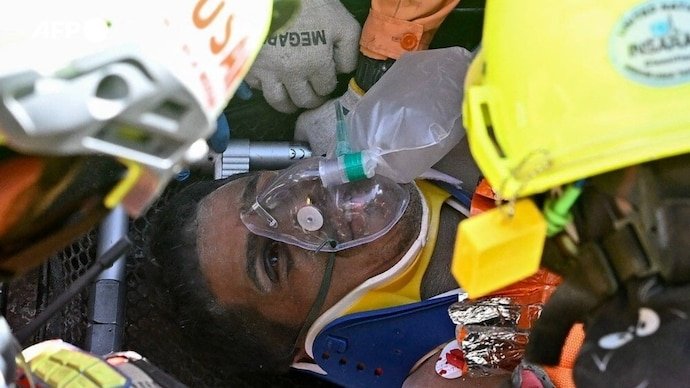
In an extraordinary story of survival against overwhelming odds, 43-year-old security guard Hernan Alberto Gil Flores was rescued alive after spending eight days trapped beneath the ruins of a collapsed shopping centre in Venezuela. His dramatic rescue followed more than 100 hours of continuous work by multinational search-and-rescue teams and has emerged as one of the most remarkable survival stories following the country’s catastrophic twin earthquakes.
The successful operation comes amid a devastating humanitarian crisis caused by powerful earthquakes that struck northern Venezuela on June 24. As rescue teams continued searching damaged buildings, officials reported thousands of fatalities while many more people remained unaccounted for. Against this grim backdrop, Gil Flores’ rescue offered a rare moment of hope, resilience, and international solidarity.
Beyond its emotional impact, the operation highlights the remarkable capabilities of modern urban search-and-rescue teams, advances in disaster response Technology, and the critical importance of international cooperation during large-scale natural disasters.
How the Rescue Unfolded
Gil Flores had been working the night shift as a security guard inside a shopping complex when two powerful earthquakes struck in quick succession. As the building collapsed around him, a small security cabin where he was stationed remained partially intact.
That small structure proved to be the difference between life and death.
While massive concrete slabs buried the surrounding area, the cabin created a confined survival space that protected him from crushing debris while leaving a limited pocket of breathable air.
Rescuers eventually established contact after detecting signs of life beneath nearly 140 tonnes of collapsed concrete and debris. What followed was an exceptionally delicate Rescue Operation requiring patience, engineering expertise, and constant monitoring to avoid triggering further collapse.
Timeline of the Extraordinary Rescue
| Date / Stage | Key Development |
|---|---|
| June 24 | Twin earthquakes measuring 7.2 and 7.5 strike northern Venezuela. |
| Immediately After | Shopping centre collapses while Gil Flores is trapped inside. |
| Following Days | Search teams continue clearing unstable debris. |
| Weekend | Initial signs of life detected beneath the rubble. |
| Sunday | Specialized rescue teams establish communication with Gil Flores. |
| Final Three Days | Food, water, oxygen, and liquid nutrients supplied through a narrow opening. |
| Day Eight | Rescuers successfully extract Gil Flores after a 100-hour operation. |
Why This Rescue Was So Difficult
Urban search-and-rescue missions become increasingly complex as time passes. Collapsed buildings remain unstable, Weather conditions can deteriorate, and aftershocks create additional dangers for both survivors and rescue personnel.
In this case, teams faced multiple challenges simultaneously:
- Extremely unstable concrete structures.
- Continuous aftershocks.
- Heavy rainfall affecting rescue operations.
- Limited access to the survivor.
- Risk of triggering additional collapse.
- Need to preserve the survivor’s limited air pocket.
Rather than rushing the extraction, engineers and rescue specialists carefully removed debris piece by piece while constantly monitoring structural stability.
How Gil Flores Survived Eight Days
Survival beneath collapsed buildings depends on several factors, and Gil Flores benefited from an extraordinary combination of circumstances.
His security cabin remained standing despite the surrounding structural failure, creating a survivable void beneath the rubble. Once rescuers established communication, they were able to provide water and liquid nutrients through a narrow shaft while maintaining verbal contact throughout the final stages of the operation.
Protecting survivors psychologically is often just as important as providing Food and water. Rescue personnel regularly spoke with Gil Flores to reassure him, explain each phase of the operation, and help reduce anxiety as heavy equipment worked around him.
This combination of structural protection, rapid medical support after contact, and continuous communication significantly improved his chances of survival.
The International Rescue Effort
One of the defining features of the operation was the extensive international collaboration.
Urban search-and-rescue specialists from several countries worked together throughout the mission, combining expertise in structural engineering, technical rescue, medical care, and disaster management.
The multinational operation included teams from:
- Chile.
- Costa Rica.
- United States.
- Portugal.
- Mexico.
- El Salvador.
- Venezuela.
The cooperation demonstrated how international disaster response has evolved into highly coordinated operations where specialized teams contribute unique expertise regardless of national boundaries.
Technology Played a Crucial Role
Modern disaster response relies heavily on advanced technology, and this rescue was no exception.
Teams used specialized equipment including telescopic cameras to maintain visual contact with Gil Flores while monitoring his condition. These cameras allowed rescuers to communicate directly, assess his physical state, and carefully plan each stage of the extraction.
Additional rescue technologies commonly used in similar operations include:
- Thermal imaging devices.
- Acoustic life-detection sensors.
- Fiber-optic search cameras.
- Structural monitoring equipment.
- Portable oxygen systems.
- Engineering stabilization tools.
Such equipment has significantly improved survival rates in complex urban disasters over the past two decades.
The Human Side of the Rescue
Beyond engineering expertise, the rescue highlighted the emotional resilience of both survivors and rescuers.
According to members of the Costa Rican Red Cross, Gil Flores initially asked rescuers not to inform his wife that he had been found alive until they were certain he could be safely extracted.
Meanwhile, Chilean firefighter Mara Paz Campos remained in regular communication with him during the final stages of the rescue, helping him remain calm while advising him on safety precautions as debris continued falling around the confined space.
Images released after the operation showed rescue workers embracing, cheering, and celebrating once Gil Flores reached the surface safely.
Understanding Urban Search and Rescue Operations
Urban Search and Rescue (USAR) teams are highly specialized emergency response units trained to locate and rescue victims trapped in collapsed structures following earthquakes, explosions, landslides, and other disasters.
A typical USAR mission involves:
- Rapid structural assessment.
- Detection of survivors.
- Medical stabilization.
- Careful debris removal.
- Continuous engineering monitoring.
- Safe extraction and evacuation.
Operations often continue around the clock, requiring coordination among engineers, doctors, firefighters, logistics specialists, communications experts, and heavy equipment operators.
Why the First 72 Hours Matter
Disaster specialists often refer to the first 48 to 72 hours after a building collapse as the “golden rescue period.” During this time, survivors are generally considered most likely to remain alive before dehydration, injuries, or lack of oxygen become life-threatening.
Gil Flores’ survival beyond eight days was therefore highly unusual.
His rescue became possible because several favorable conditions existed simultaneously:
| Critical Survival Factor | Impact |
|---|---|
| Protective security cabin | Prevented fatal crushing injuries. |
| Air pocket | Allowed continued breathing. |
| Rapid detection | Enabled communication with rescuers. |
| Food and hydration | Prevented severe dehydration. |
| Continuous medical monitoring | Supported physical and mental condition. |
The Broader Impact of Venezuela’s Earthquakes
The twin earthquakes caused widespread destruction across northern Venezuela, particularly in La Guaira state, where thousands of homes, businesses, and public buildings suffered severe damage.
Beyond structural losses, earthquakes of this magnitude typically create multiple humanitarian challenges, including:
- Mass displacement.
- Interrupted healthcare services.
- Power and water shortages.
- Transportation disruptions.
- Economic losses.
- Long-term rebuilding requirements.
Large-scale disasters also place enormous pressure on emergency response systems, requiring both domestic resources and international assistance.
Expert Insight: Why International Cooperation Saves More Lives
Major Earthquake responses increasingly depend on international cooperation because no single country can always provide every specialized capability required during catastrophic disasters. Teams trained in structural engineering, technical rescue, emergency medicine, communications, and logistics often complement one another during multinational operations.
Sharing expertise, equipment, and personnel not only accelerates rescue efforts but also improves the safety of both survivors and emergency responders working in unstable environments.
Future Outlook
As rescue operations transition toward recovery and reconstruction, Venezuelan authorities face the enormous task of rebuilding damaged communities, restoring infrastructure, and supporting displaced families.
Attention is also expected to focus on strengthening building resilience, improving disaster preparedness, and enhancing emergency response capabilities to reduce the impact of future seismic events. International humanitarian cooperation will likely remain an important component of ongoing relief efforts as affected communities begin the long process of recovery.
Conclusion
The rescue of Hernan Alberto Gil Flores stands as one of the most remarkable survival stories to emerge from Venezuela’s devastating earthquakes. Trapped beneath massive amounts of rubble for eight days, he survived through a combination of extraordinary circumstances, remarkable determination, and the tireless efforts of multinational rescue teams that refused to abandon hope.
While the broader earthquake has brought immense loss and suffering, this successful rescue demonstrates the lifesaving potential of modern urban search-and-rescue operations, advanced disaster response technology, and international collaboration. As Venezuela continues its recovery, Gil Flores’ survival will likely be remembered not only as a miracle but also as a powerful reminder of what persistence, expertise, and global solidarity can achieve even in the darkest moments following a Natural Disaster.
For breaking news and live news updates, like us on Facebook or follow us on Twitter and Instagram. Read more on Latest World on thefoxdaily.com.



COMMENTS 0