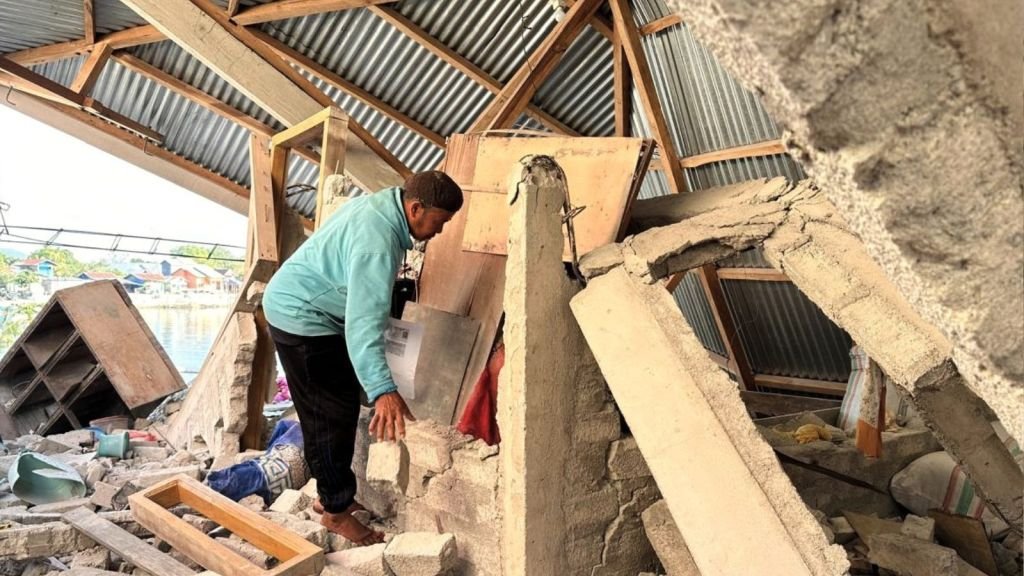
A magnitude 5.9 Earthquake struck the Flores region of Indonesia on Thursday, adding another layer of uncertainty for communities still recovering from a much stronger earthquake that devastated parts of East Nusa Tenggara province.
The latest tremor was recorded at a depth of about 10 kilometres (6.2 miles), according to the European-Mediterranean Seismological Centre (EMSC). The shallow depth is significant because earthquakes close to the surface can produce strong shaking across nearby areas.
The new earthquake comes less than a week after a destructive 7.7-magnitude earthquake struck the Flores region on Saturday, leaving at least 53 people dead, damaging hundreds of homes and forcing thousands of residents into temporary shelters.
For people already sleeping outdoors or staying away from damaged buildings, another strong tremor can be frightening even when it causes little additional structural damage. It also complicates rescue and relief operations in an area where landslides, damaged roads, electricity outages and communication problems are already slowing the response.
Another 5.9 earthquake hits Flores as aftershocks continue
The latest 5.9-magnitude earthquake is part of a period of intense seismic activity affecting Flores and surrounding parts of East Nusa Tenggara.
Following the main 7.7-magnitude earthquake on August 15, Indonesia’s Meteorology, Climatology and Geophysical Agency, known as BMKG, recorded thousands of aftershocks in the region. By August 19, BMKG had recorded 2,768 aftershocks, with magnitudes ranging from 1.1 to 6.2. Twenty-four of those aftershocks were above magnitude 5.
That level of continuing seismic activity explains why residents have remained on edge. The ground does not necessarily become quiet immediately after a major earthquake. Aftershocks can continue for days or longer as the Earth’s crust adjusts following the main rupture.
For rescue workers, however, the problem is more immediate. A fresh tremor can shake already weakened structures, trigger additional slope movement or force responders to temporarily move away from unstable buildings.
The latest quake follows a devastating 7.7-magnitude earthquake
The new earthquake would normally be a major event on its own. But its significance is amplified by what happened only days earlier.
The August 15 earthquake struck parts of Flores with a magnitude of 7.7 and caused widespread destruction. Landslides blocked roads and isolated communities, while buildings and homes were damaged across several areas.
At least 53 people were killed, while more than 900 homes were destroyed and another 450 were damaged across East Nusa Tenggara province, according to the figures provided in the original report.
At least 135 people were also reported injured.
In some communities, residents were forced to leave their homes because of structural damage and the fear of further shaking. Thousands of people moved into temporary shelters, while others spent nights outdoors.
The situation has created a difficult combination of needs. Rescue teams must search for survivors and recover victims while relief workers simultaneously try to provide food, clean water, medicine, blankets and safe shelter.
Why shallow earthquakes can be especially dangerous
The depth of an earthquake is an important factor in understanding its effects.
The latest Flores earthquake occurred at around 10 kilometres below the surface. That is considered a shallow earthquake. When seismic energy is released relatively close to the Earth’s surface, shaking can be strongly felt in nearby communities.
However, depth alone does not determine how destructive an earthquake will be. Magnitude, distance from populated areas, local geology, building quality, terrain and the type of fault involved all influence the actual damage.
In Flores, the terrain creates an additional concern. Mountainous areas and steep slopes can become unstable during strong shaking. When roads are cut by landslides, even communities that have not suffered major building damage can face difficulties receiving food, medicine and other supplies.
That makes earthquake recovery partly a transportation problem. A damaged road can delay an ambulance, relief truck or engineering crew just as effectively as a damaged building can disrupt normal life.
Rescue operations face a difficult situation
Rescue teams were already working through rubble and landslides when the latest earthquake struck.
Several communities affected by the main earthquake have faced problems with road access and communications. Some villages have been difficult to reach because landslides blocked routes through the region.
Restoring electricity and communications is therefore an important part of the Emergency Response. Without functioning communications, authorities have a harder time determining which communities need the most urgent assistance.
Relief workers have been distributing basic supplies including rice, ready-to-eat meals, drinking water, blankets and medicine. Temporary shelters have also been established for people WHO cannot safely return home.
For displaced residents, another earthquake can create a new dilemma: whether to remain near their homes to protect belongings or move farther away from potentially unstable buildings and slopes.
The safest decision after an earthquake depends on local instructions and the condition of the surrounding area. Buildings that have already been damaged should not be treated as safe simply because they remain standing.
More than 900 homes destroyed across East Nusa Tenggara
The scale of the initial destruction helps explain why the recovery is likely to take time.
| Impact | Reported figure |
|---|---|
| Major earthquake | Magnitude 7.7 |
| Deaths | At least 53 |
| Injured | At least 135 |
| Homes destroyed | More than 900 |
| Homes damaged | About 450 |
| Displaced residents | About 5,000 |
| Latest earthquake | Magnitude 5.9 |
| Latest earthquake depth | About 10 km |
The figures show why the latest tremor cannot be considered separately from the disaster that preceded it. Thousands of people were already dealing with displacement, damaged property and disrupted services.
For families who have lost homes, even moderate additional shaking can intensify fear and uncertainty. For authorities, meanwhile, every new tremor requires continued monitoring of structures, roads and slopes.
Tsunami concerns added to the fear
The earthquake emergency has also included concerns about a possible tsunami.
Residents fled in panic after tsunami warnings were issued following the earlier earthquake. The warnings were later lifted, but the episode added another layer of anxiety to an already dangerous situation.
Tsunami risk is particularly important in Indonesia because many communities are located along coastlines and the country sits in one of the world’s most active seismic regions.
Not every earthquake produces a tsunami. The potential depends on factors including the earthquake’s location, depth, magnitude and whether the seafloor is displaced in a way that moves a large volume of water.
For people living near the coast, however, official warnings should always be taken seriously. A tsunami can arrive quickly after a strong offshore earthquake, leaving little time for people to make decisions.
Why is Flores so vulnerable to earthquakes?
Indonesia is one of the world’s most earthquake-prone countries because of its location along the Pacific Ring of Fire, a broad zone associated with intense tectonic activity and numerous volcanoes.
The country’s geography is part of the explanation. Indonesia consists of thousands of islands positioned around several active tectonic boundaries. Earthquakes are therefore a recurring hazard in many parts of the country.
Flores has its own painful history with major earthquakes and tsunamis.
In 1992, a powerful earthquake and tsunami struck the island, killing about 2,500 people. The disaster remains one of the most important reminders of the island’s vulnerability to seismic and tsunami hazards.
Indonesia has also experienced catastrophes far beyond Flores. In 2004, a magnitude 9.1 earthquake off Sumatra generated a massive Indian Ocean tsunami that killed about 230,000 people across a dozen countries.
In 2018, a magnitude 7.5 earthquake in Sulawesi triggered a tsunami and contributed to the deaths of more than 4,400 people.
These disasters demonstrate why earthquake preparedness is a critical issue in Indonesia rather than a response reserved for rare events.
The biggest danger may now be secondary damage
One of the less obvious consequences of repeated earthquakes is that the danger can shift after the initial event.
During the first earthquake, collapsing buildings and landslides may cause the most immediate casualties. Afterward, weakened structures can become hazardous during subsequent shaking.
Roads can also become unstable. A slope that survived the main earthquake may fail during a later tremor, potentially cutting off an area that was previously accessible.
That is why recovery cannot simply focus on rebuilding houses. Authorities and emergency teams must also examine bridges, roads, hospitals, schools, communication networks and other essential infrastructure.
For residents, the presence of visible cracks or structural damage can be a warning that a building needs professional assessment before it is occupied again.
What happens next in Flores?
The immediate priority remains rescue and relief. Authorities and aid workers need to reach isolated communities, provide essential supplies and ensure that displaced families have safe places to stay.
The continuing aftershocks mean that monitoring will remain important. The large number of tremors recorded since the 7.7-magnitude earthquake shows that seismic activity in the region has remained elevated.
The next stage will increasingly involve assessing buildings and infrastructure, restoring essential services and helping residents who have lost homes or livelihoods.
The exact impact of the latest 5.9-magnitude earthquake will become clearer as authorities assess affected areas. A fresh tremor does not automatically mean that the original disaster is becoming worse, but in an already damaged region it can create additional risks that emergency crews cannot ignore.
Why this earthquake matters beyond the latest number
The latest 5.9 earthquake is more than another entry on a seismic activity chart. It has struck a population that is already dealing with deaths, destroyed homes, injuries, displacement and disrupted infrastructure.
That context changes how the earthquake should be understood.
For a community unaffected by a previous disaster, a magnitude 5.9 earthquake may be a frightening but temporary event. For people whose homes have already been damaged by a magnitude 7.7 earthquake, another shallow tremor can have consequences far beyond the shaking itself.
It can force families back into emergency shelters, interrupt rescue operations, worsen landslide risks and make people reluctant to return to buildings that may already be unsafe.
Flores is now facing the difficult period that follows a major Natural Disaster: the emergency response must continue even as the ground remains unsettled.
The latest earthquake is a reminder that the disaster did not end when the first major tremor stopped. For thousands of people across East Nusa Tenggara, recovery is still underway, and the continuing seismic activity means caution will remain essential while authorities work to restore roads, communications, electricity, housing and access to isolated communities.
For breaking news and live news updates, like us on Facebook or follow us on Twitter and Instagram. Read more on Latest World on thefoxdaily.com.





COMMENTS 0