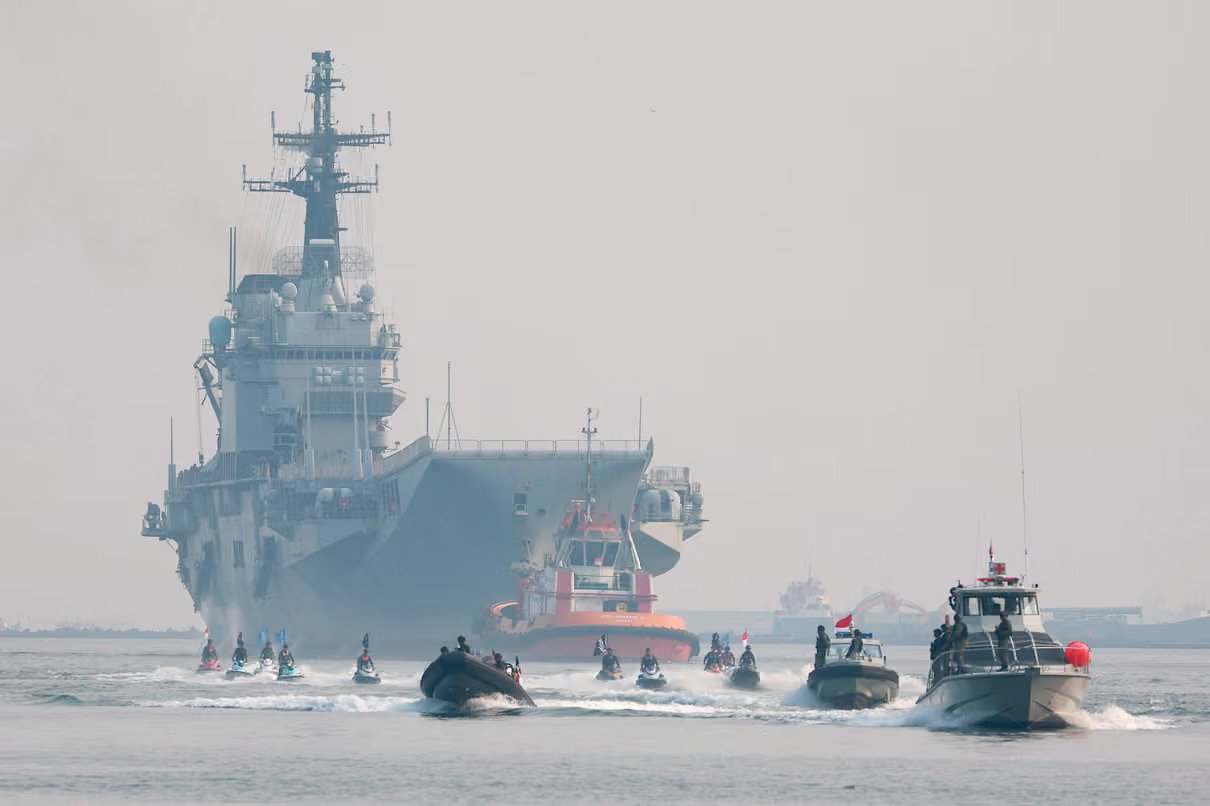
Indonesia has received its first aircraft carrier, a former Italian warship that the government says will strengthen maritime security and disaster response across the country’s vast island territory.
The 41-year-old former Italian carrier Giuseppe Garibaldi arrived at the Tanjung Priok naval base in North Jakarta on Friday morning, where it was welcomed with a military ceremony. The ship is scheduled to be formally commissioned into the Indonesian Navy next week under the name KRI Gajah Mada.
The arrival gives Indonesia a new type of naval capability and makes it only the second country in Southeast Asia to operate an aircraft carrier. Thailand is the region’s other carrier operator, with the HTMS Chakri Naruebet.
However, the acquisition has also triggered a debate over whether Indonesia needs an aircraft carrier, how much it will ultimately cost to refurbish and operate, and whether the money could be more effectively spent on other military capabilities.
Indonesia’s first aircraft carrier arrives in Jakarta
The Giuseppe Garibaldi was retired by Italy in 2024. Italy agreed in March to transfer the vessel to Indonesia as part of efforts to deepen Defence cooperation between the two countries.
The transfer also benefits Italy by eliminating the cost and logistical burden associated with decommissioning and disposing of the ageing warship.
The carrier is capable of operating short take-off and vertical landing aircraft as well as helicopters. Indonesia, however, is not initially positioning the ship primarily as a traditional carrier designed to project fighter aircraft far from its shores.
Instead, the government plans to adapt the vessel for helicopters, drones, maritime operations and disaster-response missions.
That proposed role reflects Indonesia’s geography. The country consists of thousands of islands spread across a strategically important maritime region, creating significant challenges for moving personnel, equipment and emergency supplies quickly during a crisis.
Why Indonesia named the ship KRI Gajah Mada
The Indonesian Navy will commission the former Giuseppe Garibaldi as KRI Gajah Mada, using the name of one of the country’s most prominent historical figures.
Gajah Mada was a military and political leader of the 14th-century Majapahit era. He is closely associated with campaigns and historical ideas surrounding the unification of the Indonesian archipelago.
The choice of name gives the new naval vessel a connection to Indonesia’s maritime history and its modern emphasis on national unity across a geographically dispersed country.
The carrier’s arrival also fits into President Prabowo Subianto’s broader emphasis on defence development. His administration has pursued military expansion involving submarines, frigates, fighter aircraft and missiles while increasing defence cooperation with other countries.
Indonesia sees the carrier as more than a warship
Indonesia’s proposed use of KRI Gajah Mada differs from the role traditionally associated with large aircraft carriers operated by major naval powers.
Instead of relying primarily on the vessel to launch fighter aircraft for operations far from Indonesian territory, the government wants to use it as a mobile command and support platform.
Helicopters and uncrewed aircraft would form an important part of that concept, while the ship could also support maritime operations and provide a mobile base during emergencies.
President Prabowo has specifically highlighted disaster response as one of the carrier’s potential roles.
During a disaster management meeting earlier this month, Prabowo said the ship could be used to help authorities respond to forest and peatland fires, which regularly produce hazardous haze affecting parts of Southeast Asia.
“We will refurbish it and convert it into a carrier for helicopters and drones,” Prabowo said in a video briefing. “This will greatly help our disaster response.”
He said the vessel could accommodate as many as 10 medium-sized helicopters, including aircraft with capabilities comparable to the Black Hawk and Mi-17, and could transport large quantities of water for use in areas experiencing significant numbers of fire hot spots.
Natural disasters strengthen the case for a mobile platform
Indonesia’s location gives disaster response a particular strategic importance. The country sits along the Pacific “Ring of Fire”, where geological activity contributes to earthquakes, volcanic eruptions and other natural hazards.
Its geography can make emergency logistics difficult. Reaching isolated islands can require ships or aircraft capable of carrying large quantities of supplies and personnel without relying entirely on local infrastructure.
A large naval platform could potentially serve as a mobile base from which helicopters and drones operate during emergencies.
In that role, the carrier would not necessarily need to perform the same mission as a conventional fighter-carrier. Its value would instead come from its ability to carry aircraft, equipment, personnel and supplies and move them toward areas where they are needed.
The government has therefore presented the vessel as a multifunctional asset that could support both security and humanitarian missions.
Indonesia approved $450 million in financing
The financial side of the acquisition has become one of the most contentious issues surrounding the ship.
Indonesia’s Finance Ministry approved USD 450 million in financing for the aircraft carrier programme in 2025. That figure, however, does not necessarily represent the full long-term cost of turning the retired vessel into an operational Indonesian naval asset.
Some Indonesian lawmakers have warned that refurbishment and retrofitting could push the total expenditure considerably higher.
TB Hasanuddin, a member of Parliament‘s Commission I, said the cost of retrofitting the carrier alone could reach 16 trillion rupiah, equivalent to about USD 900 million.
The difference between the approved financing and the possible refurbishment estimate illustrates one of the central questions surrounding the programme: the cost of acquiring a vessel is only one part of operating an aircraft carrier.
The hidden costs of operating an aircraft carrier
An aircraft carrier requires much more than a large hull and a flight deck. Its operation involves personnel, maintenance, fuel, aviation support, communications, weapons systems, logistics and specialised infrastructure.
Those requirements become particularly important when the vessel is more than four decades old.
Defence analysts have therefore argued that Indonesia needs to assess the complete lifecycle cost of the KRI Gajah Mada rather than focusing only on the initial transfer and refurbishment.
The Navy would need to sustain the ship over many years if it is to become a reliable operational asset. That could require continuing expenditure on maintenance, upgrades and supporting facilities.
The age of the vessel also raises questions about how much modernisation will be required before it can perform the missions Indonesia has identified for it.
Defence analysts question whether Indonesia needs a carrier
The acquisition has divided opinion among defence analysts, economists and opposition politicians.
Muhammad Fauzan Malufti of the Centre for Strategic and International Studies said the decision should be based on genuine operational requirements and Indonesia’s ability to operate the ship rather than considerations such as national pride.
He argued that policymakers need to consider the complete cost of the programme, including modernisation, personnel, maintenance, fuel, weapons systems and supporting infrastructure.
Fauzan also called for greater transparency over those factors, particularly because of the ship’s age.
His concerns extend beyond the initial purchase or transfer. Even if the vessel can be refurbished successfully, the government would still need to maintain sufficient funding to keep it operational over time.
Thailand’s carrier offers a regional comparison
Indonesia’s decision can be viewed against the experience of Thailand, the only other Southeast Asian country with an aircraft carrier.
Thailand’s HTMS Chakri Naruebet was commissioned in 1997 after being procured from Spain along with carrier-capable AV-8S Matador jump jets.
Fauzan pointed to Thailand’s carrier as an example of the challenges involved in maintaining such a vessel, arguing that it has spent significant periods in port because of operational and budget constraints.
The comparison illustrates why possessing an aircraft carrier and maintaining a consistently deployable carrier capability are not necessarily the same thing.
For Indonesia, the experience also raises the question of whether the resources required for KRI Gajah Mada could deliver greater operational value if directed toward other naval assets.
Submarines and frigates remain a competing priority
Military analyst Khairul Fahmi of the Institute for Security and Strategic Studies argued that aircraft carriers are not Indonesia’s most urgent defence requirement.
He said Indonesia has a greater need for submarines, frigates and asymmetric weapons systems to protect its maritime sovereignty and prevent potential adversaries from operating freely in Indonesian territorial waters.
Those platforms perform different missions from an aircraft carrier. Submarines can provide stealth and undersea warfare capabilities, while frigates can conduct surface combat, patrol and maritime security operations.
For a country spread across a large maritime territory, the ability to monitor and protect waters around its islands can therefore involve a combination of different platforms rather than a single major ship.
The debate is ultimately about how Indonesia should allocate limited defence resources across those competing requirements.
Carrier could still become a symbol of maritime power
Fahmi also acknowledged that an aircraft carrier could serve a broader strategic purpose if Indonesia wants to strengthen its position as a major maritime nation.
He described a carrier as potentially both a symbol of national power and a multifunctional platform capable of supporting military and non-military missions.
This dual role is central to the Indonesian government’s argument for KRI Gajah Mada.
Rather than presenting the vessel solely as a platform for projecting military force, officials have highlighted its potential contribution to disaster response, helicopter operations, drone missions and maritime support.
That approach could allow Indonesia to justify the carrier in terms of both national defence and humanitarian assistance.
Indonesia’s fiscal pressures add to the scrutiny
The carrier programme is arriving at a time when Indonesia is facing wider budget pressures.
Prabowo’s government is pursuing an ambitious free nutritious meals programme alongside other costly initiatives, while economists have raised concerns about slower growth, weaker state revenues and tighter fiscal conditions.
Those competing demands have intensified scrutiny of major defence spending.
Defence modernisation can require substantial long-term Investment, particularly when a country seeks to build capabilities involving sophisticated ships, aircraft, missiles and supporting infrastructure.
The question facing policymakers is therefore not simply whether Indonesia can acquire an aircraft carrier, but whether it can sustainably finance the carrier while continuing to fund other defence and domestic priorities.
A new chapter for Indonesia’s navy
The arrival of the former Giuseppe Garibaldi marks a significant change for Indonesia’s naval fleet. Once KRI Gajah Mada enters service, Indonesia will have an aircraft carrier for the first time and will join Thailand as the only Southeast Asian nations operating this type of vessel.
Its eventual impact will depend on how effectively Indonesia refurbishes, staffs, maintains and deploys it.
If the ship can operate helicopters and drones effectively, support maritime missions and provide a mobile base during natural disasters, it could offer capabilities beyond those of a conventional surface combatant.
But if operating costs become too high or the ship spends long periods unavailable because of maintenance and budget constraints, its strategic value could be reduced.
KRI Gajah Mada faces a major test after commissioning
The commissioning of KRI Gajah Mada next week will mark the beginning rather than the end of Indonesia’s aircraft-carrier experiment.
The government will have to demonstrate that the ageing platform can be converted into a useful and sustainable asset while keeping its long-term operating costs under control.
Its performance in disaster response could become one measure of whether the government’s multifunctional concept works in practice. Its ability to support maritime security missions will provide another test.
At the same time, Parliament, defence analysts and the public are likely to continue examining the programme’s financial requirements and whether the carrier fits Indonesia’s broader defence strategy.
The arrival of KRI Gajah Mada therefore represents both a new naval capability and a major policy choice. Indonesia now has the opportunity to develop a carrier-based platform tailored to its geography and disaster-response needs, but it must also demonstrate that the capability can be operated effectively and financed over the long term.
For breaking news and live news updates, like us on Facebook or follow us on Twitter and Instagram. Read more on Latest World on thefoxdaily.com.






COMMENTS 0