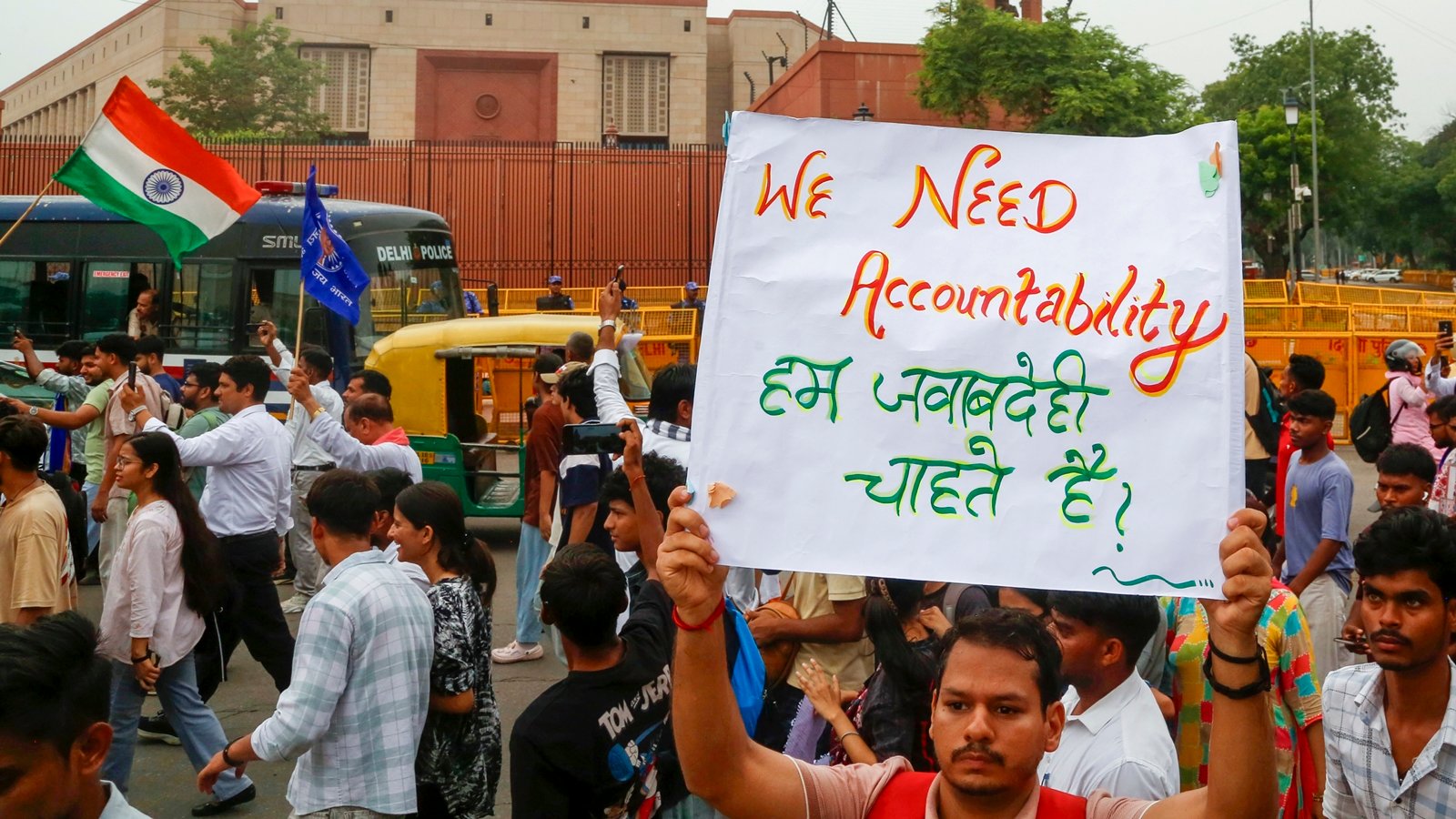
The first day of the Monsoon Session of Parliament witnessed significant disruption both inside and outside the Parliament complex, with demonstrations near the national capital prompting enhanced security measures while Opposition members repeatedly raised issues including the NEET-UG paper leak inside the Lok Sabha and Rajya Sabha.
Authorities deployed additional security personnel, riot-control equipment and communication management measures around Parliament as large crowds gathered for a protest march in central Delhi. Simultaneously, proceedings in both Houses were interrupted several times by slogan shouting and demands for discussions on issues raised by Opposition parties, resulting in multiple adjournments and limited legislative Business on the opening day.
The developments underscored how public protests and parliamentary proceedings can converge during politically sensitive sessions, particularly when contentious national issues dominate the political agenda.
Heavy Security Around Parliament as Demonstrations Intensify
Security arrangements around the Parliament complex were significantly strengthened as authorities anticipated large-scale demonstrations near the legislative district. Riot-control personnel, barricades and additional deployment of security forces were positioned around key access points to maintain law and order.
According to officials, temporary restrictions were implemented in certain areas surrounding Parliament to regulate crowd movement and ensure the security of Members of Parliament, parliamentary staff and visitors.
Several access routes experienced increased security screening, while some gates were temporarily regulated during peak movement periods as police managed protest-related activity nearby.
Communication Restrictions and Security Measures
Authorities also deployed communication management systems in parts of the Parliament area as part of broader security arrangements. Such measures are occasionally implemented during high-security events involving constitutional institutions or when intelligence agencies assess elevated security risks.
Alongside communication controls, riot-control vehicles and emergency response units remained stationed near strategic locations throughout the day to respond quickly if required.
These precautions reflected the importance of maintaining security around one of India‘s most sensitive government complexes while balancing citizens’ right to peaceful protest and ensuring uninterrupted functioning of democratic institutions.
Protests Coincide with Opening Day of Monsoon Session
The demonstrations were centred on demands related to the alleged NEET-UG examination paper leak, an issue that has generated considerable public and political attention in recent months.
Student groups and political organisations have repeatedly sought greater accountability regarding examination integrity, arguing that alleged irregularities affect millions of aspirants preparing for highly competitive entrance examinations.
The issue has become one of the most debated education-related controversies in recent years because competitive examinations play a crucial role in admissions to professional courses across the country.
NEET-UG Controversy Continues to Dominate Political Debate
The National Eligibility cum Entrance Test (NEET-UG) serves as India’s primary entrance examination for undergraduate medical education. Every year, millions of students compete for a limited number of seats in government and private medical colleges.
Because of the examination’s importance, allegations of question paper leaks or procedural irregularities often trigger widespread public concern and demands for institutional reforms.
Opposition parties used the opening day of Parliament to press the government on the issue, calling for accountability and broader discussions regarding examination security, transparency and administrative reforms.
Opposition Raises Multiple Issues Inside Parliament
Inside both Houses, Opposition members repeatedly sought discussions on matters including:
- NEET-UG examination-related concerns
- Student welfare and examination transparency
- Law and order during public demonstrations
- Other political and governance issues raised during the session
Frequent slogan shouting interrupted scheduled parliamentary business, resulting in repeated adjournments throughout the day.
Both the Lok Sabha and Rajya Sabha witnessed exchanges between treasury benches and Opposition members regarding procedural matters, with presiding officers repeatedly appealing for order.
Why Parliamentary Adjournments Matter
Repeated disruptions have consequences beyond immediate political messaging.
Parliament is responsible for debating legislation, scrutinising government policies, approving financial proposals and enabling elected representatives to raise constituency concerns. When proceedings are repeatedly interrupted, important legislative work may be postponed or delayed.
While protests and political disagreement are integral to parliamentary democracy, sustained disruptions often reduce the time available for structured debate and detailed examination of proposed laws.
| When Parliament Functions Normally | During Frequent Disruptions |
|---|---|
| Question Hour proceeds | Question Hour may be suspended |
| Bills are debated in detail | Legislative business gets delayed |
| MPs raise constituency issues | Discussion time reduces |
| Committees receive legislative inputs | Policy scrutiny becomes limited |
| Government and Opposition exchange views | Sloganeering dominates proceedings |
Large Crowds Prompt Enhanced Crowd Management
Officials indicated that attendance at the protest exceeded initial estimates, requiring authorities to deploy additional personnel and crowd-management resources.
Managing demonstrations in the vicinity of high-security government institutions presents unique operational challenges. Security agencies must simultaneously facilitate lawful public assembly while protecting constitutional offices and ensuring uninterrupted movement for emergency services and lawmakers.
Standard crowd-control strategies typically include route diversions, layered barricading, rapid response teams and continuous coordination among multiple law enforcement agencies.
Role of Security Agencies Around Parliament
Security at Parliament involves coordination among several agencies responsible for access control, intelligence gathering, traffic regulation and emergency preparedness.
The Parliament complex is considered one of India’s most sensitive protected zones due to its constitutional significance. Security arrangements are therefore regularly reviewed and strengthened during major parliamentary sessions, visits by constitutional authorities or periods of heightened public mobilisation.
Temporary restrictions implemented during such periods are generally intended to minimise security risks while allowing parliamentary proceedings to continue safely.
Education Reforms Remain in National Spotlight
The renewed political focus on examination integrity reflects broader concerns about India’s rapidly expanding education system.
Competitive entrance examinations determine admissions for millions of students seeking opportunities in medicine, engineering and other professional disciplines. Maintaining public confidence in these examinations is therefore essential.
Policy experts have suggested several reforms over recent years, including:
- Stronger digital security for examination systems
- Enhanced monitoring during paper transportation
- Greater use of encrypted question paper distribution
- Independent auditing of examination processes
- Faster investigation mechanisms for alleged irregularities
- Improved coordination between examination agencies and law enforcement
Such reforms are intended to strengthen transparency while protecting the interests of genuine candidates.
Balancing Democratic Protest and Institutional Functioning
Democratic systems often require balancing two equally important principles: citizens’ right to peaceful protest and the uninterrupted functioning of constitutional institutions.
Public demonstrations provide an avenue for citizens and organisations to express concerns and influence Public Policy. At the same time, legislative institutions must continue operating effectively to debate laws, oversee government actions and address national priorities.
Managing both objectives simultaneously requires careful coordination among law enforcement agencies, parliamentary authorities and protest organisers.
Political Impact of the Opening Day
The opening day of the Monsoon Session demonstrated that education-related issues are likely to remain a major point of contention during the session.
Alongside debates over examination integrity, Parliament is expected to consider several important legislative proposals relating to the Economy, infrastructure, Technology, governance and social welfare.
Whether these discussions proceed smoothly may depend on continued negotiations between the government and Opposition regarding procedural priorities and debate schedules.
Expert Insight: Why Parliamentary Productivity Matters
Beyond immediate political headlines, parliamentary productivity has significant implications for governance and economic confidence.
Investors, businesses and citizens closely monitor legislative sessions because important policy decisions including taxation, infrastructure spending, education reforms, Digital Regulation and economic legislation often require parliamentary approval.
Constructive debate enables detailed examination of proposed laws, encourages transparency and helps improve legislation through committee recommendations and cross-party discussion. While political disagreements are an essential feature of democracy, prolonged disruptions can delay reforms that affect businesses, public services and citizens.
What to Watch During the Rest of the Monsoon Session
As the session progresses, attention is expected to remain focused on several major issues:
- Debate on examination reforms and education policy
- Government’s legislative agenda
- Economic and fiscal measures
- Infrastructure and development initiatives
- National security and foreign policy discussions
- Public accountability and governance-related debates
The government’s ability to advance legislation, along with the Opposition’s strategy for raising key public concerns, will likely shape the tone of the remaining session.
Conclusion
The opening day of Parliament’s Monsoon Session highlighted the close relationship between public sentiment and parliamentary debate. Large demonstrations outside Parliament, enhanced security arrangements and repeated disruptions inside both Houses reflected the political significance of issues surrounding examination integrity and governance.
While security agencies focused on maintaining order around the Parliament complex, lawmakers engaged in heated exchanges over matters raised by the Opposition, limiting the day’s legislative business. As the session continues, the challenge for all stakeholders will be balancing robust democratic debate with the need for productive parliamentary functioning. The coming weeks are expected to determine whether political differences can translate into substantive discussions on education reforms, governance and other issues of national importance.
For breaking news and live news updates, like us on Facebook or follow us on Twitter and Instagram. Read more on Latest India on thefoxdaily.com.





COMMENTS 0