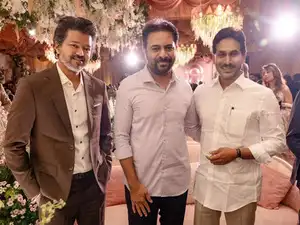
A family celebration in Chennai has unexpectedly become a talking point in southern India’s political circles. Three prominent leaders representing Telangana, Andhra Pradesh and Tamil Nadu KT Rama Rao (KTR), Y. S. Jagan Mohan Reddy and C. Joseph Vijay were seen together at a wedding reception on November 5, 2026.
The gathering took place at The Leela Palace in Chennai during the wedding celebrations of Shreya, daughter of YS Anil Reddy, and Ujjwal. Anil Reddy is related to former Andhra Pradesh Chief Minister and YSR Congress Party (YSRCP) president Jagan Mohan Reddy.
Photographs and videos from the event showed the three political figures interacting and sharing the same platform. The presence of leaders from three neighbouring southern states quickly attracted attention, particularly because each represents a different regional political formation.
While the occasion was a family celebration rather than a political meeting, the photographs have revived questions about possible cooperation among regional parties. The combined parliamentary strength of Tamil Nadu, Andhra Pradesh and Telangana 81 Lok Sabha seats provides an interesting political backdrop to the discussion.
What Happened at the Chennai Wedding?
The wedding reception brought together politicians, business leaders, film personalities and members of the YS family. Vijay attended the event as Tamil Nadu’s Chief Minister, while Jagan represented the YSRCP and KTR attended as the working president of the Bharat Rashtra Samithi (BRS).
Videos from the venue showed Vijay interacting with Jagan and posing for photographs. KTR was also present, with images showing the three leaders together. Their appearance created a rare public moment involving prominent figures from three different southern political landscapes.
Other notable guests included industrialist Gautam Adani, actor Trisha Krishnan, Vijay’s mother Shobha Chandrashekhar, Jagan’s wife YS Bharati and former YSRCP leader YS Vijayamma.
The event was primarily a family celebration. There has been no official announcement that the leaders discussed electoral arrangements, a political alliance or a common strategy. Nevertheless, their public interaction has attracted attention because of the changing political equations across southern India. :chatgpt-content-reference{index=”0″}
Why the 81 Lok Sabha Seats Matter
The political significance of the three states becomes clearer when their representation in the Lok Sabha is considered. Together, Tamil Nadu, Andhra Pradesh and Telangana account for 81 of the 543 elected seats in the Lower House of Parliament.
- Tamil Nadu: 39 Lok Sabha seats.
- Andhra Pradesh: 25 Lok Sabha seats.
- Telangana: 17 Lok Sabha seats.
- Combined strength: 81 Lok Sabha seats.
This combined representation gives the three states considerable potential influence in national parliamentary politics. A coordinated position on issues affecting southern states could help regional parties attract attention to matters such as federal funding, state autonomy, infrastructure, language policy and the distribution of national resources.
However, the 81-seat figure should not be mistaken for the strength of a single political alliance. The seats are distributed among different parties, and their political interests do not automatically align.
Any attempt to convert this numerical strength into a coordinated parliamentary bloc would require agreements on common priorities, leadership, political strategy and cooperation with other parties.
KTR and Jagan: Could BRS and YSRCP Find Common Ground?
The interaction between KTR and Jagan is particularly interesting because both leaders head or represent regional political organisations that have faced significant electoral challenges in recent years.
KTR is the working president of the BRS, which governed Telangana before losing power in the 2023 Assembly election. The party has since been working to rebuild its political position and re-establish its influence in the state.
Jagan, meanwhile, served as Andhra Pradesh Chief Minister from 2019 to 2024. His YSRCP suffered a major defeat in the 2024 Assembly election, losing power to the coalition led by the Telugu Desam Party (TDP), Jana Sena Party and BJP.
Both leaders therefore represent regional parties operating in different political circumstances from those in which they previously held power.
Their interactions have attracted attention beyond the Chennai event. Reports have previously highlighted a meeting between KTR and Jagan in Bengaluru in November 2025, while their latest appearance together has renewed discussion about whether communication between regional leaders could develop into broader cooperation. :chatgpt-content-reference{index=”1″}
There are several issues on which regional parties could potentially find common ground, including the distribution of central funds, the federal structure, infrastructure investment and the interests of states in national policymaking.
However, shared concerns do not necessarily translate into an electoral alliance. BRS and YSRCP have separate organisational structures, political histories and priorities within their respective states.
Vijay’s Political Position Adds a New Dimension
The presence of C. Joseph Vijay makes the gathering particularly noteworthy. Unlike KTR and Jagan, who have spent years in electoral politics, Vijay entered politics through the launch of his party, Tamilaga Vettri Kazhagam (TVK).
Vijay’s political journey has added a new dimension to Tamil Nadu’s established political landscape. His rise to the chief minister’s office has given TVK a prominent role in state politics and created new questions about its approach to national political alliances.
Vijay has his own political identity and priorities. Whether TVK would cooperate with other regional parties on national issues, maintain an independent position or consider a broader political arrangement remains uncertain.
His interaction with Jagan and KTR does not establish that TVK is preparing to join either party in an alliance. There has been no official announcement from the three leaders indicating a common political platform.
Nevertheless, Vijay’s presence makes the broader discussion more interesting because Tamil Nadu’s 39 Lok Sabha seats could become important in any future effort to coordinate regional political interests.
Could a Southern Political Front Emerge Outside NDA and INDIA?
One possibility being discussed in political circles is whether regional parties from southern India could explore a platform that operates independently of the BJP-led National Democratic Alliance (NDA) and the Congress-led INDIA bloc.
Such an arrangement would not necessarily need to begin as an electoral alliance. It could initially focus on common policy concerns, parliamentary coordination and demands for greater consultation between the Centre and state governments.
Regional parties have historically taken different positions on national alliances depending on their state-level interests. Some have partnered with national parties, while others have maintained independent political identities or changed their alliances over time.
The political landscape in southern India is also far from uniform. The BRS, YSRCP and TVK have different ideological backgrounds, leadership structures and electoral priorities. Any broader understanding would have to account for these differences.
There are also established political relationships involving other parties. The TDP, for example, is part of the NDA, while Congress has its own political relationships in Telangana and Tamil Nadu. These existing arrangements make the prospect of a new regional formation more complicated.
A common platform could therefore be easier to establish around specific issues than through a full electoral alliance. Parties might agree on federal funding or state rights without necessarily contesting elections together.
Why Federalism Could Become a Common Issue
One area where southern regional parties could potentially find common ground is the debate over federalism and the relationship between state governments and the Centre.
Issues such as tax devolution, centrally sponsored schemes, infrastructure funding and the allocation of national resources frequently influence discussions between state governments and the Union government.
Regional parties often argue that states should have sufficient financial and administrative freedom to address their own priorities. This can create opportunities for cooperation even among parties that disagree on other political questions.
For Tamil Nadu, Andhra Pradesh and Telangana, infrastructure and economic development are important policy areas. Connectivity, industrial investment, water management, energy projects and employment generation could all feature in discussions about regional cooperation.
However, cooperation would require agreement on specific proposals. The states may share some economic interests while competing over investments, infrastructure projects and access to resources.
Political Challenges Facing a Three-State Understanding
Despite the attention generated by the wedding photographs, building a meaningful political arrangement involving the three leaders would involve considerable challenges.
Different political priorities
Each party has its own immediate concerns. BRS is focused on rebuilding its position in Telangana, YSRCP is seeking to strengthen its presence in Andhra Pradesh, and TVK must consolidate its political position in Tamil Nadu.
These priorities could influence how much attention the leaders are willing to give to a wider regional arrangement.
Leadership and coordination
Any political platform involving multiple regional parties would need clarity about leadership, decision-making and the distribution of responsibilities. It would also need an agreed mechanism for coordinating parliamentary positions and public messaging.
Different national political relationships
Regional parties do not necessarily share the same relationship with the NDA or INDIA bloc. Their decisions about national alliances are influenced by state-level political calculations, electoral competition and relationships with other parties.
Electoral competition
Even when regional parties share concerns about national policy, their interests may conflict in particular constituencies or states. A common understanding would have to address these differences before it could develop into an electoral arrangement.
What the Chennai Meeting Does and Does Not Tell Us
The appearance of KTR, Jagan and Vijay at the same wedding reception is politically interesting because it brings together leaders from three states with a combined 81 Lok Sabha seats.
It also comes at a time when political parties across southern India are assessing their positions ahead of future national and state-level electoral contests. Regional leaders have reasons to monitor developments beyond their own states, particularly when questions of federalism and national political influence are involved.
However, it would be premature to interpret a social gathering as evidence of a new political alliance. The available reports establish that the leaders attended the same family celebration and interacted with one another. They do not establish that negotiations took place or that a common electoral strategy was discussed.
The distinction is important because political relationships can involve personal courtesy, social connections and issue-based cooperation without resulting in formal alliances.
Could the 81-Seat Arithmetic Influence National Politics?
The combined representation of Tamil Nadu, Andhra Pradesh and Telangana offers a useful way to understand why cooperation among their regional parties attracts attention.
With 81 Lok Sabha seats, the three states together account for nearly 15 per cent of the elected strength of the House. A coordinated position on important national questions could therefore carry weight in parliamentary debates and negotiations.
But the actual political influence of this representation would depend on which parties hold the seats, whether they can agree on common positions and how they coordinate with other national and regional formations.
Numbers alone cannot create a political bloc. A durable arrangement would require consistent communication, a shared agenda and a willingness to compromise on issues where the parties have different interests.
For now, the Chennai gathering has highlighted the possibility of closer interactions among southern leaders without confirming any formal political realignment.
What Happens Next?
The next indication of whether the meeting has any wider political significance will come from the leaders’ public statements and future interactions. Any formal alliance would normally require clearer signals, such as joint announcements, policy coordination or an agreed political programme.
Until then, the appearance of KTR, Jagan and Vijay should be understood as a notable social interaction that has generated political speculation rather than proof of a new southern front.
The broader question remains whether regional parties can turn shared concerns into coordinated political influence. Federalism, state rights, financial resources and infrastructure development could provide common ground, but differences over leadership, ideology and electoral strategy remain substantial.
The 81-seat arithmetic makes the possibility worth examining. Whether it develops into a political understanding will depend on decisions made by the parties themselves, not simply on photographs from a wedding reception.
Conclusion
The Chennai wedding brought together three influential political figures from Telangana, Andhra Pradesh and Tamil Nadu at a moment of considerable political change across southern India. Their appearance has renewed discussion about the possibility of regional cooperation and the role that southern states could play in national politics.
Yet there is currently no confirmed alliance involving KTR, Jagan and Vijay. The 81 Lok Sabha seats represented by their three states provide a significant numerical backdrop, but turning that strength into coordinated political influence would require a shared agenda and sustained political engagement.
For now, the gathering is a reminder of how social interactions between political leaders can attract attention in a changing political environment. Whether the Chennai meeting becomes the starting point for a wider regional conversation remains to be seen.
For breaking news and live news updates, like us on Facebook or follow us on Twitter and Instagram. Read more on Latest India on thefoxdaily.com.





COMMENTS 0