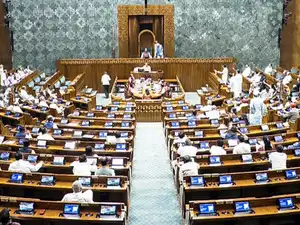
The Narendra Modi government has stepped up coordination among National Democratic Alliance (NDA) lawmakers ahead of a crucial parliamentary vote on the women’s reservation-linked legislation, with the ruling alliance confident of securing the numbers it needs. Prime Minister Narendra Modi hosted BJP parliamentary party leaders at his official residence on Sunday, while Union ministers organised region-wise and state-wise meetings with MPs to coordinate attendance and voting strategy.
The government is projecting support from around 371 Lok Sabha MPs for the revised legislative package, a figure that would put it above the two-thirds voting requirement under the expected attendance scenario. The slogan “Abki Baar, 370 Paar” reflects the ruling alliance’s confidence that it has gathered sufficient backing after several regional parties indicated support for the proposals.
However, the outcome will depend on the number of MPs present and voting when the Constitution Amendment Bill is taken up. The legislation has not yet been passed, and the government’s projected tally remains a political assessment rather than a confirmed voting result.
Modi Holds Meeting With BJP Parliamentary Party Leaders
Prime Minister Modi hosted senior BJP parliamentary party leaders at his official residence, 7 Lok Kalyan Marg, on Sunday evening. The meeting brought together senior Union ministers, party leaders and MPs from both the Lok Sabha and Rajya Sabha.
Those present included Defence Minister Rajnath Singh, Home Minister Amit Shah, BJP president Nitin Nabin and other senior party representatives. BJP general secretary (organisation) B.L. Santhosh also attended the gathering.
The meeting focused on parliamentary business and coordination ahead of the special sitting. Modi later described the interaction as productive, saying he had held conversations with members of the BJP Parliamentary Party Executive Committee.
The gathering was part of a broader effort to ensure that ruling alliance lawmakers understood the proposed legislation and remained available during the proceedings. With a constitutional amendment requiring a special majority, the government cannot rely only on its routine legislative strength.
Union Ministers Organise Region-Wise Meetings With MPs
Alongside the Prime Minister’s meeting, several Union ministers organised state-wise and region-wise dinner meetings with MPs at their residences. These gatherings were intended to strengthen coordination among NDA lawmakers and address questions about the proposed Bills before they were introduced in the Lok Sabha.
The meetings also provided an opportunity to discuss attendance, voting arrangements and the government’s position on the revised delimitation framework. Maintaining the presence of MPs is particularly important because the required constitutional majority depends partly on how many members participate in the vote.
The government is therefore concentrating on two connected tasks: securing support from MPs outside the BJP and ensuring that its existing supporters do not miss the crucial proceedings.
The political outreach comes after the Cabinet approved a revised package of legislation intended to expand parliamentary and state legislative representation while enabling the implementation of women’s reservation ahead of the 2029 general election.
Government Claims Support From 371 Lok Sabha MPs
Government sources have projected that approximately 371 Lok Sabha MPs will support the revised Constitution Amendment Bill. The expected backing includes NDA partners and regional parties that have indicated their willingness to support the proposal.
The number is significant because constitutional amendments must meet a higher voting threshold than ordinary legislation. Under Article 368 of the Constitution, an amendment must receive the support of a majority of the total membership of each House and at least two-thirds of members present and voting.
For example, if 540 MPs participate in the Lok Sabha vote, the legislation would require at least 360 votes in favour to meet the two-thirds condition. A projected tally of 371 would provide an 11-vote margin under that scenario.
The precise threshold can change depending on the number of members present and voting. Consequently, the government’s projected support figure does not automatically guarantee passage. Attendance, abstentions and the final positions of parties and individual MPs could influence the outcome.
Regional Parties Alter the Government’s Parliamentary Calculations
The government’s confidence has increased following support signals from several regional parties that had previously raised concerns about the delimitation proposal.
The Dravida Munnetra Kazhagam (DMK), led by Tamil Nadu Chief Minister M.K. Stalin, has announced support for the revised legislation. The party had earlier opposed aspects of the delimitation framework over concerns that southern states could lose their relative influence in Parliament.
The DMK’s position changed after the revised proposal included provisions that the party says protect Tamil Nadu’s parliamentary representation. Stalin has argued that supporting the updated framework is necessary to safeguard the state’s interests.
The Nationalist Congress Party (Sharadchandra Pawar) and the YSR Congress Party have also indicated support for the revised proposal. Their positions have become important to the government’s efforts to assemble the required numbers.
Other regional parties have assessed the legislation according to their own political and state-level concerns. This has made the parliamentary contest more complicated than a straightforward division between the ruling alliance and the opposition.
Three Bills Form the Centre’s Revised Legislative Package
The government is preparing to take up a three-Bill package during Parliament’s special sitting from November 30 to December 3. The proposals are intended to connect the expansion of legislative representation with the implementation of the 33 per cent women’s reservation.
The key legislations include:
- Constitution (132nd Amendment) Bill, 2026: Seeks to amend constitutional provisions governing women’s reservation and the expansion of seats in Parliament and state legislative assemblies.
- Delimitation (Second) Bill, 2026: Provides the proposed framework for redrawing parliamentary and assembly constituencies and implementing the revised allocation of seats.
- Union Territories Law (Amendment) Second Bill, 2026: Seeks to align the relevant legal framework for implementing the proposed changes in applicable Union Territories.
The revised package follows an earlier legislative attempt that failed to secure the required constitutional majority in the Lok Sabha in April. The Centre subsequently reworked its proposal and brought the revised Bills before Parliament.
Proposed 50 Per Cent Seat Expansion Linked to Women’s Reservation
One of the central features of the revised proposal is a 50 per cent increase in the number of Lok Sabha seats allocated to each state and Union Territory. The framework also proposes expanding state legislative assemblies, with the maximum strength of the Lok Sabha potentially rising from its current 543 elected members to 850.
The government says the expansion would create room for implementing the 33 per cent reservation for women in the Lok Sabha and state assemblies. The quota was provided for under the Constitution (106th Amendment) Act, 2023, but its implementation was linked to a future Census and delimitation exercise.
The revised legislation seeks to accelerate the process so that women’s reservation can be implemented before the 2029 general election. It also provides for an increase in seats reserved for Scheduled Castes and Scheduled Tribes alongside the broader expansion, with women receiving reservation within those categories as well.
Another important element is the proposed protection of the revised distribution of seats until 2051. This provision is intended to address concerns among southern states that population-based delimitation could reduce their relative share of representation because of differences in population growth across regions.
Opposition Questions the Link Between Women’s Quota and Delimitation
Despite the support signals from some regional parties, Congress and several other opposition groups have criticised the government’s approach. Their position is that the women’s reservation framework should be implemented without making it dependent on a broader delimitation exercise and expansion of parliamentary seats.
Opposition leaders have also raised concerns about the possible consequences of the proposed changes for federal representation, the balance between states and the powers of the proposed Delimitation Commission.
The disagreement has exposed differences within the INDIA bloc. While Congress has sought a coordinated opposition against the Bills, the DMK’s decision to support the revised framework has complicated those efforts. Other regional parties are also evaluating the proposal according to the safeguards they believe it provides for their respective states.
Today’s Lok Sabha Proceedings Will Test the Government’s Numbers
The special parliamentary sitting beginning Monday, November 30, will provide the first major test of the government’s revised legislative strategy. The BJP and its allies are focusing on attendance and coordination, while opposition parties are preparing to challenge the proposed changes.
The government’s projected support of 371 MPs places its expected tally above the two-thirds threshold in a scenario where 540 members vote. But the final arithmetic will only become clear when the House takes up the constitutional amendment and voting takes place.
The slogan “Abki Baar, 370 Paar” captures the government’s confidence heading into the proceedings. Whether that projected support translates into the required constitutional majority will depend on the actual numbers in the Lok Sabha, making attendance and the positions of regional parties central to the outcome.
For breaking news and live news updates, like us on Facebook or follow us on Twitter and Instagram. Read more on Latest India on thefoxdaily.com.


COMMENTS 0