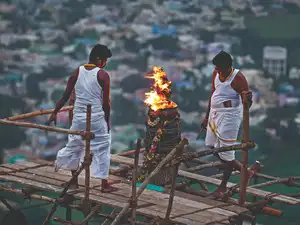
The lighting of the Karthigai Deepam lamp at the disputed deepathoon site in Thiruparankundram has triggered celebrations among Hindu devotees and renewed concerns over communal harmony in Madurai. The event followed a Supreme Court directive and was described by Hindu groups as a major victory after a prolonged legal dispute. However, protests and objections from Muslim leaders and civil society members have highlighted the sensitivities surrounding the hill and the potential consequences for relations between communities.
The episode has brought religious practice, competing claims over a shared sacred landscape and the authority of court orders into sharp focus. While devotees welcomed the lighting as the fulfilment of a long-standing demand, critics expressed concern that the development could deepen divisions in an area where religious sites and traditions exist in close proximity.
How the Thiruparankundram Deepathoon Dispute Developed
Thiruparankundram Hill is home to the Arulmigu Subramaniaswamy Temple, an important Hindu pilgrimage centre, as well as the Sikandar Badusha Dargah, a Muslim religious site. The proximity of these places of worship has made questions concerning access, religious practices and the use of different parts of the hill particularly sensitive.
The immediate dispute concerns the deepathoon, a stone pillar on the hill where some Hindu devotees and organisations have demanded that the Karthigai Deepam lamp be lit. The temple administration and state authorities have questioned whether lighting the ceremonial lamp at this particular pillar is an established religious custom.
The disagreement intensified after a devotee approached the Madras High Court seeking permission to light the lamp at the deepathoon. In December 2025, the court directed the temple administration to conduct the ritual at the pillar in addition to the customary location near the Uchipillaiyar Temple. The legal proceedings continued into 2026, with competing arguments about religious tradition, administrative authority and the potential effect on the nearby dargah.
The Supreme Court subsequently became involved in the dispute, issuing an interim direction on November 20, 2026, permitting the lamp to be lit at the deepathoon on November 24 as a one-time measure. The permission was subject to restrictions intended to protect public safety, the nearby religious site and the hill’s surroundings.
The court clarified that the temporary permission did not recognise or establish any permanent customary, religious or proprietary right over the disputed location. This distinction is central to understanding the case: permission for one ceremonial event does not automatically settle the larger dispute over the site’s long-term status.
Why the Lamp Was Not Lit at the Disputed Pillar on November 24
Despite the Supreme Court’s interim direction, the lamp was lit at the customary Uchipillaiyar Mandapam on November 24 rather than at the deepathoon. The Tamil Nadu government had filed a review petition, raising concerns about the implications of implementing the order and the possibility of disturbing communal harmony.
The decision triggered protests by Hindu organisations and devotees who argued that the authorities had failed to comply with the Supreme Court’s direction. Some demonstrators gathered near the hill, and tensions escalated as police attempted to prevent unauthorised gatherings. Several protesters were detained during the confrontation.
The incident turned a dispute over the location of a religious ritual into a wider confrontation involving the state government, temple administration, religious organisations and the judiciary.
The Supreme Court’s subsequent intervention on November 27 changed the course of events. The court directed that the lamp be lit at the deepathoon on November 28, treating the earlier failure to implement its interim direction as a serious matter. It also ordered arrangements to ensure that the ceremony could take place under judicial supervision and security measures.
Supreme Court Orders Lamp Lighting Under Strict Security
On November 28, the Karthigai Deepam lamp was finally lit at the disputed deepathoon at approximately 5 pm. The ceremony took place under the supervision of two retired judges appointed as receivers of the Arulmigu Subramaniaswamy Temple.
The supervising judges were former Meghalaya High Court Chief Justice S Vaidyanathan and former Madras High Court judge V Parthiban. Their appointment was intended to ensure that the court’s directions were implemented and that the ceremony followed the specified conditions.
The Supreme Court also directed that the ritual be performed by an authorised team, with the district administration coordinating arrangements. Access to the deepathoon was restricted to those permitted to participate in or supervise the ceremony. Members of the general public were not allowed to accompany the team to the site.
The court’s instructions also prohibited processions, public gatherings, demonstrations and slogan-raising at the location. These restrictions were designed to prevent the religious ceremony from becoming an occasion for confrontation or a larger mobilisation around the disputed site.
Security arrangements included the deployment of Central Reserve Police Force personnel. The forces were tasked with supporting local police in maintaining order around the hill, including the areas near the temple and the dargah.
A buffer zone of approximately 50 metres was maintained around the Sikandar Badusha Dargah. The arrangement was intended to ensure that the lamp-lighting ceremony could proceed without interfering with access to the Muslim place of worship.
Hindu Devotees Celebrate the Completion of the Ritual
The lighting of the lamp prompted celebrations among devotees who had campaigned for the ritual to take place at the deepathoon. People gathered near the foothills as the flame became visible, with celebrations including religious chants, fireworks and emotional expressions of relief.
For supporters of the demand, the event represented the implementation of a religious practice they believed should be permitted at the disputed pillar. The Supreme Court’s intervention was viewed by these groups as an important development after months of legal proceedings and repeated disagreements with the authorities.
The celebrations also reflected frustration over the failure to conduct the ritual at the deepathoon on November 24. Supporters argued that the November 28 ceremony fulfilled the court’s direction and addressed a demand that had remained unresolved through the earlier proceedings.
However, the celebration of the ritual should not be confused with a final legal determination of the competing claims. The Supreme Court’s permission was limited to a one-time arrangement, and the larger dispute remains subject to further judicial consideration.
Muslim Organisations and Civil Society Groups Raise Concerns
The ceremony was accompanied by opposition from Muslim organisations and civil society groups, which expressed concern about the implications of the court’s intervention for religious harmony and the protection of the nearby dargah.
On November 28, the Madurai Religious Harmony People’s Federation and the Muslim Aikkiya Jamaath organised a silent protest near the World Tamil Sangam and Gandhi Museum area. Participants from different religious and political backgrounds joined the demonstration, expressing their objections without slogans or confrontational speeches.
Protesters said they were concerned about the constitutional principles of secularism, the rights of religious minorities and the authority of the state administration. Some also questioned the impact of the judicial directions on the longstanding arrangements governing the hill and its religious sites.
One of the major concerns raised by Muslim representatives was the protection of the Sikandar Badusha Dargah. They feared that a decision concerning the deepathoon could have wider implications for the status of the dargah and the ability of worshippers to access it without interference.
The Supreme Court’s 50-metre buffer requirement and security arrangements were intended to address concerns about the immediate ceremony. Nevertheless, critics have argued that the broader questions surrounding religious coexistence and the management of the hill cannot be resolved through security arrangements alone.
The protests remained an expression of disagreement with the court’s intervention and its perceived implications. They should not be treated as evidence that all members of any religious community share the same position.
Why the Dispute Has Become a Test of Communal Harmony
The Thiruparankundram dispute has become sensitive because it involves more than the location of a ceremonial lamp. It concerns how religious traditions are recognised, how shared spaces are administered and how the rights and concerns of different communities are protected.
For Hindu devotees seeking the ritual at the deepathoon, the issue is connected to religious practice and the ability to observe a ceremony at a location they regard as significant. For Muslim representatives concerned about the nearby dargah, the dispute raises questions about the security of their place of worship and whether changes to arrangements on the hill could affect their religious access.
These positions have developed within a wider legal disagreement over the history and customary use of the disputed area. Establishing whether a particular ritual has been traditionally performed at a specific location requires consideration of evidence and legal arguments, rather than relying solely on the competing claims of religious organisations.
The presence of multiple places of worship on the same hill also makes administrative decisions particularly consequential. Even a limited change to access, security or ceremonial arrangements can be interpreted by communities as having wider implications for their religious rights.
That is why the authorities face the difficult task of implementing court directions while ensuring that neither community is subjected to intimidation or restrictions beyond those lawfully imposed. Maintaining peace requires consistent protection of religious access and respect for the rights of worshippers on both sides.
Supreme Court’s Order Does Not Settle the Permanent Dispute
An important aspect of the latest development is the limited nature of the Supreme Court’s permission. The November 28 ceremony was ordered as a one-time measure following the failure to implement the earlier direction. It does not automatically establish a permanent right to conduct the annual Karthigai Deepam ritual at the deepathoon.
The court’s directions also included safeguards concerning access, public safety and the protection of the hill’s religious and archaeological surroundings. No permanent construction, structural alteration or damage to religious or historical property was permitted as part of the arrangement.
The court’s intervention in the temple’s administration was another significant element. It suspended the temple’s Board of Trustees and appointed retired judges as receivers to oversee the arrangements connected with the ceremony. It also issued contempt notices to senior state officials and other authorities over the alleged failure to comply with its earlier order.
These steps underline the seriousness with which the court viewed the implementation of its directions. However, the contempt proceedings and the underlying dispute are separate legal questions. The final outcome will depend on the proceedings and the court’s assessment of the arguments and evidence presented by the parties.
What Happens Next in the Thiruparankundram Case?
The broader dispute over the deepathoon is expected to return before the Supreme Court in January 2027. The next stage of proceedings will be important because the one-time permission has enabled the ceremony to take place without resolving the competing claims about the site’s religious and customary status.
The court will have to consider the legal arguments surrounding the ritual, the rights asserted by the parties and the administrative arrangements governing the hill. The questions concerning the nearby dargah and the protection of religious access are also likely to remain central to discussions about how the site should be managed.
For the Tamil Nadu government, the challenge will be to comply with judicial directions while addressing concerns about public order and the protection of religious communities. For the temple administration and the organisations involved in the case, the next proceedings could determine how the annual ritual is treated in the longer term.
Until the larger dispute is resolved, the November 28 ceremony should be understood within the limited terms of the Supreme Court’s interim directions rather than as a final settlement.
Thiruparankundram’s Challenge Goes Beyond a Religious Ceremony
The lighting of the Karthigai Deepam lamp at the deepathoon has brought relief and celebration to devotees who had sought the ritual at the disputed pillar. At the same time, protests by Muslim organisations and civil society groups have demonstrated that concerns about the consequences for religious coexistence remain unresolved.
The Supreme Court’s intervention established a temporary arrangement for the ceremony, supported by judicial supervision and security restrictions. It did not decide every question surrounding the hill or grant permanent control of the disputed location to any party.
The immediate challenge for authorities is to preserve peace, protect access to both places of worship and prevent the dispute from becoming a source of hostility between communities. The longer-term challenge lies with the legal process, which must address competing claims through evidence and established principles of law.
As the case moves towards its next hearing, Thiruparankundram remains a reminder that disputes involving religious traditions and shared spaces require careful administration, judicial clarity and respect for the rights of all communities. The significance of the latest lamp lighting will ultimately depend not only on the ceremony itself but also on whether the dispute can be resolved without damaging the region’s social fabric.
For breaking news and live news updates, like us on Facebook or follow us on Twitter and Instagram. Read more on Latest India on thefoxdaily.com.





COMMENTS 0