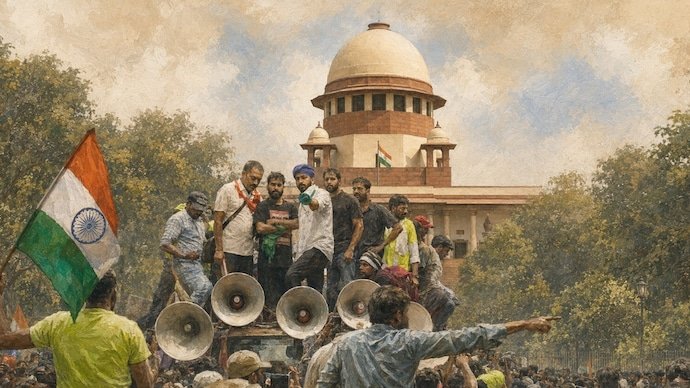
The Supreme Court’s decision to quash FIRs arising from the Cockroach Janta Party (CJP)-led Protests over the NEET-UG 2026 question-paper leak has once again brought Article 142 of the Constitution into public focus.
A three-judge bench headed by Chief Justice of India Surya Kant used the court’s special constitutional power to direct that FIRs connected with the student demonstrations between July 20 and July 25 would not be investigated and would be treated as closed. The order gave broad relief to protesters while allowing authorities to continue examining the involvement of people with specified criminal antecedents or links to violence.
The case is significant not only because thousands of young protesters received relief from criminal proceedings. It also illustrates the unusual reach of Article 142, a provision that allows the Supreme Court to pass orders necessary to do “complete justice” in a matter before it.
The same constitutional provision has been used in several landmark cases. In the 2019 Ayodhya judgment, the Supreme Court relied on Article 142 while directing that five acres of land be allotted to the Sunni Central Waqf Board for a mosque after the disputed site was awarded for the construction of a Ram temple. In 2023, the court used the provision to dissolve marriages on the ground of irretrievable breakdown in appropriate cases, even though that ground was not expressly included in the Hindu Marriage Act.
These examples show why Article 142 is regarded as one of the Supreme Court’s most powerful tools. But they also raise an important constitutional question: does the power have any real limits?
What happened in the CJP protest FIR case?
The latest controversy surrounding Article 142 began with demonstrations led by the CJP over alleged irregularities and the NEET-UG 2026 question-paper leak.
The protests began in Delhi and later spread to other parts of the country. A CJP-led Parliament March on July 20 became confrontational, with instances of violence reported in Central Delhi. More than 200 police personnel were reported injured during the disturbances.
Criminal cases were subsequently registered against protesters in Delhi and several states. For students and young people involved in the demonstrations, the continuation of those cases carried the possibility of prolonged Investigation and criminal prosecution, regardless of whether they had personally been involved in serious violence.
The withdrawal of those cases eventually became one of the conditions associated with negotiations between the protesters and the government. The CJP had also announced a proposed march in Delhi for September 5.
Following discussions, the Centre indicated that it would not pursue the relevant FIRs or register fresh cases arising from demonstrations during the specified period. Delhi Police and the governments of Bihar, Maharashtra, Assam and West Bengal subsequently approached the Supreme Court seeking comprehensive closure of the cases.
Solicitor General Tushar Mehta told the court that Article 142 could be used to bring the matter to a complete end. The bench, comprising CJI Surya Kant and Justices Joymalya Bagchi and V Mohana, accepted the request and exercised its extraordinary jurisdiction.
The court directed that the relevant FIRs would not be investigated and would be treated as closed for all purposes.
Why did the Supreme Court invoke Article 142?
The court’s decision was based on the circumstances surrounding the protests and the interests of the young people involved.
The applications before the court sought a comprehensive solution rather than requiring individual protesters to approach different courts to obtain relief. Article 142 provided a constitutional mechanism through which the Supreme Court could bring the proceedings to an end in one order.
The court nevertheless did not treat the power as a blanket amnesty for everyone who may have participated in violence.
Authorities were permitted to separately examine the involvement of 2,873 people identified as having previous criminal records or suspected links to violence. This distinction is important because the order was aimed primarily at protesters who had participated in the agitation without being responsible for serious criminal conduct.
The Supreme Court’s intervention therefore combined broad relief with a carve-out for individuals whose conduct required separate scrutiny.
That approach also helped resolve the immediate confrontation between the government and the CJP-led movement. After the court’s intervention, the organisation withdrew its planned September 5 Delhi march.
What exactly is Article 142?
Article 142 is a constitutional provision dealing with the Supreme Court’s authority to ensure that justice is effectively delivered in cases before it.
Article 142(1) provides that the Supreme Court may pass any decree or make any order necessary for doing “complete justice” in a cause or matter pending before it. Such decrees and orders are enforceable throughout India.
The provision is unusual because it gives the Supreme Court flexibility to design a remedy where ordinary legal procedures may not be sufficient to resolve the particular circumstances of a case.
Unlike ordinary statutory powers, Article 142 comes directly from the Constitution. This gives it considerable legal weight and allows the court to address situations where a rigid application of existing procedures could leave a genuine injustice unresolved.
It is often described as an extraordinary or curative power. Its purpose is not simply to allow judges to do whatever they believe is fair. Instead, it enables the country’s highest court to fashion an effective remedy within the matter that is before it.
How Article 142 was used in the Ayodhya judgment
One of the most consequential applications of Article 142 came in the Supreme Court’s 2019 Ayodhya verdict.
The Constitution Bench unanimously held that the disputed 2.77-acre site should be handed over for the construction of a Ram temple and directed the creation of a trust to oversee the process.
At the same time, the judgment made findings concerning the unlawful dispossession of Muslims from the mosque and the demolition of the Babri Masjid on December 6, 1992.
The court described the demolition as an egregious violation of the rule of law. It also found that the mosque had been unlawfully desecrated in 1949, when idols were placed inside the structure and the premises were subsequently locked.
The court concluded that simply deciding the title dispute was not enough to fully address the consequences of what had happened.
It therefore invoked Article 142 and directed the Centre or the Uttar Pradesh government to allot five acres of land at a prominent location in Ayodhya to the Sunni Central Waqf Board for the construction of a mosque.
The five-acre parcel was not the disputed land awarded for the temple. Instead, it was framed as a form of restitution for the unlawful destruction of the mosque and the deprivation suffered by the Muslim community.
The Ayodhya judgment is one of the clearest examples of the court using Article 142 to create a remedy that was not simply a conventional consequence of deciding legal title.
Article 142 and divorce: another major example
Article 142 has also played an important role in family-law cases.
In Shilpa Sailesh v. Varun Sreenivasan, a Constitution Bench examined whether the Supreme Court could dissolve a marriage that had irretrievably broken down even though irretrievable breakdown was not itself an express statutory ground for divorce under the Hindu Marriage Act.
The court held that it could exercise Article 142 in appropriate cases to dissolve marriages that had become completely unworkable and emotionally dead.
However, the judgment also stressed that this was not an automatic right. The power had to be exercised with great care and caution after the court was convinced that the marriage had irretrievably broken down and that dissolution was the appropriate way to achieve complete justice.
The ruling illustrated an important feature of Article 142: its extraordinary character does not eliminate the need for judicial restraint.
The Bhopal gas case shows both the reach and risks of Article 142
Another major example came from the aftermath of the Bhopal gas disaster.
In 1991, the Supreme Court used Article 142 in proceedings concerning the settlement between the Union of India and Union Carbide Corporation arising from the disaster. The court approved the settlement and also dealt with criminal proceedings connected with the matter.
The criminal-proceeding aspect of that decision was later reviewed and reversed. The episode remains important in discussions about Article 142 because it demonstrated how far the Supreme Court could go while attempting to bring a massive and complex dispute to a final resolution.
It also highlighted the constitutional debate surrounding the limits of judicially created remedies, particularly when they intersect with statutory provisions and criminal law.
Is Article 142 limitless?
No. Despite the breadth of the language used in Article 142, the power is not unlimited.
The Supreme Court has repeatedly clarified that Article 142 cannot be used to override the Constitution or violate fundamental rights. Nor can it be exercised to deprive a person of substantive legal rights without the necessary safeguards.
The court has also held that Article 142 cannot be used to simply replace laws enacted by Parliament. Its function is generally understood as supplementing the legal framework where an effective remedy is required, not rewriting legislation because judges believe another policy would be preferable.
In Supreme Court Bar Association v. Union of India, a Constitution Bench made an important distinction. It held that Article 142 is curative in nature and cannot be used to ignore substantive rights or to “supplant” substantive law applicable to the matter before the court.
In other words, the provision gives the Supreme Court tremendous flexibility, but it does not turn the court into a body with unlimited legislative authority.
Later judgments have reinforced the principle that orders under Article 142 must remain consistent with constitutional requirements and cannot be used to achieve results that directly contradict express constitutional provisions.
Why Article 142 is different from an ordinary court power
Most courts operate within defined statutory procedures. Judges interpret legislation, apply established legal principles and issue remedies authorised by law.
Article 142 gives the Supreme Court an additional constitutional tool. It can be particularly important when a dispute is unusually complex, when multiple proceedings need to be brought to an end or when strict application of existing procedures would fail to resolve the underlying injustice.
That explains why the provision appears in cases involving very different subjects, including land disputes, Family Law, mass disasters, criminal proceedings and public-interest matters.
But the very flexibility that makes Article 142 useful also makes judicial restraint essential.
A broad constitutional power can affect people who are not directly before the court, reshape practical outcomes and sometimes have consequences that extend well beyond the original dispute. The legitimacy of its use therefore depends not only on the text of Article 142 but also on the reasoning used by the court and the safeguards surrounding its exercise.
What the CJP FIR order tells us about the limits of the power
The latest order provides an example of how the court can use Article 142 without treating every participant in a mass protest identically.
The Supreme Court gave broad relief to protesters covered by the order but preserved the ability of authorities to proceed against individuals with specified criminal backgrounds or suspected involvement in violence.
That distinction reflects the underlying purpose of “complete justice”. The objective was not merely to cancel criminal cases. It was to balance the future prospects of young protesters and the need to end a prolonged dispute with the principle that serious criminal conduct should not automatically disappear because it occurred during a wider demonstration.
The order also demonstrates another practical advantage of Article 142: it can prevent fragmented litigation. Instead of forcing individual students to challenge FIRs separately across several jurisdictions, the Supreme Court was able to issue a comprehensive direction covering the relevant cases.
Why the Article 142 debate matters beyond the NEET protests
The current controversy is ultimately about more than the CJP agitation.
Every use of Article 142 contributes to the evolving understanding of how India’s highest court balances judicial power, statutory law and constitutional responsibility.
Its flexibility can be especially valuable when laws do not provide an obvious remedy for unusual circumstances. The Ayodhya land allocation, the dissolution of irretrievably broken marriages and the resolution of aspects of the Bhopal litigation all show different ways in which the court has attempted to close gaps or provide relief that conventional legal mechanisms may not have delivered efficiently.
At the same time, the limits imposed by the Constitution, fundamental rights and substantive law remain critical safeguards.
The Supreme Court’s own judgments make clear that Article 142 is not a licence to ignore legislation. Nor is it designed to allow the judiciary to create an entirely new legal system whenever an existing rule appears inconvenient.
The larger lesson from the latest Article 142 ruling
The decision to quash the CJP protest FIRs demonstrates why Article 142 remains one of the most distinctive powers in the Indian constitutional system.
The provision allows the Supreme Court to look beyond the narrow mechanics of an individual proceeding and consider what remedy is necessary to bring a matter to a just and workable conclusion.
In the NEET-UG protest case, that meant closing FIRs linked to the specified protests, protecting many young participants from potentially prolonged criminal proceedings and leaving room for separate scrutiny of people with alleged serious criminal involvement.
In Ayodhya, it meant ordering an alternative parcel of land for a mosque after the court found that the Muslim community had suffered an unlawful loss. In family-law cases, it has allowed the court to end marriages that have irretrievably collapsed when continuing them would serve no meaningful purpose.
But the central constitutional principle remains the same: Article 142 is extraordinarily broad, not boundless. The Supreme Court can use it to complete justice, but that authority operates within the Constitution and cannot legitimately be transformed into a power to disregard fundamental rights, substantive legal protections or the structure of laws enacted by Parliament.
The CJP FIR order is therefore another chapter in a much larger constitutional story one in which the Supreme Court has exceptional authority to craft remedies, but where the credibility of that authority ultimately depends on how carefully and exceptionally it is exercised.
For breaking news and live news updates, like us on Facebook or follow us on Twitter and Instagram. Read more on Latest India on thefoxdaily.com.






COMMENTS 0