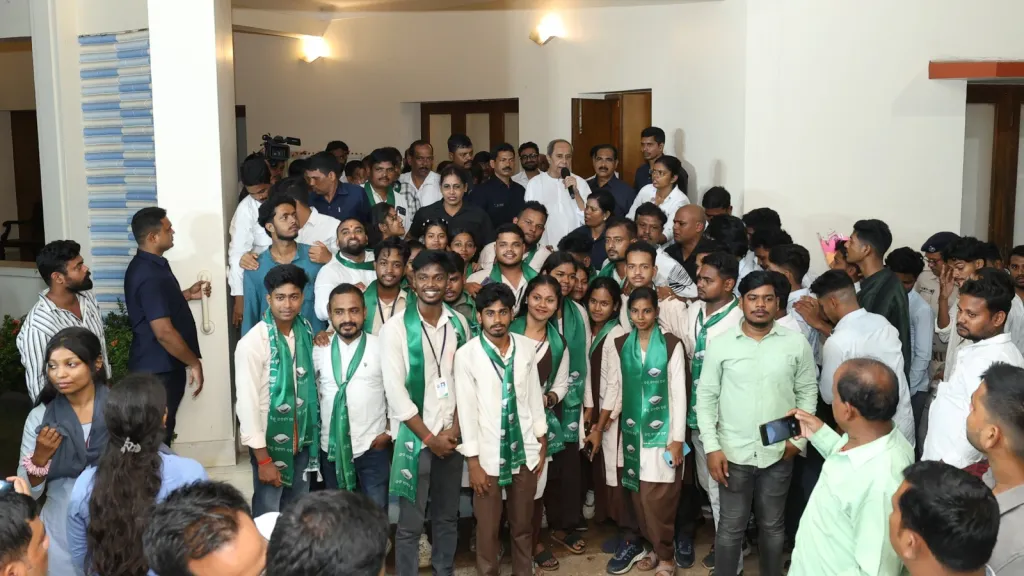
Odisha’s student union elections have emerged as a significant political contest between the ruling Bharatiya Janata Party (BJP) and the opposition Biju Janata Dal (BJD), with both parties claiming their student wings’ performances as evidence of their influence among young voters. The Akhil Bharatiya Vidyarthi Parishad (ABVP), affiliated with the Rashtriya Swayamsevak Sangh (RSS), won around 141 president posts across 337 colleges and universities, while the Biju Chhatra Janata Dal (BCJD), the BJD’s student wing, secured nearly 120. The Congress-affiliated National Students’ Union of India (NSUI) finished a distant third.
The results reflect a competitive campus political landscape rather than a decisive statewide mandate for either side. While ABVP secured seven of nine posts at Utkal University, BCJD swept the polls at Rama Devi Women’s University in Bhubaneswar. The contrasting outcomes highlighted the organisations’ varying strengths across institutions and the importance both the BJP and the BJD attach to connecting with Odisha’s younger generation.
Held for the first time in eight years, the elections took place more than two years after the BJP came to power in Odisha. The contest attracted unprecedented involvement from mainstream political parties, with senior leaders reportedly helping select candidates, coordinate campaigns and provide financial support. Party-coloured banners, prominent political slogans, campaign rallies and victory processions further illustrated how student elections have become intertwined with state politics.
Odisha Student Election Results: ABVP and BCJD Compete for Campus Influence
According to officials, ABVP won approximately 141 presidents’ posts across 337 government and aided colleges and state-run universities. BCJD secured around 120 posts, while NSUI won roughly 30. Independent candidates accounted for the remaining victories.
The state Higher Education Department has not released a consolidated party-wise tally, making the reported figures an important but incomplete picture of the overall results. The numbers also do not establish how students across Odisha view the BJP, BJD or Congress in state and national elections.
The direct contest between ABVP and BCJD nevertheless gave the elections broader political significance. The BJP sought to build on its position as the state’s ruling party, while the BJD attempted to demonstrate that its organisational network and Naveen Patnaik’s political appeal remained relevant among students after the party’s electoral setbacks in 2024.
For the Congress, NSUI’s relatively limited number of victories indicated that it remained behind the two principal competitors in this round of campus elections. However, student union results are shaped by institution-level organisation, candidate popularity and local concerns, and should not be treated as a direct measure of support in wider elections.
Why the Student Elections Matter to the BJP
The BJP had promised to restore student union elections in Odisha in its 2024 election manifesto. Their revival therefore became both a fulfilment of a political commitment and an opportunity for the party to strengthen its engagement with students through ABVP.
The elections also offered a platform for the ruling party to build relationships with young people who will become an increasingly important constituency in future state and national elections. Campus organisations can provide political parties with volunteers, local networks and opportunities to engage with students on education, employment and public policy.
Before the results, a strong ABVP performance could have helped the BJP reinforce its narrative of political expansion following its victories in Odisha’s 2024 Assembly and Lok Sabha elections. The final outcome, however, was more mixed: ABVP won the largest reported number of presidents’ posts, but BCJD also secured a substantial share.
A BJP insider cited in reports suggested that a sweeping ABVP victory could have been presented as evidence of a shift in younger voters’ support away from the BJD. With the results divided between the two organisations, neither party can reasonably claim that the elections delivered an unambiguous verdict on the political preferences of Odisha’s Gen Z population.
Mohan Charan Majhi Highlights Restoration of Campus Democracy
Chief Minister Mohan Charan Majhi defended the decision to revive the elections, accusing the previous BJD government of keeping student union polls suspended for political reasons.
In a post on X, Majhi said his government had fulfilled its promise to the student community by conducting the elections and restoring democratic participation on campuses. His statement framed the polls as an institutional commitment rather than merely a contest between rival student organisations.
The BJP’s position is that regular student elections give students a formal opportunity to choose their representatives and raise campus-related concerns. The BJD, meanwhile, questioned the fairness of the process and accused the ruling party of using its position to influence the outcome. Those allegations remain claims made by the respective political sides and should be distinguished from the declared election results.
Amit Shah Congratulates ABVP
Union Home Minister Amit Shah congratulated ABVP workers following the results, presenting the organisation’s performance as a sign of support for its national ideology.
In his post on X, Shah referred to ABVP’s reported successes in Punjab University, Delhi University and universities in Odisha. He described the results as evidence that young people supported the organisation’s emphasis on putting the nation first.
Shah’s remarks reflected the BJP’s effort to connect campus-level victories with its wider political message. However, the results across Odisha’s institutions were not uniform, and BCJD’s victories demonstrated that the BJD retained an organised presence among students despite its defeat in the 2024 state elections.
Naveen Patnaik and BJD Seek to Retain Support Among Young Voters
For the BJD, the elections were an opportunity to demonstrate that its political influence had not disappeared following its loss of power in Odisha in 2024. The party had traditionally maintained a strong presence on campuses through BCJD, and its performance in the latest polls gave it grounds to argue that it remained competitive among students.
BJD president and former chief minister Naveen Patnaik responded to the results by praising the students and party workers who participated in the elections. He also accused the BJP government of attempting to secure victories through unfair means.
In a post on X, Patnaik said the outcome reflected the dedication and unity of Odisha’s Gen Z, youth and student community. He commended BJD and BCJD leaders for opposing what he described as a government conspiracy to influence the elections, and called for efforts to preserve the academic environment and help students build a better future.
Patnaik’s response placed the emphasis on allegations of electoral unfairness and the continuing political relevance of the BJD. However, the BCJD’s performance cannot by itself establish that most young people in Odisha support Patnaik or his party. The results show that the organisation secured a considerable number of campus victories, not that students statewide delivered a uniform political verdict.
BJD Alleges Misuse of Government Machinery
BJD leaders accused the ruling BJP of using government machinery and police influence to help ABVP candidates. They also alleged that elections were cancelled in places where ABVP had a weak organisational presence.
BJD leader Bijay Nayak argued that the results demonstrated continued support for Patnaik among Gen Z and young people, despite what he described as attempts by the ruling party to influence the polls.
These allegations formed part of the political dispute surrounding the elections. Assessing them conclusively would require institution-specific evidence about the conduct of polling, the cancellation of elections and the actions of officials. The overall results alone do not establish whether either party’s allegations are correct.
For the BJD, the immediate political objective was to show that its defeat in the 2024 Assembly and general elections had not eliminated its grassroots presence. Its wins at several institutions, including Rama Devi Women’s University, provided a basis for making that argument, even as ABVP finished ahead in the reported statewide tally.
Campus Tensions Rise During Odisha Student Union Elections
The growing involvement of political leaders was accompanied by tensions at several campuses. Disputes over access to institutions, the declaration of results and the conduct of the elections brought student politics into the public spotlight.
A video showing senior BJD MLA Arun Kumar Sahoo confronting police outside a women’s college in his Nayagarh constituency circulated widely. Sahoo questioned the alleged presence of non-students on the campus, highlighting concerns about outside involvement in student elections.
At Rama Devi Women’s University in Bhubaneswar, BJD leaders, including a former minister, the city’s mayor Sulochana Das and two MLAs, staged a sit-in over delays in announcing the results. The protest drew attention to the high stakes attached to the election at one of the state capital’s prominent women’s institutions.
The delay was followed by a commotion and a scuffle between ABVP and BCJD supporters. Police struggled to bring the situation under control before the results were announced at approximately 2.40 am. BCJD subsequently swept the polls at the university.
Utkal University also witnessed tension over the timing of the results. The announcement came at around 2 am, hours after NSUI and other Congress leaders blocked a national highway to protest the delay.
These incidents illustrated how campus contests can become flashpoints when rival political organisations treat student elections as indicators of wider political strength. They also raised questions about maintaining a safe academic environment and ensuring that students can participate without intimidation or disruption.
Why Rama Devi and Utkal University Results Matter
The contrasting outcomes at Rama Devi Women’s University and Utkal University became prominent features of the election narrative because both institutions are important centres of higher education in Bhubaneswar.
ABVP’s victory in seven of nine posts at Utkal University gave the organisation a notable result at a major state institution. BCJD’s sweep at Rama Devi Women’s University, meanwhile, showed that the BJD’s student wing could still mobilise support effectively in at least some prominent campuses.
The two results underline the limitations of treating Odisha’s student elections as a single statewide political verdict. Campus-level outcomes can vary depending on candidates, student priorities, local organisational networks and the issues dominating individual institutions.
The results also demonstrate why both major parties invested substantial resources and senior leadership attention in the elections. A victory at a prominent university can provide visibility, help recruit new members and offer a platform to raise issues that resonate with students elsewhere.
Gen Z Concerns Extend Beyond BJP Versus BJD
Although political leaders framed the elections as evidence of their respective organisations’ influence, students’ choices may reflect a wider range of concerns than party loyalty alone. Issues such as employment opportunities, affordable education, examination schedules, campus facilities, safety, scholarships and the quality of university administration can shape student preferences.
Student union elections also offer young people an opportunity to assess how effectively candidates represent their immediate interests. A student may support a candidate because of a proposed campus initiative, an individual’s reputation or a local organisational connection without necessarily endorsing every position of the candidate’s parent political party.
For that reason, the number of presidents’ posts won by ABVP or BCJD should not be interpreted as a direct measure of how Odisha’s young population would vote in a state or national election. Student unions represent a specific campus electorate, and their results are influenced by factors that may differ from those shaping general elections.
The elections nonetheless provide both organisations with an opportunity to build political networks among young people. Their longer-term relevance will depend partly on whether elected student representatives address campus concerns and maintain credibility after the campaign period ends.
What the Results Mean for Odisha Politics
The reported tally gives ABVP the highest number of presidents’ posts, with BCJD close behind and NSUI trailing. This provides the BJP with a basis to highlight its student wing’s performance, while the BJD can point to its substantial number of victories and its success at prominent institutions.
Neither outcome settles the broader question of which party has greater support among Odisha’s Gen Z population. The elections were conducted at colleges and universities, and their results do not capture the views of all young people in the state, including those who are not enrolled in participating institutions.
The political significance of the results will also depend on how the parties respond. For the BJP, the challenge is to translate its student wing’s campus presence into sustained engagement with young people. For the BJD, maintaining its student network and demonstrating its ability to represent campus concerns will be important as it seeks to rebuild after its 2024 electoral defeat. NSUI’s performance leaves the Congress with a smaller reported share of victories in this contest.
The return of student union elections after an eight-year gap is itself significant. Regular and transparent polls can provide students with a platform to develop leadership skills, raise institutional concerns and hold their representatives accountable. Their value, however, depends on whether campuses remain focused on education and student welfare rather than becoming extensions of wider political confrontations.
Conclusion: A Competitive Contest, Not a Final Verdict on Gen Z
Odisha’s student union elections have revealed a close contest between ABVP and BCJD, with the BJP-affiliated organisation securing the largest reported number of presidents’ posts and the BJD’s student wing winning nearly as many. The results at Utkal University and Rama Devi Women’s University further illustrate the uneven distribution of support across institutions.
The BJP has highlighted the revival of student elections and ABVP’s performance, while Naveen Patnaik and the BJD have emphasised their student wing’s victories and raised allegations about the fairness of the process. Both parties have used the results to advance their broader political narratives.
Ultimately, the elections do not provide a definitive answer to whether Odisha’s students or Gen Z are more aligned with the BJP or Naveen Patnaik. They show that both political camps retain meaningful campus-level support. Whether that translates into lasting influence will depend on their ability to address students’ concerns, maintain credible organisations and deliver results beyond election campaigns.
For breaking news and live news updates, like us on Facebook or follow us on Twitter and Instagram. Read more on Latest India on thefoxdaily.com.





COMMENTS 0