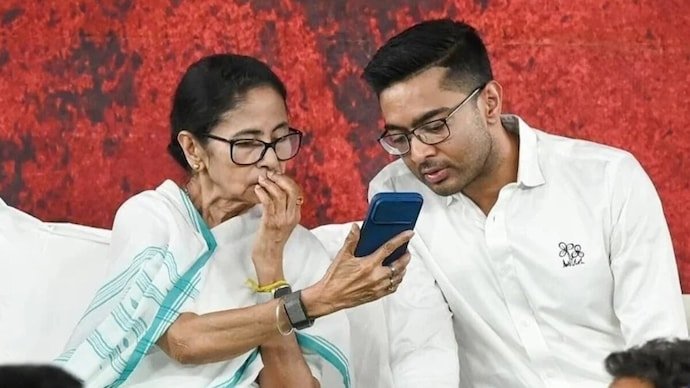
For the first time since coming to power in West Bengal in 2011, the Trinamool Congress (TMC) finds itself confronting an existential political challenge. Following a crushing defeat in the recently concluded West Bengal Assembly elections, party chief Mamata Banerjee is expected to attend the INDIA Bloc meeting in New Delhi on June 8 alongside General Secretary Abhishek Banerjee.
The meeting arrives at a pivotal moment not just for the opposition alliance but also for the future of the TMC itself. Once considered one of India’s most formidable regional political forces, the party is now battling electoral rejection, internal dissent, leadership questions, and an increasingly confident BJP government in Bengal.
While the official purpose of the INDIA bloc meeting is to discuss opposition strategy following recent elections across multiple states, for Mamata Banerjee it may serve a much larger objective: rebuilding political relevance after the most serious setback of her career.
The questions facing the TMC today are significant. Can the party prevent defections? Can Mamata Banerjee reinvent herself as a national opposition figure once again? And most importantly, can a party built around a single dominant leader adapt to a dramatically altered political reality?
The End of a Political Era in West Bengal
The recent Assembly election result represents a historic turning point in West Bengal politics.
For fifteen years, the TMC dominated the state’s political landscape. Under Mamata Banerjee’s leadership, the party successfully ended the Left Front’s decades-long rule and established itself as the principal political force in Bengal.
During that period, Mamata cultivated an image as both a grassroots fighter and a powerful regional leader capable of challenging national parties.
However, electoral dominance often creates its own vulnerabilities. Long periods in power can generate anti-incumbency sentiment, organizational complacency, factionalism, and growing public expectations.
The latest election appears to have exposed many of these weaknesses simultaneously.
Why the INDIA Bloc Meeting Matters More Than Ever
For most opposition parties, the upcoming INDIA bloc meeting is an opportunity to discuss strategy. For the TMC, it may be an opportunity to secure political oxygen.
The gathering will bring together leaders from major opposition parties at a time when questions are being raised about the future direction of anti-BJP politics in India.
Mamata Banerjee’s presence carries symbolic and strategic significance.
Symbolically, it signals that the TMC remains committed to national opposition politics despite losing power in Bengal.
Strategically, it allows the party to position itself as part of a broader coalition rather than appearing isolated following its electoral defeat.
For Mamata, the meeting also offers an opportunity to re-enter the national political conversation after a period dominated by state-level setbacks.
The Real Challenge: Internal Turmoil Within TMC
While political observers focus on electoral outcomes, the greater challenge may be unfolding within the party itself.
Reports of lawmakers skipping key meetings, speculation regarding defections, leadership disagreements, and public criticism from party insiders suggest that the TMC is facing a confidence crisis.
Political parties often survive electoral defeats. What proves more difficult is managing the internal consequences of defeat.
When a party remains in power, leaders generally stay united because access to political influence, resources, and opportunities remains intact. Once power is lost, dormant rivalries frequently emerge.
This appears to be the phase the TMC is currently navigating.
The Numbers Problem Facing the Party
One of the most concerning developments for the TMC leadership has been reports that a large number of legislators skipped a meeting called by Mamata Banerjee.
Although absences alone do not necessarily indicate rebellion, such incidents often serve as early warning signs of organizational instability.
Political history shows that major party splits rarely happen suddenly. Instead, they usually begin with growing dissatisfaction, reduced participation, public criticism, and informal faction-building.
Whether the TMC can prevent this process from accelerating may determine its future trajectory.
Mamata Banerjee’s Return to Street Politics
One of the most notable developments since the election defeat has been Mamata Banerjee’s decision to return to protest politics.
For much of her career, Mamata built her political identity as a street fighter willing to challenge powerful institutions through public mobilization.
Her recent protests indicate a deliberate effort to revive that image.
Political setbacks often force leaders to reconnect with their original strengths. In Mamata’s case, that strength has traditionally been direct engagement with supporters rather than conventional administrative politics.
The strategy may also help shift public attention away from internal party problems and toward broader political narratives involving democracy, opposition rights, and Governance.
The ‘Vote Manipulation’ Narrative and Opposition Politics
Mamata Banerjee’s allegations regarding electoral irregularities align with a broader narrative increasingly promoted by sections of the opposition.
Across multiple elections, opposition parties have raised concerns about voter rolls, electoral processes, campaign financing, and institutional neutrality.
The INDIA bloc meeting provides an ideal platform for these issues to be discussed collectively.
For the TMC, aligning its concerns with those of other opposition parties could help transform what appears to be a state-specific electoral defeat into part of a larger national Political Debate.
Whether this strategy succeeds depends largely on whether other opposition leaders choose to amplify the narrative.
How BJP Changed Bengal’s Political Landscape
The TMC’s current difficulties cannot be understood without examining the BJP’s rise in West Bengal.
For decades, Bengal politics was largely dominated by regional and Left-oriented forces. The BJP was considered a marginal player in the state.
Over the past decade, however, the party invested heavily in organizational expansion, grassroots outreach, and voter mobilization.
The recent election result suggests that this long-term strategy has fundamentally altered Bengal’s political structure.
| Political Factor | TMC Era | Current Situation |
|---|---|---|
| Political Dominance | TMC-led | BJP emergence as dominant force |
| Opposition Strength | Fragmented | Highly organized |
| Leadership Stability | Strong central control | Growing internal questions |
| Electoral Position | Incumbent advantage | Rebuilding phase |
The challenge for the TMC is no longer simply winning elections. It is adapting to an Environment where it no longer enjoys overwhelming political dominance.
The Abhishek Banerjee Question
Another crucial issue is the future role of Abhishek Banerjee.
For years, he has been viewed as the party’s most prominent next-generation leader and a potential successor to Mamata Banerjee.
However, electoral defeats often intensify scrutiny of leadership structures.
Questions regarding organizational strategy, candidate selection, campaign management, and future direction inevitably become more prominent after major losses.
How Abhishek navigates this period may significantly influence both his personal political future and the broader future of the TMC.
Why Regional Parties Across India Are Watching Closely
The developments within the TMC are not relevant only to West Bengal.
Regional parties across India face similar challenges:
- Dependence on charismatic leadership.
- Succession planning concerns.
- Expanding national parties.
- Changing voter expectations.
- The rise of social media-driven political campaigns.
The TMC’s response to its defeat could become a case study for other regional parties confronting similar pressures.
If the party successfully reorganizes and stages a comeback, it may offer a blueprint for political recovery. If it fails, it could serve as a warning about the risks of organizational over-centralization.
The Bigger Story: Is the INDIA Bloc Entering a New Phase?
Beyond the TMC’s immediate concerns, the upcoming meeting may reveal whether the INDIA bloc itself is evolving.
Opposition alliances often function differently when members are politically strong versus when they are politically vulnerable.
Parties suffering electoral setbacks generally become more dependent on coalition support, while stronger parties seek greater influence within alliance structures.
The balance of power inside the opposition ecosystem may therefore become one of the most important stories emerging from the June 8 meeting.
Mamata Banerjee’s political leverage within the alliance could depend significantly on how other leaders interpret the TMC’s current position.
Can TMC Stage a Political Comeback?
History suggests that writing off experienced political leaders is often a mistake.
Mamata Banerjee has repeatedly demonstrated resilience throughout her political career. She overcame powerful opponents, built a statewide movement, defeated entrenched political establishments, and governed Bengal for more than a decade.
However, political comebacks require more than determination.
They require organizational reform, leadership renewal, effective communication, coalition-building, and a compelling vision for the future.
The coming months will reveal whether the TMC is capable of undertaking that transformation.
Future Outlook
The June 8 INDIA bloc meeting may become one of the most important political events for the TMC since its electoral defeat.
It offers Mamata Banerjee an opportunity to rebuild alliances, strengthen opposition solidarity, and reposition the party within the national political conversation.
At the same time, the party must address internal dissatisfaction, prevent organizational fragmentation, and redefine its role in a post-defeat environment.
The road ahead will not be easy. But political history shows that periods of crisis often become moments of reinvention.
Conclusion
Mamata Banerjee’s expected participation in the INDIA bloc meeting comes at a moment when the Trinamool Congress faces its most serious challenge in fifteen years. Electoral defeat, internal unrest, questions over leadership, and a transformed political landscape have combined to create an unprecedented test for the party.
Yet the crisis also presents an opportunity. By leveraging opposition unity, reconnecting with grassroots politics, and addressing organizational weaknesses, the TMC may still find a path back to relevance.
The real significance of the upcoming meeting lies not merely in alliance discussions but in whether it marks the beginning of the TMC’s recovery or confirms the start of a prolonged period of political decline. The answer will shape not only the future of West Bengal politics but also the broader trajectory of opposition politics in India.
For breaking news and live news updates, like us on Facebook or follow us on Twitter and Instagram. Read more on Latest India on thefoxdaily.com.






COMMENTS 0