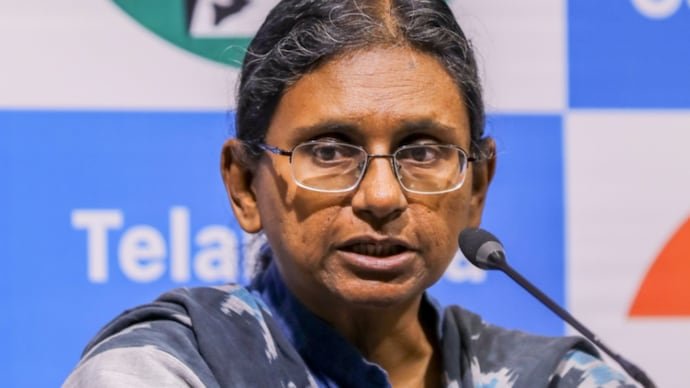
The rejection of Congress candidate Meenakshi Natarajan’s nomination for the Madhya Pradesh Rajya Sabha election has evolved from a procedural election dispute into a broader Political Controversy involving allegations of internal party rivalries, interstate political coordination, and competing narratives from the Bharatiya Janata Party (BJP) and Congress.
While the immediate issue concerns the validity of Natarajan’s nomination papers, the bigger political story revolves around a question that has generated intense speculation: how did the BJP obtain the documents it used to challenge the Congress leader’s candidature?
The answer offered by BJP sources has added a new dimension to the controversy. According to party insiders, several of the documents originated from Telangana rather than Madhya Pradesh, fueling speculation about possible divisions within the Congress and prompting strong denials from opposition leaders.
As both parties attempt to shape public perception, the episode has become a case study in how modern political battles increasingly involve not only electoral contests but also information networks, internal party dynamics, and strategic messaging.
What Triggered the Controversy?
The controversy began when the nomination of senior Congress leader Meenakshi Natarajan for the Rajya Sabha election in Madhya Pradesh was challenged.
Rajya Sabha nominations undergo detailed scrutiny to ensure candidates meet all legal and procedural requirements. Any discrepancy in documentation, declarations, or eligibility criteria can become grounds for objections during the scrutiny process.
In this case, BJP representatives raised objections based on documents and information that they claimed revealed issues within the nomination papers submitted by Natarajan.
The challenge ultimately escalated into a political confrontation after questions emerged regarding the origin of the documents used by the BJP.
Who Is Meenakshi Natarajan?
Meenakshi Natarajan is one of the Congress party‘s prominent national leaders and has held several important organizational positions over the years.
Known for her close association with the party leadership, she has been involved in organizational restructuring, political outreach campaigns, and election management efforts across multiple states.
Her political profile extends beyond Madhya Pradesh, where she has long maintained influence, making her nomination particularly significant for the Congress party.
As a result, any challenge to her candidature naturally attracts attention beyond state politics and becomes a matter of national interest within party circles.
BJP’s Claim: Documents Came from Telangana
According to BJP sources, the documents used to challenge Natarajan’s nomination were not sourced from Madhya Pradesh.
Instead, party insiders claim that key materials were obtained through the BJP’s network in Telangana.
A senior BJP functionary reportedly suggested that the information came through political channels connected to Telangana, though the identity of the individual or individuals involved has not been disclosed publicly.
The remarks have generated intense speculation because they appear to hint at the possibility that individuals with knowledge of internal Congress affairs may have contributed information that later became useful in challenging the nomination.
However, no concrete evidence supporting such claims has been publicly presented.
Why Telangana Has Become Central to the Debate
The Telangana connection has drawn attention because of reports of political tensions that have periodically surfaced within Congress circles in the state.
According to BJP sources, discussions regarding differences between Meenakshi Natarajan and Telangana Chief Minister Revanth Reddy have circulated within political circles on multiple occasions.
The speculation intensified after Congress leadership entrusted Natarajan with organizational responsibilities and outreach initiatives in Telangana.
Some political observers interpreted these assignments as evidence of the central leadership’s desire to obtain direct feedback regarding party organization and Governance performance in the state.
Whether such interpretations were accurate remains a matter of Political Debate, but BJP leaders have sought to connect these circumstances with the emergence of the documents used in the Rajya Sabha nomination challenge.
The Congress Response: A Political Diversion
The Congress has firmly rejected the BJP’s allegations and dismissed suggestions of internal sabotage.
Party leaders argue that the BJP is deliberately attempting to create a narrative of factionalism within the Congress to divert attention from more substantive questions surrounding the Rajya Sabha election.
Congress representatives contend that claims about internal divisions are politically motivated and designed to weaken public confidence in the party’s organizational unity.
According to Congress leaders, the focus should remain on the circumstances surrounding the nomination process itself rather than speculative theories regarding document sources.
The party has consistently maintained that allegations of internal betrayal are unsupported and intended to generate political controversy.
Why Internal Party Dynamics Matter in Elections
Even though no evidence has publicly confirmed the BJP’s claims, the controversy highlights a broader reality of Indian Politics: internal party dynamics often influence electoral outcomes as much as inter-party competition.
Large political organizations frequently contain multiple power centers, competing ambitions, and regional leadership structures.
These realities can create friction over:
- Candidate selection.
- Leadership appointments.
- Organizational control.
- Resource allocation.
- Electoral strategy.
- Future political succession.
As a result, allegations of internal leaks or political maneuvering often emerge during high-stakes elections, whether they are ultimately proven or not.
How Rajya Sabha Elections Differ from General Elections
The controversy has also brought renewed attention to the unique nature of Rajya Sabha elections.
Unlike Lok Sabha elections, where voters directly elect representatives, Rajya Sabha members are chosen by elected legislators in state assemblies.
| Lok Sabha Election | Rajya Sabha Election |
|---|---|
| Direct public voting | Elected by state legislators |
| National campaign focus | Assembly arithmetic is crucial |
| Mass voter participation | Indirect electoral process |
| Constituency-based contests | State-level representation |
Because Rajya Sabha elections often depend on legislative numbers and procedural compliance, nomination scrutiny becomes especially important.
Minor technical issues can sometimes become politically significant.
The Information War in Modern Politics
One of the most notable aspects of this controversy is the focus on information gathering.
Modern political competition increasingly extends beyond public campaigning and legislative debates.
Parties invest significant resources in:
- Research operations.
- Document verification.
- Legal scrutiny.
- Political intelligence gathering.
- Digital monitoring.
- Electoral compliance checks.
The debate over how the BJP obtained the documents reflects this evolving reality.
Political success today often depends not only on public support but also on organizational capacity to identify vulnerabilities and respond strategically.
Could the Controversy Affect Congress Internally?
Even if the allegations remain unproven, such controversies can create challenges for political organizations.
Rumors of internal divisions can sometimes become politically damaging regardless of their factual basis.
For Congress, maintaining unity remains particularly important as the party seeks to strengthen its position in several key states.
Any perception of factional conflict may distract from broader political objectives and provide opponents with opportunities to question organizational cohesion.
This explains why Congress leaders have moved quickly to reject the BJP’s narrative and emphasize party unity.
The Strategic Messaging Battle
At its core, the dispute is not merely about documents.
It is also about competing political narratives.
The BJP’s version suggests that information emerged because of internal dissatisfaction within Congress.
The Congress narrative argues that the BJP is manufacturing stories of factionalism to divert attention from questions about the electoral process.
Both parties are attempting to influence public perception by framing the controversy in ways that reinforce their broader political messaging.
This is a common feature of modern political communication, where controlling the narrative can be almost as important as winning the underlying argument.
Why This Story Matters Beyond One Nomination
Although the immediate issue concerns a single Rajya Sabha nomination, the controversy touches on larger themes in Indian politics.
It highlights:
- The growing importance of political intelligence networks.
- The role of organizational discipline within parties.
- The significance of procedural compliance in elections.
- The influence of interstate political relationships.
- The power of narrative-building in modern campaigns.
As political competition becomes increasingly sophisticated, such episodes offer insight into how parties operate behind the scenes and manage high-stakes electoral battles.
What Happens Next?
The future course of the controversy will depend on whether additional evidence emerges regarding the source of the documents and whether either party chooses to escalate the issue further.
If concrete proof supporting or disproving the allegations becomes available, the political narrative could shift significantly.
For now, the dispute remains largely a battle of competing claims.
Both BJP and Congress appear determined to defend their respective positions, ensuring that the issue continues to attract political attention beyond the immediate Rajya Sabha election.
Conclusion
The controversy surrounding Meenakshi Natarajan’s rejected Rajya Sabha nomination has evolved into a broader political story involving allegations of internal party divisions, interstate political networks, and strategic information gathering. BJP claims that crucial documents originated from Telangana have fueled speculation about Congress infighting, while Congress insists the allegations are an attempt to distract from larger electoral questions.
Regardless of where the documents ultimately came from, the episode underscores the increasingly complex nature of contemporary politics, where procedural disputes quickly transform into battles over perception, narrative, and organizational credibility.
As the political fallout continues, the controversy serves as a reminder that modern elections are often fought as intensely behind the scenes as they are in public view. In that sense, the debate over Meenakshi Natarajan’s nomination may reveal as much about the mechanics of political power as it does about the nomination itself.
For breaking news and live news updates, like us on Facebook or follow us on Twitter and Instagram. Read more on Latest India on thefoxdaily.com.






COMMENTS 0