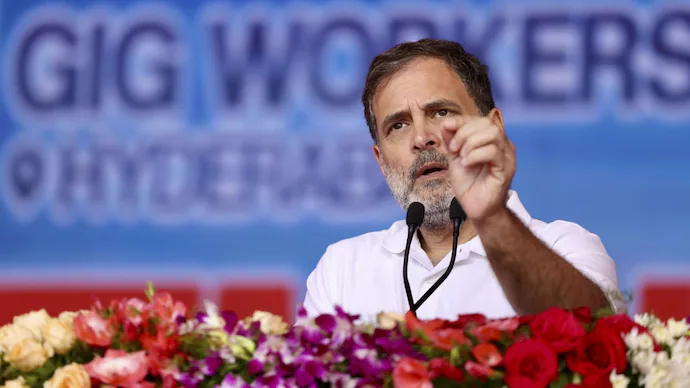
Congress leader Rahul Gandhi has turned the party’s strong performance in Rajasthan’s Panchayati Raj elections into a direct political challenge to the BJP, arguing that rural voters have rejected the ruling party’s record on farmers, employment, inflation and local self-government. The results, which placed the Congress well ahead of the BJP in both Panchayat Samiti and Zila Parishad seats, have given the opposition fresh ammunition against Chief Minister Bhajanlal Sharma’s government.
In a post on X on Friday, Gandhi thanked Rajasthan’s rural voters for backing the Congress and described the mandate as a responsibility for his party. He argued that people in villages had been watching the government’s decisions and were now expressing their dissatisfaction through the ballot box.
His remarks went beyond celebrating a local electoral victory. Gandhi sought to present the outcome as a broader verdict on the BJP’s governance, linking rural voting patterns to concerns over agricultural incomes, inflation, unemployment, migration and the authority of elected village institutions.
Rahul Gandhi Says Rural Voters Have Sent a Message to BJP
Gandhi’s criticism focused on what he described as the BJP’s failure to address the problems facing rural communities. He specifically accused the ruling party of attacking the Mahatma Gandhi National Rural Employment Guarantee Act (MGNREGA), pushing farmers into financial difficulties and taking powers away from panchayats.
Thanking voters for placing their confidence in the Congress, he said the party must now treat that support as a responsibility rather than simply an electoral achievement.
He also questioned the BJP’s claims about its performance under the ‘double-engine government’ model, pointing out that the party was in power in Rajasthan when the rural elections took place.
Gandhi’s message was that the election outcome reflected dissatisfaction with decisions affecting village economies and local administration. He also connected rising living costs and limited employment opportunities with migration from rural areas, arguing that these pressures had contributed to the political response.
By describing the Rajasthan result as the voice of villages across the country, Gandhi attempted to give the Congress’s gains a national dimension. However, the results are specific to local body elections in Rajasthan and should be distinguished from a statewide Assembly or parliamentary verdict.
Congress Leadership Sees Results as Warning for BJP
The Congress leadership reinforced Gandhi’s interpretation of the outcome, presenting the results as a warning to the BJP about the political consequences of ignoring public concerns.
Congress general secretary in-charge of communications Jairam Ramesh congratulated Rajasthan’s voters for extending strong support to the party in the Panchayati Raj elections.
The party argued that the outcome demonstrated that electoral support cannot be taken for granted, particularly when voters are concerned about everyday economic pressures and the functioning of local institutions.
For the Congress, the rural results offer an opportunity to challenge the BJP’s political position beyond major cities and urban constituencies. Panchayat elections are especially significant because they involve local representatives who are directly connected to village-level administration, public services and development priorities.
Congress Leads BJP by a Wide Margin in Panchayat Samiti Elections
The State Election Commission’s figures showed a substantial gap between the two principal parties in the Panchayat Samiti elections. The Congress won 3,701 seats, compared with 2,181 for the BJP, giving the opposition a lead of 1,520 seats in the results available on Friday evening.
The Congress also performed strongly in the Zila Parishad elections, securing 599 seats against the BJP’s 301. The difference of 298 seats further strengthened the party’s claim that it had made significant gains across Rajasthan’s rural political landscape.
The Congress finished ahead of the BJP in Panchayat Samiti seats in 33 of the 37 districts where counting was held. The BJP led in only four districts: Ajmer, Balotra, Salumber and Udaipur.
These figures provide the clearest indication of the scale of the Congress’s performance. The party’s advantage across most districts suggests that its gains were not confined to a single local pocket or constituency, although the final political picture remains subject to the completion of counting in the deferred districts.
Figures displayed on the State Election Commission website on Friday evening showed results for 7,393 of the 7,543 Panchayat Samiti seats. For Zila Parishads, results were available for 981 of the 1,275 seats.
Regional Parties and Independents Also Make Their Mark
Although the main political contest centred on the Congress and BJP, regional parties and independent candidates also secured a notable share of seats. Their performance indicates that Rajasthan’s rural electoral landscape remains competitive beyond the state’s two largest political parties.
The Rashtriya Loktantrik Party (RLP), led by Nagaur MP Hanuman Beniwal, won 496 Panchayat Samiti seats. The Bharat Adivasi Party (BAP) secured 276 seats, while the Bahujan Samaj Party (BSP) won 60 and the Communist Party of India (Marxist) secured 50. The Aam Aadmi Party won two seats.
Independent candidates collectively won 627 Panchayat Samiti seats, making them another significant presence in the local election results.
In the Zila Parishad elections, the RLP secured 37 seats and the BAP won 22. The BSP and CPI(M) won six seats each, while Independents secured 10 seats.
The performance of these parties and independent candidates matters because local elections often reflect regional identities, community-level issues and candidate networks that do not always follow the same political patterns as state or national elections.
BJP Minister’s Family Suffers Setback in Sikar
The results also attracted attention because of defeats involving the family members of prominent BJP leaders. In Sikar, the wife and two sons of Rajasthan Urban Development and Housing Minister Jhabar Singh Kharra lost their respective Panchayat Samiti elections.
Shanti Devi contested from ward 17 as a BJP candidate, while Ajay Singh entered the contest from ward 20. Kharra’s other son, Durga Singh, contested independently from ward 19. All three candidates were defeated.
The outcome was politically significant because it involved candidates connected to a serving minister. However, the defeats should be viewed as individual constituency results rather than proof of a uniform rejection of every BJP leader or candidate in the district.
In Churu, the electoral fortunes of another prominent BJP family moved in the opposite direction. Former minister and senior BJP leader Rajendra Rathore’s son, Parakram Singh Rathore, won Zila Parishad ward 39 by 17,861 votes. His daughter-in-law, Kanika Singh, also secured victory from ward 23, with a margin of 2,384 votes.
The contrasting outcomes in Sikar and Churu underline how local political contests can produce different results even for candidates associated with influential political families.
Results Put Pressure on Bhajanlal Sharma Government
The Congress’s lead across most of the districts where counting took place represents a political setback for the BJP government led by Chief Minister Bhajanlal Sharma. The government is approaching its third anniversary in December, giving the opposition an opportunity to use the rural results to question its performance.
For the BJP, the outcome raises questions about its ability to maintain support among rural voters, particularly on issues involving agriculture, employment, prices and village-level development. The Congress is likely to use the results to argue that the concerns raised by rural communities have not been adequately addressed.
Nevertheless, Panchayati Raj elections have a different political character from Assembly elections. Candidates often depend on local recognition, community relationships, development records and village-level networks. The results therefore offer an important indication of political sentiment but do not automatically predict the outcome of the next state election.
The BJP’s performance in the four districts where it finished ahead in Panchayat Samiti seats also shows that its rural support has not disappeared across Rajasthan. The broader picture is one of a strong Congress performance alongside continuing regional differences.
Why MGNREGA and Panchayat Autonomy Are Central to the Political Debate
Gandhi’s reference to MGNREGA places rural employment policy at the centre of the Congress’s response to the election results. The employment guarantee programme has long been an important part of India’s rural welfare framework, providing eligible rural households with a legal guarantee of wage employment through public works.
For rural communities, the programme is connected not only to income support but also to the availability of work close to home. Its implementation can influence household finances, seasonal migration and the ability of vulnerable families to manage periods when agricultural employment is limited.
The Congress’s criticism suggests that it wants to make rural employment and the future of MGNREGA major political issues in Rajasthan. The BJP’s response to these allegations will be important in determining how the debate develops, particularly as the government faces questions about rural economic conditions.
Gandhi also raised the issue of panchayat powers. Elected panchayats are responsible for important aspects of local governance, including village development planning and the implementation of public programmes. Their authority and financial resources can directly affect how effectively local needs are addressed.
By combining the issues of employment, farmers’ distress and local self-government, the Congress is attempting to connect its electoral performance with a wider argument about rural development and democratic participation.
Counting Deferred in Four Rajasthan Districts
The elections covered 7,543 Panchayat Samiti seats and 1,275 Zila Parishad seats across 37 of Rajasthan’s 41 districts. However, the counting process was not completed across all districts at the same time.
Counting in Kota, Baran, Karauli and Sri Ganganagar has been deferred until December 17. The State Election Commission said the decision was linked to the approaching end of the five-year terms of the existing Zila Parishads and Panchayat Samitis in these districts, which expire next month.
The scale of participation was considerable. According to the SEC, 4,069 candidates contested the 1,275 Zila Parishad wards, while 25,108 candidates were in the contest for 7,543 Panchayat Samiti wards across 419 Panchayat Samitis in the 37 districts.
Across all 41 districts, the election framework covered 1,403 Zila Parishad wards and 8,245 Panchayat Samiti wards across 457 Panchayat Samitis.
The deferred counting means the available figures do not yet represent the complete result across the state. The December 17 counting process will provide a fuller picture of the political balance in the four remaining districts.
What the Rajasthan Rural Election Results Mean for Congress and BJP
The Congress’s strong lead gives the party an opportunity to rebuild its political narrative around rural concerns and challenge the BJP’s claim to broad support in Rajasthan. Its performance in 33 of the 37 districts where Panchayat Samiti counting was held is particularly important because it demonstrates an advantage across a wide geographical area.
For Rahul Gandhi, the results offer a platform to connect local electoral gains with national issues such as rural employment, agricultural distress, inflation and the powers of local governing bodies. His remarks indicate that the Congress intends to use the Rajasthan outcome as part of a wider political campaign focused on the condition of India’s villages.
The BJP, meanwhile, will have to assess why it fell behind the Congress across most districts and whether local organisational weaknesses, candidate selection or voter dissatisfaction contributed to the outcome. The party’s performance in the four districts where it led shows that the political picture is not uniform, but the overall seat gap presents a challenge.
The final assessment will become clearer after counting in the four deferred districts. Until then, the results available from the 37 districts have given the Congress a significant rural electoral advantage and strengthened its challenge to the BJP government in Rajasthan.
For breaking news and live news updates, like us on Facebook or follow us on Twitter and Instagram. Read more on Latest India on thefoxdaily.com.






COMMENTS 0