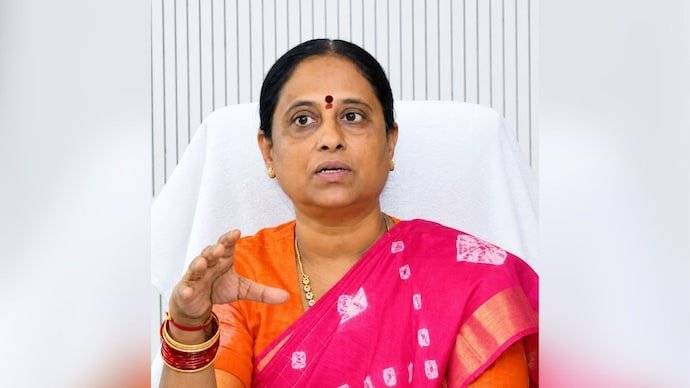
Telangana Chief Minister A Revanth Reddy has emerged politically stronger after the Congress high command backed his decision to remove Konda Surekha from the state cabinet, bringing a prolonged internal dispute to a decisive end.
Surekha, a senior Congress leader and five-time MLA from the Warangal region, was dropped from the council of ministers on September 3 after the state Congress disciplinary machinery recommended action against her. The dispute intensified after her daughter, Konda Sushmita Patel, publicly challenged Reddy over the Parakala Assembly constituency and made remarks that the party considered objectionable.
Reddy subsequently recommended Surekha’s removal, and the Governor approved the decision. Surekha will remain an MLA and has said she intends to continue serving her constituency.
The episode has become more than a dispute between two Congress leaders. It is a test of Reddy’s authority over a state unit that includes veterans with independent political bases, leaders who have crossed party lines in the past and influential figures with competing ambitions ahead of the next assembly election.
The decision also leaves the chief minister with three cabinet vacancies to fill, creating a new political contest over representation, loyalty, caste equations and regional balance within the Telangana Congress.
Why Konda Surekha fell out with Revanth Reddy
Surekha’s relationship with Reddy had been under strain for some time, but the immediate trigger was the emerging contest over the Parakala Assembly seat.
Reddy publicly endorsed MLA Revuri Prakash Reddy’s candidature from Parakala for the 2028 Assembly election during a visit to the constituency. The announcement angered the Surekha family because her daughter Sushmita Patel and her husband, former MLC Konda Murali, have been projecting her as a potential Congress candidate from the seat.
Surekha herself had represented Parakala earlier, between 2009 and 2012, before moving into other political contests in the Warangal region.
Reddy’s endorsement was therefore interpreted by the Surekha camp as a message that the chief minister intended to control the party’s candidate-selection process well ahead of the election.
Sushmita responded with sharply worded criticism of the chief minister and challenged the leadership over the constituency. Her remarks went beyond an ordinary intra-party disagreement and turned the dispute into a direct challenge to Reddy’s authority.
That escalation ultimately made it difficult for the state leadership to treat the episode as simply a family-level disagreement.
How the Parakala controversy escalated
The Parakala dispute initially involved a local question over who should contest the seat in the next Assembly election. It quickly became a broader confrontation over who controls political space inside the Telangana Congress.
Sushmita Patel said she would contest from Parakala regardless of who stood against her and challenged the chief minister’s authority in unusually direct terms.
The Congress leadership took exception to those remarks. What made the situation more damaging for Surekha was that she and her husband did not publicly disown their daughter’s statements.
They argued that Sushmita was an adult and entitled to express her own opinion. From the perspective of the party organisation, however, the issue was not only about who had made the remarks. It was about whether a sitting minister and her family were openly challenging the authority of the chief minister and the party leadership.
The Telangana Pradesh Congress Committee’s disciplinary mechanism eventually recommended strong action.
A show-cause notice was issued to Surekha on August 19. The state disciplinary committee later recommended that she be removed from the cabinet after considering her response.
The matter was then taken to the Congress high command in New Delhi.
Reddy’s Delhi negotiations ended the uncertainty
Both Reddy and Surekha travelled to Delhi as the dispute moved from the state unit to the national leadership.
Surekha made several attempts to present her case to senior Congress leaders. She had also met Congress president Mallikarjun Kharge earlier and sought political intervention.
Her outreach included a personal gesture toward Reddy. On August 28, she visited the chief minister’s residence during Raksha Bandhan and tied him a rakhi, but the attempt did not prevent the eventual cabinet action.
The significance of the Delhi meetings was that the dispute was no longer simply a matter for the Telangana Congress organisation. The high command had to decide whether Reddy’s authority should be backed or whether Surekha should be given greater protection as a senior Backward Classes leader.
The final outcome clearly favoured the chief minister.
Reddy maintained that the decision of the high command would be final. Once the party leadership gave its approval, he recommended Surekha’s removal from the cabinet, and the Governor subsequently approved it.
Surekha says she was not given a chance to resign
After her removal, Surekha challenged the manner in which the decision was taken.
Speaking to the media, she said she had not been asked to resign and questioned how she could have stepped down voluntarily.
She also accused Reddy of influencing the Congress high command and argued that she had not been given an adequate opportunity to explain her position before the decision was made.
Surekha has nevertheless indicated that she will remain with the Congress and continue working as an MLA.
Her response means the cabinet dispute may be over, but the underlying political tension may not disappear immediately.
She retains an electoral base in Warangal East and has a long political history across multiple parties. That makes her more than a former minister without an organisational platform.
Who is Konda Surekha?
Konda Surekha is a veteran politician from the Warangal region and a prominent leader from the Backward Classes community.
She has represented three Assembly constituencies over the course of her career: Shayampet, Parakala and Warangal East. She was first elected from Parakala in 2009 in undivided Andhra Pradesh.
She entered the Congress government led by Y S Rajasekhara Reddy and served as minister for women development and child welfare.
After YSR’s death, Surekha left the Congress and joined the political movement led by his son, Y S Jagan Mohan Reddy. She later left the YSR Congress Party, citing differences, and joined the Bharat Rashtra Samithi, then known as the TRS.
She won the Warangal East seat on a BRS ticket in 2014.
In 2018, she returned to the Congress. Five years later, she became a minister in the Congress government formed after the 2023 Telangana Assembly election.
Her political journey across the Congress, YSRCP and BRS demonstrates both her electoral resilience and her willingness to challenge established party arrangements when she believes her political interests are being threatened.
Why her challenge was different this time
Reddy has previously managed disagreements with powerful leaders inside the Telangana Congress.
One example is Komatireddy Venkat Reddy, another influential figure who has had differences with the chief minister but remains part of the broader Congress power structure.
The Surekha dispute became more difficult because it involved a direct challenge over a future Assembly ticket and public criticism from a close family member.
Party leaders could potentially tolerate internal lobbying over candidate selection. An open challenge to the chief minister’s authority is considerably harder to accommodate, particularly when the leader making or supporting the challenge is a sitting cabinet minister.
The Congress disciplinary committee ultimately treated the episode as a matter of organisational discipline rather than merely a personal disagreement.
That distinction allowed Reddy to frame the action as an institutional decision rather than a personal political vendetta.
Why Surekha’s OBC identity matters politically
Surekha’s removal has also generated discussion about caste representation within the Telangana Congress.
She is a prominent OBC leader, and some party figures have questioned whether action against her could have political consequences among Backward Classes voters.
The issue is important because Telangana’s political competition is not based solely on party identity. Caste, region, community networks and individual leaders can all influence electoral outcomes.
Reddy therefore has to balance two objectives at once: maintain discipline within the party while ensuring that politically important social groups continue to feel represented.
The chief minister’s response appears to be partly visible in the changes announced alongside Surekha’s removal.
Other BC leaders have received important organisational or government positions, including Gadwal Vijayalakshmi’s appointment as Telangana Planning Board vice-chairperson, Nerella Sharada’s elevation in the Women’s Commission and G Sudha Rani’s appointment to the Kakatiya Urban Development Authority.
These moves do not erase the political significance of Surekha’s exit, but they show the leadership is also paying attention to representational balance.
Chinna Reddy also loses his Planning Board post
The Surekha episode was accompanied by another significant organisational decision.
Senior Congress leader G Chinna Reddy was removed as vice-chairman of the Telangana Planning Board, with his appointment rescinded with immediate effect.
Gadwal Vijayalakshmi was named his replacement.
Chinna Reddy is an experienced Congress leader and former minister in united Andhra Pradesh. His removal therefore carried significance beyond the immediate disciplinary controversy.
The party said the action was connected to controversial remarks and disciplinary concerns. His exit from the Planning Board added to the impression that Reddy and the state Congress leadership were trying to establish tighter control over dissent within the organisation.
At the same time, the reshuffle created an opportunity to promote leaders from different political and social backgrounds.
Reddy now has three cabinet berths to fill
With Surekha out of the cabinet, Reddy has to make decisions on three ministerial vacancies.
Two of the vacancies had already existed for some time, meaning several leaders are likely to compete for promotion.
The appointments will not be straightforward.
The chief minister must consider regional representation, caste balance, seniority, electoral strength, factional loyalties and the need to maintain a working relationship between the state government and the Congress organisation.
Every cabinet appointment also changes the internal balance of power. A minister with strong grassroots support can become a valuable electoral asset but can also develop an independent political base.
After the experience with Surekha, Reddy is likely to be particularly conscious of loyalty and discipline when making the next appointments.
Why the next cabinet appointments are politically important
Reddy’s choices could reveal how he intends to shape the Congress government for the remainder of its current term.
The party won the 2023 Assembly election after defeating the BRS and ending its long period in power. The government now needs to maintain internal cohesion while delivering on its promises and preparing for the next election.
Cabinet expansion can be used to reward loyal leaders, bring influential groups into the administration and strengthen the party’s organisation in regions where the Congress needs improvement.
It can also be used to build new political alliances inside the party.
For that reason, the three vacant positions are likely to attract intense lobbying from MLAs and their supporters.
The Congress high command has backed Reddy’s authority
The most important political outcome of the Surekha episode may be what it says about the relationship between the Telangana chief minister and the Congress high command.
Reddy was able to take the issue to Delhi, maintain his position and secure approval for the removal of a sitting minister.
That represents an important affirmation of his authority within the party.
The decision also sends a message to other leaders who may be considering public dissent: disagreements over policy and political strategy can exist, but direct challenges to the chief minister and party discipline carry consequences.
That is particularly relevant in a state Congress unit where several leaders have independent political histories and where internal competition is intense.
Reddy appears to have concluded that allowing the Surekha confrontation to continue would create a precedent that could weaken his authority further.
Surekha’s political career shows why this is not the end
Although Surekha has lost her cabinet position, she has not lost her electoral mandate.
She remains the elected MLA from Warangal East and has said she intends to continue representing the constituency.
Her history suggests that she has repeatedly rebuilt her political career after difficult periods.
She moved from the Congress to the YSRCP, then to the BRS and eventually returned to the Congress before becoming a minister in 2023.
That record makes it difficult to assume that her removal from the cabinet will automatically end her influence.
Much will depend on whether she reconciles with the state leadership, continues to challenge Reddy from within the Congress or develops an independent political strategy.
For now, she has not announced plans to leave the party.
The Parakala seat could remain a flashpoint
The dispute over Parakala is unlikely to disappear simply because Surekha has been removed as a minister.
Reddy has already indicated support for Revuri Prakash Reddy as the likely Congress candidate, while the Konda family continues to see Sushmita Patel as a potential claimant.
Candidate selection will ultimately be decided by the Congress leadership closer to the 2028 Assembly election, but the disagreement has exposed a larger struggle over who controls the party’s local political machinery.
If the family continues pushing Sushmita’s candidacy, the issue could resurface later.
The chief minister will therefore have to manage the constituency carefully while preventing a local ticket dispute from again becoming a statewide leadership confrontation.
What the episode means for Telangana Congress
The Konda Surekha episode reveals both the strength and the vulnerability of the Telangana Congress government.
On one side, Reddy has demonstrated that he can secure the high command’s backing and remove a dissenting minister.
On the other, the fact that such a dispute escalated so publicly shows that the party continues to contain competing centres of influence.
Managing those leaders will be one of Reddy’s biggest organisational challenges.
The chief minister cannot simply remove every leader who disagrees with him. Strong regional figures are also necessary for elections, government administration and party mobilisation.
The real test will be whether Reddy can maintain discipline without creating a wider backlash among groups that feel their leaders are being sidelined.
Why the next phase may be more important than Surekha’s exit
The removal itself has now been completed. The more important political question is what Reddy does next.
His cabinet appointments will reveal which leaders he trusts and which social and regional constituencies he wants to strengthen.
The restructuring of associated posts will also shape the balance inside the Telangana Congress.
At the same time, Surekha’s continued role as an MLA means her political voice has not disappeared.
If she chooses to cooperate with the party leadership, the dispute could eventually settle into an uneasy political truce. If she continues to challenge Reddy or mobilises support around caste or regional grievances, the episode could become the beginning of another factional contest.
A warning to dissenters and a test for Reddy
Konda Surekha’s removal sends a clear message about the current balance of power in the Telangana Congress.
Public challenges to Revanth Reddy’s leadership, particularly from within the cabinet, are unlikely to be tolerated when they are seen as undermining party discipline or the chief minister’s authority.
The Congress high command’s approval has strengthened that message.
But the decision also places greater responsibility on Reddy. Having asserted his authority, he now has to use it carefully.
The next cabinet appointments will be scrutinised for evidence of factional favouritism, regional balance and social representation. His handling of Surekha after her removal will also influence whether the conflict remains contained or develops into a larger rebellion.
For the moment, the immediate winner is clearly Reddy. He has secured the backing of the Congress high command and removed a minister who had become a source of internal conflict. The harder task is what comes after that victory.
Three cabinet berths must now be filled, competing leaders will demand recognition and the Congress must prepare for the next electoral cycle while keeping its internal factions together.
Surekha may have lost her ministerial position, but she remains an elected MLA with a long record of political survival. That means the episode is best understood not as the end of her political career, but as a significant setback in her ongoing contest for influence within Telangana Congress.
For Revanth Reddy, the episode has delivered an important political lesson as well: asserting authority can settle one rebellion, but keeping a diverse and ambitious state party united requires constant negotiation. The next Cabinet Reshuffle may show whether he can convert the backing he received in the Surekha episode into a more stable political command.
For breaking news and live news updates, like us on Facebook or follow us on Twitter and Instagram. Read more on Latest India on thefoxdaily.com.





COMMENTS 0