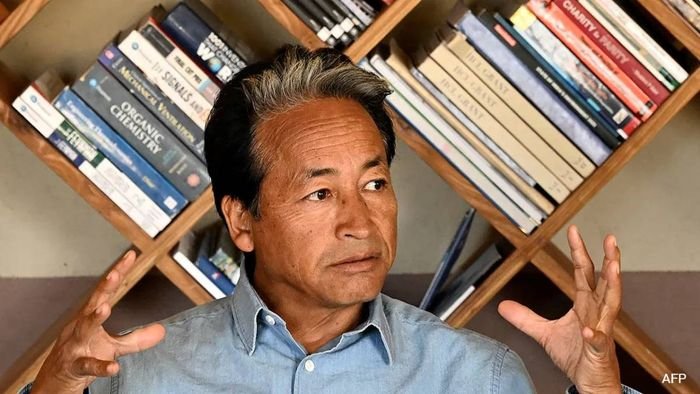
Climate activist and educationist Sonam Wangchuk has appealed to President Droupadi Murmu for urgent intervention in Ladakh, alleging that the Union Territory’s administration is conducting a coordinated smear and defamation campaign against him and other critics. His appeal has intensified an ongoing dispute over governance, democratic safeguards, land policies and the functioning of educational institutions associated with him.
In a video message shared on social media platform X on November 7, Wangchuk accused the administration led by Lieutenant Governor Vinai Kumar Saxena of using official influence and resources to discredit people raising concerns about Ladakh’s future. He also questioned restrictions on public expression and alleged that local institutions were facing administrative pressure.
The appeal follows a series of controversies involving the Himalayan Institute of Alternatives, Ladakh (HIAL), which Wangchuk founded with his wife, Gitanjali J Angmo. These include the cancellation of the institute’s land allotment in August 2025, a recent direction concerning its Desert Flower School and a separate labour dispute involving allegations of unpaid maternity benefits.
The Ladakh administration had not issued an immediate response to Wangchuk’s latest allegations at the time of his appeal. The allegations concerning an online campaign and the purported sting recording have not been independently established.
Wangchuk asks President Murmu to intervene
In his message to President Murmu, Wangchuk raised concerns about the political and administrative situation in Ladakh, arguing that residents of the Union Territory should enjoy the same democratic rights and constitutional protections as people elsewhere in India.
He alleged that the Lieutenant Governor-led administration had created an environment in which criticism of government decisions could lead to police action. According to Wangchuk, even social media comments and likes had resulted in FIRs and arrests.
He also questioned the extent of democratic representation available to Ladakh’s residents. Since Ladakh became a separate Union Territory in October 2019, local groups have repeatedly demanded stronger constitutional safeguards, elected legislative powers and greater control over decisions affecting land, employment and natural resources.
Wangchuk urged the President to ensure justice and equal rights for people living in strategically important border regions, specifically mentioning Ladakh and Arunachal Pradesh. His appeal connected the region’s governance concerns with the broader question of protecting the interests of communities living along India’s international borders.
The activist has been associated with the movement seeking Sixth Schedule protections and statehood for Ladakh. These demands have become central to discussions between local representatives and the Union government over the region’s political future.
What Wangchuk alleges about the purported sting operation
A major part of Wangchuk’s latest appeal concerns a recording that he described as the result of a sting operation conducted by his lawyers. He alleged that a creative agency connected to two social media pages had been involved in efforts to target him online while promoting the work of the Lieutenant Governor.
According to Wangchuk, two Facebook and Instagram pages named ‘Ladakh Lens’ and ‘Ladakh Vision’ appeared on October 14. He said their emergence, one day after Saxena made remarks about him at the India Today Conclave in Mumbai on October 13, prompted his legal team to investigate their origins.
Wangchuk alleged that the two pages had been created by the same creative agency. He said their similar appearance and timing raised questions about whether they were part of a coordinated effort to shape public opinion against him.
The video shared by the activist includes excerpts of a conversation between his lawyers and a person they described as the alleged owner of the creative agency. During the exchange, the individual reportedly discusses possible connections with the Lieutenant Governor’s team, offers to facilitate contacts in Ladakh and refers to a Pune-based company involved in handling the work.
Wangchuk interpreted the conversation as evidence pointing towards the involvement of people connected to the administration in online campaigns against its critics. He further alleged that public resources were being used to damage the reputation of Ladakhi leaders.
However, the recording does not by itself establish the identity of the person speaking, the authenticity of the alleged agency’s connections or whether the Lieutenant Governor’s office authorised any campaign. The claims would require independent verification, including examination of the original recording, the people involved and any relevant financial or administrative records.
Wangchuk said he had initially shared material from the purported sting operation with a senior official in the Union Home Ministry and sought intervention. He claimed that communication with the official stopped after a few exchanges.
He added that he had been reluctant to make the recording public because of concerns about its possible impact on the country’s dignity and morale. According to him, only selected excerpts had been released, while additional material was being withheld from Lok Niwas for the time being.
Dispute follows Saxena’s criticism of Wangchuk
The allegations come against the backdrop of an increasingly public disagreement between Wangchuk and Lieutenant Governor Vinai Kumar Saxena.
At the India Today Conclave in October, Saxena questioned Wangchuk’s environmental work and criticised some of his statements about Ladakh. The Lieutenant Governor said the activist had not provided satisfactory answers when asked what he had done to protect the region’s climate and environment.
The disagreement also involved the administration’s Sindhu Jal Samriddhi Abhiyan, which includes the construction of rock check dams along the Indus and its tributaries. Saxena had promoted the structures as environmentally friendly because they did not use cement, concrete or steel.
Wangchuk, however, expressed concern that constructing such structures across the river system could have long-term ecological consequences. He argued that local communities had reservations about the initiative and questioned whether the environmental impact had been adequately considered.
The exchange illustrates a wider disagreement over how Ladakh should manage its fragile mountain ecosystem, water resources and development priorities. The region faces growing environmental pressures, including water scarcity, changing weather patterns, glacier-related risks and the effects of expanding infrastructure.
These issues have also shaped Wangchuk’s public activism. His work has frequently focused on sustainable development, education and climate adaptation in the Himalayan region.
HIAL land cancellation remains at the centre of the dispute
The latest appeal also comes amid a prolonged legal and administrative dispute involving the Himalayan Institute of Alternatives, Ladakh.
In 2018, HIAL was allotted approximately 1,076 kanals and one marla of land at Phyang Thang near Leh for a proposed 40-year lease. The land was intended for the development of an alternative educational institution focused on sustainable development and the challenges facing mountain communities.
On August 21, 2025, the Ladakh administration cancelled the land allotment. It cited the institute’s alleged failure to complete the lease formalities, execute the lease deed and pay the required premium within the stipulated period. The administration also questioned whether the land had been used for its intended purpose, including the establishment of a recognised university.
The administration maintained that the original allotment was conditional and that the required conditions had not been fulfilled within the specified period. It argued that the allotment had lapsed and that the land should revert to the authorities.
Wangchuk and Angmo have disputed this explanation. They have attributed the delay in completing the lease arrangement to bureaucratic obstacles, arguing that the administration had not finalised the necessary lease policy despite repeated communications from HIAL.
Angmo has said the institute applied for execution of the lease deed shortly after the original allotment and repeatedly followed up with the authorities. She has also referred to earlier communications that, according to her, acknowledged administrative delays and allowed construction work to continue.
HIAL challenged the cancellation before the High Court of Jammu and Kashmir and Ladakh. The legal dispute remains significant because the institute’s future activities and the use of the allotted land are linked to the outcome of the proceedings.
The administration has also defended its decision in court, arguing that the institute did not fulfil the conditions attached to the allotment. The competing positions mean that the underlying land dispute remains a matter for judicial consideration rather than an issue settled by either side’s public statements.
Fresh notice over Desert Flower School activities
The dispute escalated again in November when the administration directed HIAL to refrain from undertaking further activities connected with the functioning of its Desert Flower School at Phyang.
A notice issued through the Leh Tehsildar on November 1 referred to the pending proceedings before the High Court and instructed the institute to maintain the status quo. The administration said it had received information that classes and other activities had begun without the required consent, clearances or approvals from the relevant authorities.
The notice advised HIAL not to take further steps towards operating the school until the court delivered its decision or issued additional directions. The administration argued that activities undertaken while the land dispute remained pending could affect the proceedings.
Wangchuk and Angmo have described the action as another instance of administrative harassment. They have argued that the school was developed to address local educational needs and that the authorities had been aware of the institute’s plans.
Desert Flower School is part of HIAL’s wider educational ecosystem. The institute has promoted an approach focused on practical learning, local challenges and sustainable development rather than relying exclusively on conventional classroom education.
The dispute raises questions about the relationship between pending land proceedings, regulatory approvals and the functioning of educational institutions. The administration maintains that the legal process must be respected, while HIAL argues that administrative delays have prevented it from completing the necessary formalities.
The High Court’s eventual decision will be important in determining the legal position surrounding the land allotment and the activities that can take place on the disputed property.
Labour Court reserves order in maternity benefits case
Another issue involving HIAL emerged on November 7, when the Labour Court in Leh reserved its order in a case concerning allegations of unpaid statutory maternity benefits and unfair treatment of a former employee.
The complaint was filed by Amina Khatoon, who reportedly joined HIAL in 2023. She alleged that the institute withheld 26 weeks of maternity benefits after she gave birth in 2024, despite her submitting the required medical and delivery documents.
Khatoon also alleged that her official email account was deactivated and that she was removed from workplace communication groups shortly after childbirth. She further claimed that the institute did not clearly communicate her employment or rejoining status and withheld her experience certificate, affecting her subsequent employment prospects.
The case was registered before the labour authorities in Leh on June 27, 2026. The proceedings involved claims under the relevant wage and maternity benefit laws.
Notices were issued to HIAL’s chief executive officer, Gitanjali Angmo, and other representatives during the proceedings. Reports on the case said the institute’s representatives appeared at one hearing but did not attend several subsequent proceedings. The authority had provided further opportunities for their appearance before listing the matter for final orders.
The Labour Court’s decision is separate from the land and school disputes involving HIAL. The allegations made by the former employee should not be treated as established findings unless supported by the court’s final order.
The case has added another layer of scrutiny to an institution already involved in a high-profile disagreement with the Ladakh administration. Its outcome will determine the legal position on the employee’s claims and any benefits or relief that may be ordered.
Wangchuk questions Ladakh’s land, power and tourism policies
Beyond the allegations of a smear campaign, Wangchuk used his appeal to criticise several policies introduced or pursued by the Ladakh administration.
He alleged that decisions concerning land, industry, electricity and tourism were increasingly favouring corporate interests rather than protecting the needs of local communities. His concerns reflect a wider debate about how development should be managed in a region with limited natural resources and a distinctive cultural and ecological environment.
Land ownership and access are particularly sensitive issues in Ladakh. Local organisations have argued that constitutional safeguards are necessary to protect traditional land rights, employment opportunities and the region’s demographic and cultural identity.
Supporters of stronger protections say that decisions about large infrastructure projects, industrial development and tourism should involve meaningful participation from local communities. They fear that rapid commercial development without adequate safeguards could put pressure on land, water and fragile mountain ecosystems.
The administration, meanwhile, has defended its development initiatives and has argued that investment and infrastructure projects are important for improving public services and economic opportunities. The disagreement reflects competing approaches to balancing development, environmental protection and local decision-making.
Liquor policy allegations and the administration’s response
Wangchuk also criticised the administration’s excise policy, alleging that it was encouraging the expansion of liquor outlets in villages. He claimed that the number of mandatory No Objection Certificates required for opening liquor outlets had been reduced from 16 to six.
The allegation has been disputed by the Ladakh administration, which issued a public clarification following his earlier remarks on the issue.
According to the administration, the Excise Policy for 2026–27 was notified in June 2026 but was rolled back on August 26 after receiving feedback and suggestions from residents and social organisations. The proposal to open additional wine shops was withdrawn, and the previous excise policy was restored through a subsequent notification.
The administration said that only one standalone liquor shop was operational across Ladakh following the rollback. It also provided separate figures for liquor outlets attached to restaurants and bars.
This disagreement demonstrates why the policy claims need to be considered alongside the administration’s official response. Wangchuk has raised concerns about the direction of liquor regulation and its potential impact on villages, while the authorities say the proposed expansion was withdrawn after public feedback.
The broader issue is how excise decisions are made in a region where residents have expressed concerns about social change, substance abuse and the impact of commercial activities on local communities.
Sixth Schedule and statehood demands remain unresolved
The political background to Wangchuk’s appeal is the continuing demand for greater constitutional protection and democratic representation in Ladakh.
Since the region became a Union Territory in 2019, local groups have sought safeguards covering land, employment, cultural identity and political representation. The Leh Apex Body and the Kargil Democratic Alliance have been among the principal organisations involved in discussions with the Union government.
The demands have included statehood and the extension of Sixth Schedule protections under the Constitution. The Sixth Schedule currently provides autonomous arrangements for certain tribal areas in the northeastern states, including protections for local governance and community-level decision-making.
Supporters of extending similar safeguards to Ladakh argue that its tribal communities and distinctive geographical conditions require stronger institutional protection. They also want elected representatives to have greater authority over decisions affecting the region.
Talks between the Union government and Ladakhi representatives have continued, but major differences remain over the structure and powers of any proposed constitutional arrangement. Local representatives have argued that alternative mechanisms must not dilute their demands for meaningful legislative authority and safeguards.
For Wangchuk, the latest appeal to President Murmu is therefore part of a broader campaign over Ladakh’s political future. His argument is that administrative decisions and restrictions on public criticism cannot be separated from the question of whether residents have adequate democratic control over their region.
Why the controversy matters beyond Ladakh
The dispute has implications beyond the immediate disagreement between Wangchuk and the Lieutenant Governor’s administration. Ladakh occupies a strategically important position along India’s borders with China and Pakistan, making governance, infrastructure and public confidence important national concerns.
The region also faces environmental challenges that require long-term planning. Water availability, glacier changes, fragile mountain ecosystems and the impact of tourism all influence the sustainability of development projects.
Local participation is therefore important when authorities make decisions about land use, infrastructure, industrial activity and natural resources. The question of how much decision-making power should rest with elected local institutions remains central to the ongoing debate.
The controversy also highlights the importance of transparent investigations when allegations of organised online campaigns are made. If the purported recording contains evidence of improper coordination, independent verification would be necessary to establish who was involved and whether public resources were misused.
Equally, administrative decisions involving land allotments, schools and public institutions must be assessed through official records and judicial proceedings rather than political accusations alone.
What happens next?
Several developments could shape the next phase of the dispute. The High Court’s consideration of HIAL’s challenge to the cancellation of its land allotment will remain important for the institute’s future. The administration’s restrictions on Desert Flower School activities are also connected to the pending legal proceedings.
The Labour Court’s reserved order in the maternity benefits case will determine the immediate legal position on the former employee’s complaint. Separately, Wangchuk’s allegations about the social media pages and the purported sting operation may invite further scrutiny if the relevant authorities decide to examine the material.
His appeal to President Murmu also places the broader questions of democratic rights, local governance and administrative accountability before the highest constitutional office. Whether it leads to an official intervention remains uncertain.
For now, the disagreement reflects a widening divide over Ladakh’s administration, development priorities and political safeguards. Wangchuk is seeking intervention against what he describes as a campaign to silence critics, while the administration’s earlier actions have been defended on regulatory and legal grounds.
The central questions will ultimately require evidence, transparent administrative explanations and decisions through the appropriate legal and constitutional processes. The outcome will matter not only for Wangchuk and HIAL but also for the wider debate over how Ladakh should be governed and how its residents can protect their rights, resources and democratic voice.
For breaking news and live news updates, like us on Facebook or follow us on Twitter and Instagram. Read more on Latest India on thefoxdaily.com.





COMMENTS 0