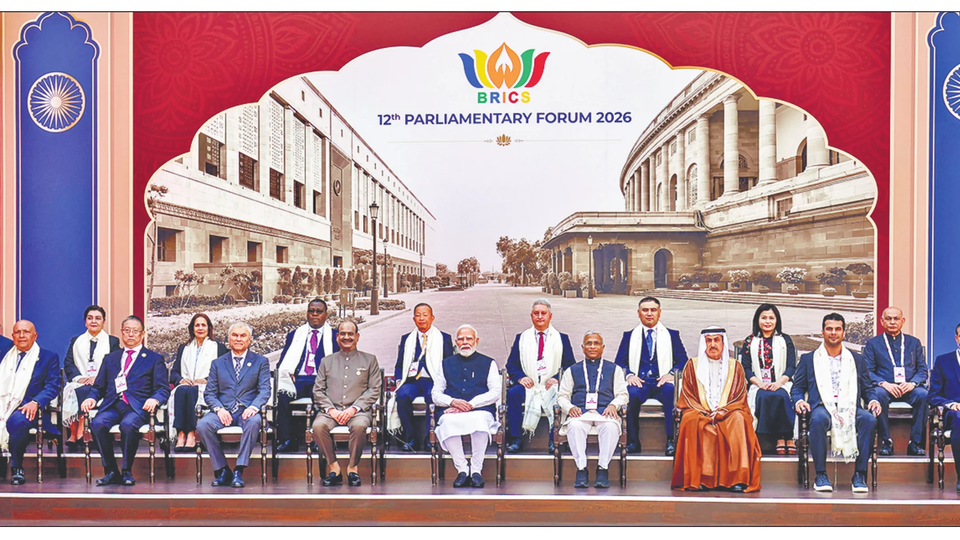
Lok Sabha Speaker Om Birla has urged parliaments of BRICS member and partner countries to translate dialogue and shared commitments into concrete results, strengthen democratic institutions and ensure that developing nations have a stronger voice in global policymaking.
Speaking at the inauguration of the 12th BRICS Parliamentary Forum at Samvidhan Sadan in New Delhi on Monday, Birla said the grouping’s success should be measured by its ability to improve people’s lives. He highlighted the unanimous adoption of a joint statement at the BRICS Summit of Heads of State under India’s chairship, while stressing that implementing agreed commitments remained a major challenge.
The two-day forum, themed “Strengthening Parliaments for People-Centric Development”, brings parliamentary representatives together to discuss resilience, innovation, cooperation and sustainability amid geopolitical tensions and economic uncertainty. Prime Minister Narendra Modi also met parliamentary delegations during the event.
Birla Says BRICS Success Depends on Implementation
Birla emphasised that dialogue alone was not enough to deliver meaningful progress. He called on participating legislatures to turn common positions into policies and actions that produce tangible benefits for citizens.
“True measure of BRICS success lies in translating dialogue into tangible outcomes,” Birla said, highlighting the role of parliaments in turning political commitments into practical measures.
He identified lawmaking, budgetary processes, legislative deliberations and oversight as important tools through which parliaments can support the implementation of agreements reached by BRICS leaders.
The unanimous adoption of the joint statement at the BRICS Summit under India’s chairship was an important achievement, Birla said. However, he stressed that the real test would be whether the commitments were followed by action.
The emphasis on implementation places legislatures at the centre of the forum’s agenda. While governments negotiate international agreements and establish shared priorities, parliamentary institutions can scrutinise policies, allocate public resources and monitor whether commitments are being translated into outcomes.
Global Conflicts Make Dialogue and Diplomacy Essential
Birla said regional conflicts, wars, economic instability, trade tensions, terrorism and climate change were creating challenges that extended beyond national borders. He argued that these problems required sustained dialogue, diplomacy and international cooperation.
“Parliaments can foster mutual trust, bridge differences and advance peaceful resolution of global challenges,” he said.
His remarks highlighted the role of parliamentary diplomacy in maintaining communication between countries, particularly when geopolitical disagreements make cooperation more difficult. Legislatures can provide a platform for representatives to exchange views, discuss shared concerns and explore areas where cooperation remains possible.
The forum’s focus on parliamentary engagement comes amid uncertainty in the international economic and security environment. Birla’s message was that dialogue should help countries manage differences and identify practical responses rather than remain limited to formal declarations.
BRICS Parliaments Urged to Strengthen the Global South’s Voice
Birla called for a stronger role for the Global South in international decision-making. He said the concerns and priorities of developing countries must be reflected in responsive policies, practical cooperation and measures that improve citizens’ lives.
The appeal reflects a central theme of BRICS engagement: increasing the influence of developing economies in discussions that shape global economic governance and international cooperation.
For parliamentary institutions, this means examining whether national and international policy frameworks adequately address the needs of their populations. Birla urged legislators to ensure that the concerns raised by developing countries move beyond declarations and lead to concrete action.
His remarks also underscored the importance of cooperation among participating countries while recognising that meaningful results depend on implementation within individual national systems.
Birla Calls for Stronger Democratic Institutions and Accountability
Birla urged BRICS parliaments to strengthen legislative frameworks, accountability mechanisms and oversight so that democratic institutions could remain effective during periods of disruption.
Parliaments play a central role in examining government decisions, reviewing expenditure, debating legislation and holding public authorities accountable. Strong oversight can help ensure that policy commitments are implemented transparently and that public resources are directed towards stated objectives.
Birla’s emphasis on institutional resilience linked these responsibilities to the broader challenges facing countries during periods of political, economic and environmental uncertainty.
He also stressed that economic growth and environmental protection should be treated as complementary priorities rather than competing objectives. The message places sustainability alongside development, innovation and institutional effectiveness in the forum’s discussions.
Youth Empowerment and People-Centric Development in Focus
Youth empowerment was another key theme in Birla’s address. He urged BRICS legislatures to create meaningful opportunities for young people and help channel their creativity, technological skills and aspirations into nation-building.
As countries confront changes in technology, employment and economic development, young people’s skills and participation can be important to future growth. Birla called on parliaments to support conditions in which younger generations can contribute to national development.
The forum’s theme, “Strengthening Parliaments for People-Centric Development”, reflects the broader objective of connecting institutional cooperation with citizens’ needs. Its focus on resilience, innovation, cooperation and sustainability is intended to encourage discussion of how parliaments can respond to changing social and economic conditions.
Birla referred to Prime Minister Narendra Modi’s vision of transforming BRICS into an “ecosystem of solutions”. He said the forum’s effectiveness should be assessed by the results it helps produce, rather than the range of subjects discussed.
Om Birla Holds Bilateral Meeting With Russian Parliamentary Delegation
Before the forum, Birla held a bilateral meeting on Sunday with a Russian parliamentary delegation led by Vyacheslav Volodin, chairman of Russia’s State Duma.
The discussions covered cooperation at global forums, efforts to combat terrorism and ways to deepen parliamentary engagement between the two countries.
The meeting formed part of the wider parliamentary outreach surrounding the BRICS forum, providing an opportunity for representatives to discuss bilateral cooperation alongside the multilateral agenda.
Why the 12th BRICS Parliamentary Forum Matters
The 12th BRICS Parliamentary Forum provides a platform for legislators from member and partner countries to discuss how parliamentary institutions can support cooperation and development. Its agenda combines institutional accountability with broader priorities such as sustainability, innovation and resilience.
Birla’s address placed particular emphasis on the gap that can emerge between international commitments and their implementation. Unanimous statements and shared declarations can establish common priorities, but their impact depends on the policies, resources and oversight mechanisms that follow.
His call for a stronger Global South voice also highlighted the importance of ensuring that developing countries’ concerns are reflected in global policymaking. Parliamentary cooperation can contribute by sustaining dialogue, strengthening oversight and helping translate agreed priorities into national action.
Conclusion
Om Birla’s message to BRICS parliaments was clear: dialogue must lead to measurable outcomes. At the 12th BRICS Parliamentary Forum in New Delhi, the Lok Sabha Speaker called for stronger democratic institutions, more effective oversight, greater opportunities for young people and a more influential role for developing nations in global decision-making.
With geopolitical tensions, economic uncertainty and climate-related challenges affecting countries across regions, the forum is focused on how parliaments can support practical cooperation. The ultimate test, as Birla stressed, will be whether shared commitments are implemented in ways that deliver tangible improvements in people’s lives.
For breaking news and live news updates, like us on Facebook or follow us on Twitter and Instagram. Read more on Latest India on thefoxdaily.com.






COMMENTS 0