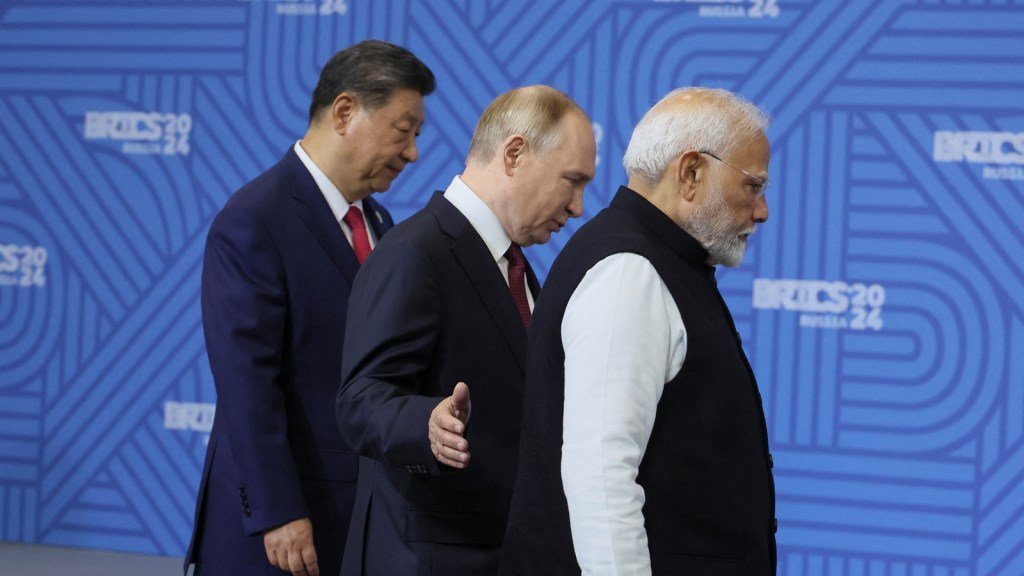
Prime Minister Narendra Modi’s back-to-back engagements with Russian President Vladimir Putin and Chinese President Xi Jinping at the 2026 BRICS Summit put India’s increasingly complex foreign-policy balancing act under the spotlight.
Modi met Putin in New Delhi on Friday ahead of the summit’s main proceedings, with the two leaders reviewing cooperation across defence, energy, trade, space, industrial production and other strategic areas. On Saturday, Modi is scheduled to hold a closely watched bilateral meeting with Xi, whose return to India comes seven years after his last visit.
The two meetings are significant for very different reasons. Russia remains an important source of energy, defence cooperation and strategic support for India, while China is simultaneously India’s largest trading challenge and its most consequential Asian security rival.
That makes the Modi-Putin and Modi-Xi meetings more than routine summit diplomacy. Together, they show how New Delhi is trying to protect its interests without being pulled completely into any one geopolitical camp.
Why the Modi-Putin meeting matters
Modi and Putin met at Bharat Mandapam in New Delhi on September 11, with their discussions covering a broad range of bilateral issues. The meeting was also their second encounter of 2026, following talks on the sidelines of the Shanghai Cooperation Organisation summit in Bishkek in August.
India and Russia continue to describe their relationship as a strategic partnership, but its practical importance has expanded significantly in recent years because of Energy Security and geopolitical uncertainty.
Russia has remained a major supplier of crude oil to India, while Moscow has historically played a major role in India’s defence ecosystem. At the same time, both countries are looking to broaden economic cooperation beyond the traditional energy and defence relationship.
The latest discussions therefore focused not simply on maintaining existing ties but on finding new areas where bilateral trade and investment can grow.
India and Russia still have a $100 billion trade target
One of the clearest economic objectives is the goal of increasing India-Russia bilateral trade to $100 billion by 2030.
That target reflects a recognition in both capitals that the relationship cannot remain disproportionately dependent on energy and defence. Expanding industrial cooperation, increasing Indian exports and creating new investment opportunities are necessary if the trade relationship is to become broader and more balanced.
Areas such as railways, steel, industrial manufacturing, pharmaceuticals, food products, technology and critical minerals offer potential avenues for expansion.
Russia’s INNOPROM India exhibition, held in New Delhi from September 9 to 11, also reflected this effort to build a stronger industrial dimension into the relationship. The event brought Russian companies and industrial technologies into direct contact with Indian businesses at a time when both countries are looking for alternatives to vulnerable global supply chains.
The challenge is turning political targets into commercially sustainable trade. A $100 billion goal is meaningful only if companies on both sides can overcome payment, logistics, market-access and sanctions-related complications.
Energy remains at the heart of the relationship
Energy is another reason Moscow remains important to New Delhi.
Russian crude has become a major component of India’s energy strategy since the disruption of global oil markets following the Russia-Ukraine war. Access to competitively priced crude has helped Indian refiners manage energy costs and maintain supplies for a rapidly expanding economy.
For India, the relationship is therefore not simply about diplomatic friendship. It has a direct connection to fuel prices, industrial activity, inflation and energy security.
At the same time, New Delhi has repeatedly argued that its energy decisions are driven by national interests rather than an alignment with Moscow’s geopolitical position. That distinction is central to India’s broader foreign-policy approach.
India wants access to Russian energy without becoming politically dependent on Russia, just as it wants strong relations with Western economies without allowing those relationships to dictate every decision involving Moscow or Beijing.
Nuclear cooperation adds another strategic layer
Civil nuclear cooperation is another area where India and Russia have long-term interests.
The two countries have discussed expanding cooperation in nuclear energy, including the possibility of additional reactors and wider technological collaboration. Nuclear power has particular significance for India because the country needs large amounts of reliable electricity while simultaneously trying to reduce the long-term carbon intensity of its energy system.
Unlike crude oil, nuclear power projects operate on much longer timelines. Decisions made today can shape energy infrastructure for decades.
That gives the India-Russia nuclear relationship a strategic dimension that goes beyond the immediate geopolitical headlines surrounding the BRICS summit.
Modi also raised the security of global shipping
Global conflicts were another important part of the Modi-Putin conversation and the wider BRICS discussions.
Modi has emphasised that international trade depends on secure Shipping routes, uninterrupted supply chains and the safety of seafarers. That message carries particular weight for India because the country is heavily dependent on maritime trade for both imports and exports.
Wars and regional conflicts can quickly turn a security problem into an economic problem. Attacks on shipping lanes can increase insurance costs, lengthen voyages and raise freight rates. Disruptions to oil routes can have an even broader effect by pushing up energy prices.
For a country as dependent on imported energy and international commerce as India, freedom of navigation is therefore not an abstract diplomatic principle. It is directly linked to economic stability.
Russia wants BRICS to become more economically influential
Putin has used the BRICS platform to argue that the global economic system is undergoing a major structural transformation, with emerging economies playing a larger role.
That message fits partly with India’s own approach to BRICS, although New Delhi has been careful about how far it wants the grouping to move toward an explicitly anti-Western identity.
India’s BRICS chairmanship is focused on practical cooperation in areas such as trade, finance, energy, critical minerals, technology and supply chains. Those priorities allow New Delhi to strengthen cooperation among emerging economies without formally turning BRICS into a military or ideological alliance.
That distinction is crucial.
India has strategic partnerships with the United States, Europe, Japan, Australia and other Western and Indo-Pacific countries. At the same time, it maintains longstanding relationships with Russia, Iran and other non-Western powers.
New Delhi therefore has little interest in replacing one bloc mentality with another.
Then comes Xi Jinping
The Modi-Xi meeting carries an entirely different weight.
Xi’s visit to India for the BRICS summit is his first in the country since 2019. Relations between India and China deteriorated sharply after the military confrontation along the Line of Actual Control in eastern Ladakh, creating one of the most serious crises in bilateral relations in decades.
The two countries have since taken steps toward reducing military tensions, including disengagement in parts of the contested areas. But disengagement does not automatically mean that the underlying strategic dispute has been resolved.
That is why the latest Modi-Xi meeting will be watched closely for evidence of whether the relationship can move from crisis management toward broader stabilisation.
The border issue will remain the first test
The India-China border is unlikely to disappear from the bilateral agenda simply because economic cooperation is being discussed.
Recent talks between India’s National Security Adviser Ajit Doval and Chinese Foreign Minister Wang Yi have provided a diplomatic channel for addressing the boundary question. The two sides are expected to review the progress of those discussions during the Modi-Xi engagement.
The language surrounding an “early and substantial harvest” in boundary delimitation and border management is significant because it suggests an attempt to achieve practical progress rather than leaving the relationship dependent solely on military disengagement.
But expectations need to remain measured.
A stable border requires more than a single leaders’ meeting. Military deployments, patrol arrangements, communication mechanisms, infrastructure development and the broader boundary dispute all involve complex negotiations.
A successful Modi-Xi meeting could create political momentum. It cannot, by itself, settle the boundary question.
The $112 billion problem behind Modi-Xi talks
Trade may prove almost as important as the border.
India-China bilateral trade reached roughly $127.7 billion in FY 2024-25, but the relationship remains heavily tilted toward China. India’s trade deficit with China has climbed to around $112 billion.
For New Delhi, that imbalance is becoming increasingly difficult to ignore.
India imports large quantities of Chinese machinery, electronics, chemicals, components and other industrial inputs, while Indian exports to China remain comparatively limited.
The problem is not simply the size of the deficit. It also reflects the structure of the relationship.
If Indian companies cannot gain meaningful access to the Chinese market, increased bilateral trade can continue to benefit Chinese exporters disproportionately. That is why India is expected to push for greater market access for sectors including pharmaceuticals, information technology and agricultural products.
Why India wants a strategic economic dialogue with China
A proposed strategic economic dialogue could provide a more structured mechanism for addressing some of these problems.
Instead of treating trade disputes as isolated issues, such a dialogue could bring together questions involving market access, investment, visas, business restrictions and the broader commercial relationship.
That does not mean India is preparing to open its economy without safeguards. New Delhi has remained cautious about Chinese investment in strategically sensitive areas, particularly after the deterioration in bilateral relations.
The more realistic objective is controlled economic engagement: expanding commerce where it benefits India while reducing vulnerabilities in sectors considered strategically important.
Why India cannot simply choose Russia over China
It would be tempting to interpret Modi’s meetings with Putin and Xi as evidence that India is moving decisively toward a Russia-China camp. The reality is considerably more complicated.
India and Russia have a longstanding strategic relationship, but Russia has also deepened its partnership with China. Meanwhile, India and China remain competitors for influence in Asia despite their economic interdependence.
New Delhi therefore has to manage relationships that sometimes overlap and sometimes conflict.
India needs Russian energy and defence cooperation. It needs stable relations with China because China is a major trading partner and shares a disputed land border with India. It also needs strong economic and technological relationships with Western countries.
This is the essence of India’s strategic autonomy: maintaining the ability to make decisions based on Indian interests rather than formally joining one geopolitical bloc.
The Modi-Putin and Modi-Xi meetings are connected
Although the two bilateral meetings involve different issues, they are linked by India’s broader BRICS strategy.
With Russia, India can strengthen energy security, defence cooperation, industrial partnerships and access to strategic resources.
With China, India can test whether the recent reduction in border tensions can be converted into a wider stabilisation process while simultaneously addressing the huge trade imbalance.
Within BRICS itself, India can push for practical economic cooperation without allowing the organisation to become defined exclusively by opposition to Western powers.
That is a difficult line to walk, especially as BRICS has expanded and now includes countries with very different foreign-policy priorities.
BRICS is becoming more important but also more complicated
The expansion of BRICS has increased its economic and political weight, but it has also made consensus harder.
Members have different relationships with the United States, different security concerns and sometimes conflicting regional interests. The wars in Ukraine and West Asia are examples of issues on which the wider grouping cannot necessarily be expected to speak with one voice.
India’s approach is therefore likely to emphasise areas where cooperation is achievable.
Trade facilitation, digital payments, energy security, supply-chain resilience, critical minerals, development finance and technology offer more practical opportunities than attempting to create a unified geopolitical front.
For New Delhi, the value of BRICS may ultimately depend less on dramatic declarations and more on whether member states can build mechanisms that actually make trade, investment and financial cooperation easier.
What the Modi-Xi meeting could realistically achieve
The most important outcome would not necessarily be a major breakthrough. Even establishing a more predictable political relationship could be valuable.
India and China have a direct interest in preventing another military crisis along the border. Regular communication between senior officials can reduce the risk that local incidents escalate into larger confrontations.
Progress on border management could then create space for discussions on trade and economic issues.
But there are limits to what can be achieved quickly. The trade deficit will not disappear through a single agreement, and the boundary dispute cannot be resolved merely through summit diplomacy.
The more useful measure of the meeting will be what happens afterward: whether officials maintain momentum, whether economic dialogue becomes institutionalised and whether border negotiations produce concrete results.
India’s real challenge is keeping all sides engaged
The significance of Modi’s meetings with Putin and Xi ultimately lies in what they reveal about India’s position in a rapidly changing international system.
New Delhi is not trying to choose between Russia and China, nor is it abandoning its growing partnerships with Western countries. Instead, it is attempting to use relationships with competing powers to preserve room for manoeuvre.
That strategy brings advantages, but it also carries risks.
Closer India-Russia ties can attract pressure from Western governments. Improved India-China relations could raise concerns among some partners about Beijing’s influence. A large trade relationship with China creates economic dependence even as the two countries compete strategically.
Managing those contradictions requires constant diplomacy rather than a single grand alignment.
Why the BRICS summit matters for India
The 2026 BRICS Summit gives India an unusual opportunity to put that approach on display.
Modi’s meeting with Putin demonstrates that India intends to preserve and expand its relationship with Moscow, particularly in energy, defence and industrial cooperation. His meeting with Xi tests whether India and China can move beyond the most dangerous phase of their recent confrontation and address the economic relationship more seriously.
The two engagements also show why India’s BRICS chairmanship matters beyond the summit itself.
If New Delhi can persuade members to focus on practical cooperation in trade, finance, energy, critical minerals and supply chains, BRICS can become a useful instrument for India’s economic and diplomatic goals without becoming an exclusive anti-Western bloc.
That is the tightrope Modi is walking.
India wants Russian energy without strategic dependence, Chinese trade without an unsustainable deficit, border stability without compromising its security interests, and stronger Western partnerships without surrendering strategic autonomy.
The Putin meeting has reinforced one side of that equation. The Modi-Xi meeting will test another.
The real measure of India’s BRICS strategy will not be the optics of leaders meeting at Bharat Mandapam. It will be whether those meetings produce enough practical progress to make India more secure, more economically resilient and more influential without forcing it into someone else’s geopolitical camp.
For breaking news and live news updates, like us on Facebook or follow us on Twitter and Instagram. Read more on Latest India on thefoxdaily.com.





COMMENTS 0