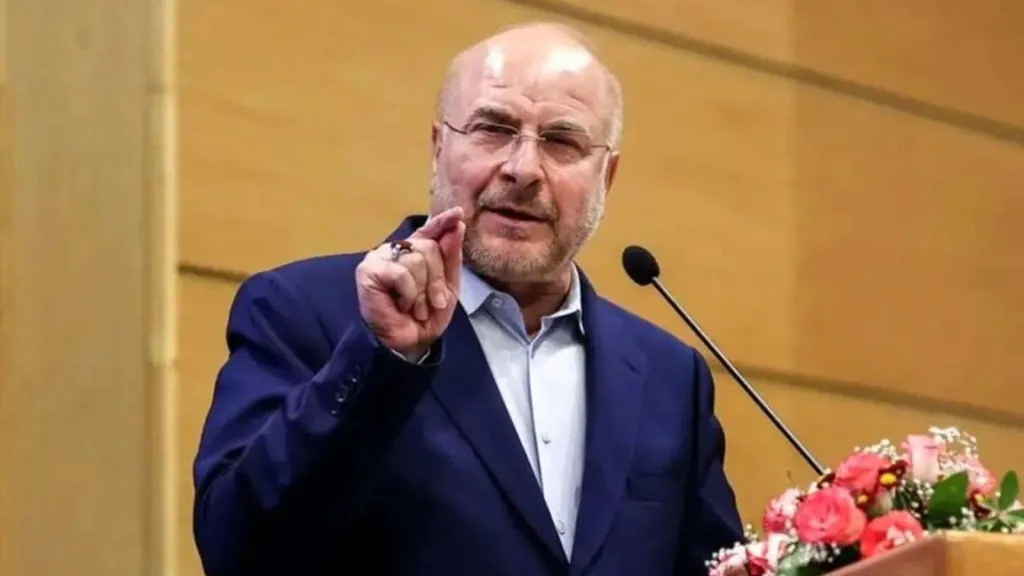
Iranian Parliament Speaker Mohammad-Baqer Qalibaf has cancelled his planned visit to New Delhi for the 12th BRICS Parliamentary Forum, as tensions across West Asia rise again and concerns grow over a possible escalation involving Iran, the United States and regional actors.
The forum is scheduled to take place on October 26 and 27 in the Central Hall of Parliament, with Lok Sabha Speaker Om Birla serving as host. Prime Minister Narendra Modi is expected to inaugurate the gathering on October 26. Although Qalibaf will not attend, Iran has confirmed that a parliamentary delegation will participate in the meeting.
In a statement confirming the cancellation, the Iranian embassy in New Delhi cited “certain unforeseen circumstances” without providing further details. The development comes amid renewed security warnings, reported concerns about possible Iranian attacks on US personnel and continuing uncertainty over efforts to bring Washington and Tehran back to formal negotiations.
Qalibaf has played a prominent role in negotiations with the United States in recent months, according to the report. His absence from the parliamentary gathering removes a senior Iranian representative from a forum expected to bring together lawmakers and parliamentary leaders from BRICS member and partner countries, including high-level representatives from Russia and China.
Iran Confirms Parliamentary Delegation Will Attend BRICS Forum
The Iranian embassy announced Qalibaf’s decision in an official statement issued in New Delhi. It said the speaker of Iran’s Islamic Consultative Assembly would be unable to attend the meeting of speakers of parliaments from BRICS member countries.
However, Tehran emphasised that the cancellation would not mean Iran was withdrawing from the event.
“It is also emphasized that the parliamentary delegation of the Islamic Republic of Iran will participate in the meeting,” the embassy said.
The statement added that Iran remained committed to active and effective participation in BRICS summits and meetings at the highest levels. It also said the Iranian delegation would continue dialogue and consultations with representatives of other member countries.
According to the embassy, those discussions would aim to expand and deepen bilateral and multilateral cooperation, particularly in parliamentary relations.
The Iranian mission also thanked the Indian government for its hospitality and the arrangements made for the forum. It expressed the hope that the meeting would produce constructive outcomes and strengthen cooperation among member countries.
The embassy did not directly connect Qalibaf’s absence to the security situation in West Asia. Its statement referred only to unforeseen circumstances, leaving the specific reason for the cancellation unclear.
BRICS Parliamentary Forum Scheduled for October 26–27
The 12th BRICS Parliamentary Forum will bring together presiding officers, lawmakers and other delegates from BRICS member and partner countries. The event is scheduled to be held in the Central Hall of Parliament in New Delhi, with Lok Sabha Speaker Om Birla hosting the gathering.
Prime Minister Narendra Modi is expected to inaugurate the forum on October 26. High-level representatives from Russia and China are also expected to attend, according to the supplied report.
The meeting is intended to provide a platform for parliamentary engagement among participating countries. Iran’s decision to send a delegation despite Qalibaf’s absence indicates that its parliamentary representatives will still take part in the scheduled discussions.
However, the available information does not identify who will lead Iran’s delegation in place of Qalibaf or explain whether his absence will change the format of any planned bilateral engagements.
Renewed Security Concerns Across West Asia
Qalibaf’s cancellation comes as tensions across West Asia have risen, with the United States and Iran issuing alerts and warnings amid fears of another escalation. The report describes a situation in which security concerns are growing even as mediators continue efforts to restart formal talks between Washington and Tehran.
The New York Times reported that the US government had placed personnel on heightened alert across the region and moved to reduce staffing levels at some embassies and consulates. The reported measures followed intelligence assessments indicating that Iran had increased efforts to target American personnel.
According to officials quoted by the newspaper, intelligence officials sent a warning memorandum to US Secretary of State Marco Rubio on Friday about potential dangers facing State Department employees in the Middle East and elsewhere.
The memorandum from Director of National Intelligence Jay Clayton reportedly stated that agencies had “received intelligence that Iran has substantially increased efforts to target US personnel”.
The Associated Press separately reported that the US State Department was reducing staffing at four embassies in the region following intelligence assessments about possible threats to American personnel.
The diplomatic missions identified in the report were in Jordan, Lebanon, Qatar and the United Arab Emirates.
However, the State Department’s public explanation for the staffing reductions reportedly pointed specifically to increased threats from Yemen’s Houthi rebels rather than directly citing threats from Iran. US officials also denied that the drawdowns were connected to possible new American and Israeli strikes on Iran.
The distinction is important because the reported security measures have been linked to more than one regional threat. The available information does not establish that the embassy staffing changes were a direct response to a planned US or Israeli military operation against Iran.
Trump Warns of Further Military Action Against Iran
US President Donald Trump has continued to make public statements about American military operations against Iran, adding to uncertainty over the next phase of the confrontation.
Speaking at a rally in Florida on Friday, Trump referred to the US military campaign, known as Operation Epic Fury, and suggested that further action remained possible if Tehran did not agree to negotiations.
“We may do another little Epic Fury, or they will agree. If they are smart, they will just say, let’s get down to business,” Trump said.
The remarks came as mediators were reportedly trying to bring Washington and Tehran back to formal talks. The conflict was described in the supplied report as having reached a stalemate, although diplomatic efforts to find a way forward were continuing.
Trump’s statement did not establish that another military operation had been authorised or that a decision on further action had been made. It nevertheless underscored the uncertainty surrounding the prospects for negotiations and the possibility of renewed confrontation.
Iran Warns Over US Activity Around the Strait of Hormuz
Maritime security has emerged as another point of tension between Iran and the United States. Iranian state television reported that the Islamic Revolutionary Guard Corps Navy had again threatened to strike US military bases in the region if Washington continued helping guide commercial ships through the Strait of Hormuz.
The strait is a critical route for global energy trade, making any escalation around the waterway a potential concern for regional security and international markets.
Iranian Foreign Minister Abbas Araghchi warned of the broader consequences of further escalation in an opinion column published in the Financial Times.
“Any further escalation around the Strait of Hormuz or elsewhere in the region will put civilian lives and the well-being of all regional states and the global economy at great risk,” Araghchi wrote.
The warning highlights the potential consequences of an expansion of the confrontation beyond direct military exchanges. Disruption around a major energy shipping route could affect commercial movement and increase uncertainty across regional and global markets.
However, the supplied report does not establish that commercial shipping through the strait has been disrupted as a result of the latest threats. The remarks instead reflect the competing warnings and security concerns surrounding the waterway.
Renewed Fighting Involving Yemen’s Houthis Adds to Regional Risks
The security situation is also complicated by a resurgence of fighting between a Saudi-led coalition and Yemen’s Houthi movement. The report said the Houthis had launched missile and drone strikes against Saudi Arabia.
The renewed activity has added another layer to the region’s security concerns, particularly as US officials have referred to Houthi-related threats when explaining the reduction of staffing at diplomatic missions.
The available information does not establish that the renewed Houthi attacks are directly coordinated with Iran’s reported plans to target US personnel. Nor does it establish that the embassy staffing reductions were prompted by a single threat or incident.
Instead, the developments illustrate the range of security concerns facing governments and diplomatic missions across West Asia, where several overlapping confrontations and military threats are contributing to uncertainty.
Political Pressures in Israel and the United States
The renewed tensions are unfolding alongside important political developments in Israel and the United States. Israel is scheduled to hold elections on October 27, while the United States is preparing for congressional elections on November 3.
According to the supplied report, opinion polls in Israel showed Prime Minister Benjamin Netanyahu’s Likud party trailing Gadi Eisenkot’s Yashar party ahead of the election.
An N12 News poll published the previous week placed Yashar first with 23 seats, one fewer than in the previous poll. A Channel 13 poll published around the same time also put Yashar in first place, with 20 seats.
In both polls, Likud was placed second with 19 seats. These figures reflect the findings reported by the two surveys, rather than confirmed election results. The information provided does not include full methodological details, such as sample sizes or margins of error, needed to assess the polls more comprehensively.
In the United States, a Reuters/Ipsos poll reported that Trump’s approval rating had fallen to its lowest level across his two presidential terms. The four-day poll, which closed on Monday, found that 31% of Americans approved of his performance in office, down one percentage point from two weeks earlier.
The report linked the decline to public concerns about high gasoline prices and suggested that voters could punish the Republican Party in the November 3 congressional elections. The poll figures measure reported public approval at the time of the survey; they do not establish the eventual election outcome.
The domestic political pressures in both countries form part of the wider backdrop to the renewed security concerns. However, the available information does not demonstrate that electoral calculations directly caused any particular military or diplomatic decision.
Diplomatic Efforts Continue Despite Escalation Fears
Despite the latest warnings, mediators have continued trying to bring the United States and Iran back to formal negotiations. The reported stalemate has left uncertainty over whether diplomatic efforts can prevent another phase of military escalation.
Qalibaf’s absence from the BRICS Parliamentary Forum comes at a time when dialogue between governments and parliamentary representatives remains relevant to regional diplomacy. Iran’s embassy has stressed that its delegation will continue consultations with other BRICS members, particularly on parliamentary cooperation.
Still, the cancellation alone does not establish a change in Iran’s broader diplomatic position or prove that negotiations with the United States have been abandoned. The embassy has not publicly attributed the decision to the renewed security situation, and the precise circumstances behind the cancellation remain unspecified.
The scheduled BRICS meeting will proceed on October 26 and 27, with Iran represented by a parliamentary delegation. Meanwhile, security warnings, military threats and efforts to restart negotiations continue to shape the wider regional environment.
What Qalibaf’s Cancellation Means for the BRICS Meeting
The immediate confirmed development is that Iran’s parliament speaker will not travel to New Delhi for the forum, while an Iranian parliamentary delegation will still attend. The embassy has reaffirmed Tehran’s commitment to participation in BRICS meetings and continued engagement with member countries.
The cancellation comes amid renewed tensions involving Iran, the United States and other regional actors, but no direct link between the two developments has been officially confirmed in the supplied information.
With the forum approaching, the focus will be on the discussions among participating parliamentary delegations and whether the gathering provides opportunities to maintain bilateral and multilateral engagement. At the same time, developments around US diplomatic staffing, the Strait of Hormuz and continuing efforts to resume negotiations will remain important indicators of the wider security situation in West Asia.
For now, the region faces renewed uncertainty as governments issue warnings and diplomatic efforts continue. Iran’s decision to maintain its parliamentary participation in New Delhi offers continuity in its engagement with BRICS, even as Qalibaf’s absence raises questions about the circumstances behind his cancelled visit.
For breaking news and live news updates, like us on Facebook or follow us on Twitter and Instagram. Read more on Latest India on thefoxdaily.com.





COMMENTS 0