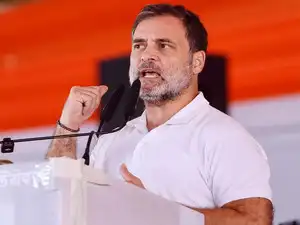
The political confrontation over Rahul Gandhi‘s ‘vote chori’ allegations has intensified, with the Bharatiya Janata Party (BJP) responding by citing figures on the National Democratic Alliance’s (NDA) electoral performance under different Chief Election Commissioners.
On November 6, BJP spokesperson Pradeep Bhandari questioned Gandhi’s claims that the NDA had received favourable treatment under Chief Election Commissioner Gyanesh Kumar. In a post on X, Bhandari argued that the alliance’s election victory rate was actually higher during the tenure of former CEC V S Sampath, who served while the Congress-led United Progressive Alliance (UPA) was in power.
According to Bhandari’s figures, the NDA won 75% of elections held during Sampath’s tenure, compared with approximately 66% during Kumar’s tenure. He used the comparison to challenge Gandhi’s argument and made a sarcastic reference to Sonia Gandhi, asking whether she had been involved in ‘vote chori’ on behalf of the BJP during the earlier period. :chatgpt-content-reference{index=”0″}
What Pradeep Bhandari Said About NDA’s Election Success Rate
Bhandari’s response focused on comparing the NDA’s reported electoral performance during two different periods of the Election Commission‘s leadership.
He pointed out that V S Sampath served as Chief Election Commissioner from June 11, 2012, to January 15, 2015, during the UPA government’s tenure. Bhandari claimed that the NDA won 75% of elections conducted during that period.
He contrasted this with the approximately 66% success rate he attributed to the NDA under Gyanesh Kumar, who became India’s Chief Election Commissioner on February 19, 2025.
In his post, Bhandari argued that the figures contradicted Gandhi’s suggestion that the NDA’s electoral performance under Kumar indicated favouritism by the Election Commission. He also questioned whether Gandhi’s reasoning would imply that Sonia Gandhi had facilitated electoral manipulation for the BJP when Sampath was heading the poll body.
The comparison was presented as a political counterargument rather than an independent investigation into election procedures. The percentages cited were Bhandari’s figures, and the post did not provide a detailed methodology or election-by-election breakdown for calculating the success rates. :chatgpt-content-reference{index=”1″}
Why the BJP Is Responding to Rahul Gandhi’s ‘Vote Chori’ Allegations
Rahul Gandhi has repeatedly accused the BJP and the Election Commission of India of electoral irregularities. His allegations have focused on the conduct of elections, changes to voter lists and the role of constitutional institutions in protecting the voting rights of citizens.
Gandhi has also questioned the Special Intensive Revision (SIR) of electoral rolls and raised concerns about whether the process could result in eligible voters being removed. The BJP has rejected these allegations and defended the Election Commission’s procedures.
The dispute has become a major political issue, with opposition parties demanding accountability from the poll panel and the BJP accusing Congress leaders of questioning electoral institutions after losing elections.
At an INDIA bloc rally at Delhi’s Ramlila Maidan on November 1, Gandhi renewed his allegations against the BJP and Chief Election Commissioner Gyanesh Kumar. Opposition leaders accused the poll body of failing to protect electoral fairness, while the ruling party rejected the charges. :chatgpt-content-reference{index=”2″}
Who Are V S Sampath and Gyanesh Kumar?
V S Sampath
V S Sampath served as India’s 18th Chief Election Commissioner between June 2012 and January 2015. His tenure coincided with the Congress-led UPA government at the Centre and included a period of significant electoral activity.
Bhandari referred to this period to argue that the NDA’s reported election success rate was higher under a CEC appointed during a Congress-led government than under the current election chief.
Gyanesh Kumar
Gyanesh Kumar became the 26th Chief Election Commissioner of India on February 19, 2025, after first being appointed as an Election Commissioner on March 15, 2024.
His tenure has been marked by political controversy surrounding electoral procedures and the opposition’s allegations of irregularities. Rahul Gandhi and other opposition leaders have questioned the Election Commission’s handling of voter-roll revisions and its response to concerns raised about electoral processes. The BJP has defended the poll body and rejected claims of manipulation. :chatgpt-content-reference{index=”3″}
Does the NDA’s Election Win Rate Settle the ‘Vote Chori’ Debate?
The figures cited by Bhandari have added another argument to the political debate, but comparing an alliance’s electoral success rates across different CEC tenures does not, by itself, establish whether elections were conducted fairly or whether votes were manipulated.
Election outcomes are influenced by several factors, including political alliances, candidate selection, campaign strategies, voter preferences, local issues and the performance of governments. A party or alliance winning a larger share of elections during a particular period does not automatically demonstrate that the Election Commission favoured it.
Similarly, a lower success rate does not independently disprove allegations of electoral irregularities. Assessing such claims requires examination of specific evidence, electoral procedures, voter records and the functioning of relevant institutions.
Bhandari’s comparison is therefore best understood as the BJP’s political response to Gandhi’s allegations, rather than conclusive evidence resolving the wider dispute.
Political Tensions Over the Election Commission Continue
The latest exchange reflects the continuing confrontation between the BJP and opposition parties over the credibility of India’s electoral process. While Rahul Gandhi has called for greater accountability from the Election Commission, the BJP has maintained that the opposition’s allegations are politically motivated and unsupported.
The disagreement has moved beyond individual statements, becoming part of a wider debate about voter-list revisions, institutional independence and public confidence in elections.
Bhandari’s remarks have brought historical comparisons into that debate by highlighting the NDA’s claimed success rate during Sampath’s tenure. His reference to Sonia Gandhi was intended as a sarcastic challenge to Rahul Gandhi’s argument, not an independently established allegation of wrongdoing.
For now, the central dispute remains unresolved. The BJP continues to reject the ‘vote chori’ allegations, while Rahul Gandhi and opposition leaders are demanding answers from the Election Commission. The credibility of the competing claims will ultimately depend on verifiable evidence and transparent examination of the electoral processes being questioned.
For breaking news and live news updates, like us on Facebook or follow us on Twitter and Instagram. Read more on Latest India on thefoxdaily.com.





COMMENTS 0