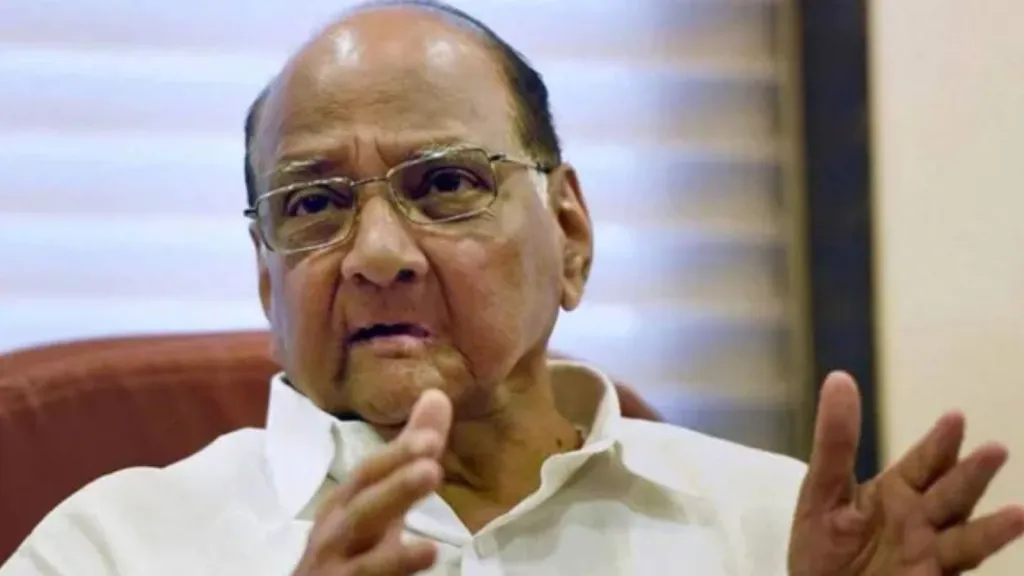
The BJP’s defence of Sharad Pawar has brought an unexpected political dimension to the growing dispute over the proposed delimitation legislation. As Congress leaders accuse the Nationalist Congress Party (Sharadchandra Pawar) chief of betraying the INDIA bloc, the ruling party has turned the controversy into an opportunity to question Congress’s political consistency and highlight Pawar’s past role in helping it return to power in Maharashtra.
The confrontation comes ahead of the bill’s scheduled introduction in the Lok Sabha on Monday. Although NCP(SP) working president Supriya Sule has maintained that the party will announce its formal position only after examining the legislation, party sources indicate that it is inclined to support the proposed measure alongside the implementation of women’s reservation.
For the BJP, the disagreement is about more than Pawar’s position on the bill. It offers an opportunity to expose divisions within the Opposition alliance, challenge Congress’s claim to lead the INDIA bloc and present the delimitation proposal as part of a broader effort to implement women’s political reservation.
Why the BJP Has Come Out in Sharad Pawar’s Defence
The BJP’s response followed a series of sharp remarks from Congress leaders accusing Pawar and his party of weakening the INDIA bloc by supporting the delimitation legislation. Instead of directly limiting its response to the merits of the bill, the BJP questioned Congress’s treatment of a politician whose support had helped it form governments in Maharashtra on two important occasions.
BJP Maharashtra spokesperson Navnath Ban argued that Congress was overlooking its own political history with Pawar. He recalled the post-election arrangements following the 1999 Maharashtra Assembly elections, when Pawar’s support helped Congress participate in the formation of the state government.
Ban also referred to the political developments in 2019, crediting Pawar’s initiative with helping Congress return to power in Maharashtra. His argument was that Congress had benefited from Pawar’s political calculations when it suited the party but was now questioning his independence because of a disagreement over the Delimitation Bill.
The BJP is using this history to frame Congress’s criticism as political ingratitude. By portraying Pawar as a leader who has repeatedly helped Congress despite differences, the party is attempting to shift attention away from whether NCP(SP) should support the legislation and towards the credibility of Congress’s attack.
Maharashtra Revenue Minister Chandrashekhar Bawankule also criticised Congress’s approach, describing its attack on NCP(SP) as evidence of vulnerability and frustration. The BJP’s response suggests that it sees the disagreement as an opportunity to deepen the political distance between Congress and its allies.
Sharad Pawar’s Hospitalisation Adds a Political Dimension
Pawar’s hospitalisation in Mumbai has added another layer to the controversy. BJP leaders believe Congress should have shown greater restraint while criticising an Opposition leader who is currently receiving medical care.
Although the BJP’s defence has focused primarily on Pawar’s political contributions and Congress’s past dependence on his support, the reference to his health has also allowed the ruling party to question the timing and tone of the Congress attack.
For NCP(SP), the episode presents a delicate situation. Pawar has maintained an independent political identity throughout his career, including periods when he worked with parties that were otherwise his rivals. His supporters argue that maintaining communication with leaders across political boundaries is part of democratic politics and should not automatically be interpreted as a betrayal of allies.
A party insider described Pawar’s political journey as an open book and said his decisions had been taken within the constitutional framework. The insider also defended his secular credentials and argued that other parties should not assume they could take him for granted.
Why Women’s Reservation Is Central to the Delimitation Dispute
The BJP’s defence of Pawar is closely connected to its argument that delimitation and women’s reservation should be treated as linked legislative issues rather than separate political questions.
BJP spokesperson Navnath Ban credited Pawar with laying the foundation for women’s reservation in Maharashtra. As chief minister in the early 1990s, Pawar introduced reservation for women in local self-government institutions, expanding their participation in grassroots political decision-making.
That history has become an important part of the BJP’s argument. By highlighting Pawar’s earlier contribution, the party is attempting to present support for the current legislation as consistent with a political objective that he had backed during his tenure in Maharashtra.
India’s 2023 constitutional amendment provides for reserving one-third of seats in the Lok Sabha and state legislative assemblies for women. However, its implementation is linked to a future delimitation exercise, meaning the reservation does not automatically take effect immediately after the law was passed.
The BJP argues that delimitation is therefore necessary to operationalise the women’s reservation framework. From its perspective, opposing the delimitation legislation while publicly supporting women’s reservation creates a political and legislative contradiction.
Congress, however, has sought to distinguish between the objective of increasing women’s representation and the proposed delimitation process. The disagreement is not simply about whether women should receive greater representation. It concerns the conditions under which constituency boundaries and legislative representation should be reorganised.
BJP Leaders Question Congress Over Its Position on Delimitation
Senior BJP MLA Parag Alavani described Congress’s attempt to separate delimitation from women’s reservation as strange, arguing that the party had previously agreed to the linkage.
Alavani also defended the need to reconsider constituency sizes. He argued that population growth had made it increasingly difficult for a single elected representative to maintain meaningful contact with everyone in a large constituency.
He questioned how one representative could effectively connect with 20 lakh to 25 lakh people over a five-year term. According to his argument, creating smaller constituencies and increasing the number of elected representatives could improve public access to legislators and help development work move faster.
This is one of the BJP’s central political arguments in favour of delimitation: constituency boundaries should reflect changing population patterns and the practical demands of representation.
However, the issue is more complicated than simply reducing the population covered by each representative. Any delimitation exercise can affect the distribution of parliamentary and assembly seats among states, making the process politically sensitive, particularly for states concerned about losing relative representation.
The debate therefore involves several questions at once: how constituency boundaries should be redrawn, how representation should be distributed, how population changes should be considered and how the women’s reservation law should be implemented.
Congress Sees an Opportunity to Reassert Its Opposition Role
According to BJP leaders who spoke to The Indian Express, Congress’s attack on Pawar is also part of a wider political strategy. They believe Congress wants to establish itself as the principal Opposition voice both nationally and in Maharashtra.
The BJP leaders see the controversy as an attempt by Congress to demonstrate that it is prepared to challenge allies when their positions differ from its own. They also believe the delimitation debate could expose disagreements within the INDIA bloc, particularly if parties take different positions on the legislation.
For Congress, the issue carries its own political risks. The party has to maintain its opposition to the proposed delimitation framework without appearing to undermine women’s reservation. It must also manage relations with regional allies whose electoral interests and political calculations may differ from its own.
Congress leader Vijay Wadettiwar intensified the criticism on Saturday, accusing Pawar of having a history of backstabbing and suggesting that NCP(SP) was primarily motivated by the pursuit of political power.
Such remarks have widened the disagreement beyond the technical provisions of the legislation. Instead of remaining a debate about parliamentary representation, the issue has become a test of trust among parties that have jointly opposed the BJP under the INDIA bloc.
Why Sharad Pawar’s Independent Political Style Creates Tensions
Pawar’s political career has frequently involved negotiations and interactions with leaders across party lines. His ability to maintain relationships with political rivals has helped him remain influential in Maharashtra, but it has also created occasional discomfort among allies.
NCP(SP) leaders argue that maintaining cordial relations with political opponents is not evidence of abandoning an alliance. They describe Pawar as a leader who makes independent decisions and does not necessarily follow the political expectations of other parties.
That approach has been visible in several interactions with Prime Minister Narendra Modi and senior BJP leaders over the years.
In February 2016, Modi had lunch with Pawar in Baramati, the political stronghold associated with the NCP leader. Later that year, while attending an event at the Vasantdada Sugar Institute near Pune, Modi referred to Pawar as his “political mentor”.
In 2017, the NDA government conferred the Padma Vibhushan on Pawar, one of India’s highest civilian honours. The decision reflected the recognition of his contribution to public life, but it also became part of the political discussion surrounding his relationship with the BJP leadership.
More recently, Pawar attended an event in Pune in August 2023 where Modi received the Lokmanya Tilak National Award. His presence at the ceremony triggered criticism from Uddhav Thackeray, who framed the political situation as a contest between the INDIA and NDA alliances.
These episodes demonstrate why Pawar’s interactions with BJP leaders remain politically sensitive. His supporters view them as normal democratic engagement, while some allies see the same interactions as potentially confusing the Opposition’s political message.
How the Dispute Could Affect the INDIA Bloc
The controversy over Pawar’s position could become another test of unity for the INDIA bloc, which brings together parties with different regional priorities, political histories and approaches to the BJP.
Regional parties often make decisions based on their own state-level political calculations. A position that appears advantageous to one party may create difficulties for another, especially when a national legislative proposal has implications for representation across different states.
NCP(SP)’s reported willingness to support the delimitation bill, subject to its formal assessment, illustrates this challenge. Congress’s criticism indicates that it expects greater coordination among Opposition parties on an issue it considers politically and constitutionally significant.
The BJP, meanwhile, has an incentive to highlight these differences. If Opposition parties publicly disagree over the legislation, the ruling party can argue that the INDIA bloc lacks a common position on an important national issue.
However, a disagreement over one bill does not automatically mean the alliance is breaking apart. Parties may still cooperate on other parliamentary issues or negotiate a common position after examining the legislation’s final provisions.
The immediate question is whether NCP(SP) will formally support the bill when it comes before the Lok Sabha and how Congress will respond if the party maintains that position.
What Happens When the Delimitation Bill Comes Before Parliament?
The legislation is scheduled to come up in the Lok Sabha on Monday, making the next parliamentary sitting important for both the government’s legislative plans and the Opposition’s political response.
NCP(SP) has not publicly announced a final position through its working president Supriya Sule. Her stated position is that the party will study the legislation before deciding. Reports of support from party sources indicate a possible direction, but they should not be treated as a formal parliamentary commitment until the party communicates its decision.
The distinction matters because delimitation is a consequential constitutional and political exercise. Its provisions can influence the number and distribution of elected representatives, while its connection with women’s reservation makes the debate especially significant for future elections.
For the BJP, the coming debate is also an opportunity to challenge Congress on its political record and question why it is attacking Pawar after benefiting from his support in Maharashtra. For Congress, the challenge is to defend its position on delimitation while preventing disagreements with regional allies from weakening its broader Opposition strategy.
Ultimately, the dispute is about more than whether Sharad Pawar supports one piece of legislation. It reflects a deeper disagreement over political independence, alliance discipline and the future structure of electoral representation in India. The BJP’s defence of Pawar shows how the delimitation debate has become a wider contest over who speaks for the Opposition and whose political decisions are considered acceptable within the INDIA bloc.
For breaking news and live news updates, like us on Facebook or follow us on Twitter and Instagram. Read more on Latest India on thefoxdaily.com.




COMMENTS 0