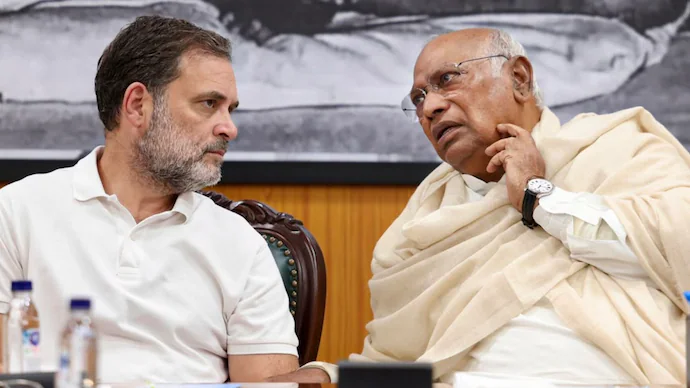
The political confrontation over the proposed delimitation legislation intensified after Congress president Mallikarjun Kharge accused the BJP of seeking to secure permanent political dominance through the constitutional changes being considered by the Narendra Modi government. Following a meeting of INDIA bloc leaders, Kharge said Opposition parties had collectively decided to oppose the proposed legislation in Parliament, arguing that it threatened democratic institutions and failed to adequately protect the interests of Scheduled Castes (SCs) and Scheduled Tribes (STs).
Kharge’s remarks, including his reference to the BJP’s alleged ambition of achieving “800 paar”, added a sharper political dimension to the debate over increasing the strength of the Lok Sabha. The Opposition’s concerns extend beyond the proposed expansion of parliamentary seats to questions about how constituencies would be redistributed, whether historically disadvantaged communities would retain adequate representation and how the changes could affect the balance of political power between states.
The INDIA bloc meeting also exposed differences within the Opposition alliance. Sharad Pawar’s Nationalist Congress Party (Sharadchandra Pawar) faction did not attend the meeting, even as its reported willingness to support the delimitation legislation had already drawn criticism from Congress leaders.
Why Mallikarjun Kharge Is Opposing the Delimitation Bill
Addressing journalists after the INDIA bloc meeting, Kharge said Opposition leaders had reached a collective decision to resist the constitutional amendment proposed by the Modi government. He described the legislation as a threat to democracy and accused the ruling party of attempting to consolidate power through changes to the country’s parliamentary framework.
Kharge said: “All the leaders have collectively decided that the Constitution Amendment Bill being brought by the Modi government poses a major threat to democracy. They want to destroy democracy and take complete control of power.”
His criticism reflects the Opposition’s broader concern that the proposed constitutional changes could have consequences extending well beyond the immediate increase in the number of parliamentary seats. Delimitation determines the boundaries of electoral constituencies and can influence how political representation is distributed across the country.
The Congress president also highlighted the position of Scheduled Castes and Scheduled Tribes, arguing that the proposed amendment did not sufficiently protect their interests. This concern is significant because reserved constituencies form an important part of India’s constitutional framework for ensuring political representation of historically disadvantaged communities.
For the Opposition, the central question is not simply whether the Lok Sabha should have more members. It is whether the proposed expansion and the process used to redraw constituencies will preserve fair representation across states and social groups.
What Does the ‘800 Paar’ Remark Mean?
The expression “800 paar” is a political reference to the possibility of a substantially larger Lok Sabha following the proposed increase in parliamentary seats. The BJP’s reported plan to expand the strength of the House has become a major point of disagreement between the government and Opposition parties.
Kharge used the phrase to question the political intentions behind the legislation. By suggesting that the BJP was pursuing an “800 paar” objective, he sought to portray the proposed changes as an attempt to strengthen the ruling party’s position for the long term.
However, the proposed expansion of the Lok Sabha and the BJP’s alleged political motives are separate issues. An increase in the number of seats would change the size of the legislature, but it would not automatically guarantee electoral victory or permanent control for any political party.
The political dispute centres on how the additional seats would be allocated, how the delimitation process would operate and whether the new arrangement would alter the relative influence of different states. These questions are particularly sensitive because India’s population growth has not been uniform across regions.
Why SC and ST Representation Has Become a Major Issue
One of Kharge’s strongest objections concerns the protection of Scheduled Caste and Scheduled Tribe representation under the proposed constitutional amendment.
India’s Constitution provides for reserved seats in the Lok Sabha and state legislative assemblies for SCs and STs. These constituencies are intended to ensure that communities historically excluded from political power have elected representatives in legislatures.
Any major expansion of parliamentary representation therefore raises questions about how reserved seats will be calculated and distributed. If the total number of constituencies changes, the process must also address how representation for SC and ST communities will be maintained under the revised structure.
The Opposition’s argument is that these safeguards must be clearly established rather than left uncertain during the implementation of a larger delimitation exercise.
The issue also has a wider constitutional dimension. Delimitation is not merely an administrative exercise involving the redrawing of electoral boundaries. It can affect the political voice of communities and regions, making transparency and clearly defined rules important to public confidence in the process.
INDIA Bloc Opposition Faces Questions Over Internal Unity
Although the INDIA bloc leaders announced a collective decision to oppose the proposed amendment, the absence of Sharad Pawar’s NCP(SP) faction highlighted the difficulties of maintaining a unified Opposition position.
Pawar’s party had come under criticism from Congress after reports suggested that it was prepared to support the delimitation legislation alongside women’s reservation. NCP(SP) working president Supriya Sule had said the party would take a formal position after examining the bill, while party sources indicated support for the proposal.
The disagreement illustrates a broader challenge facing the INDIA bloc. Its constituent parties have different regional interests, political priorities and calculations about how constitutional and electoral reforms could affect their respective states.
Congress wants the Opposition to present a coordinated position against the proposed legislation. Regional parties, however, may assess the bill according to its implications for their own political constituencies and state-level representation.
The absence of Pawar’s faction is particularly significant because the NCP(SP) has been an important participant in Opposition politics in Maharashtra. Its reported position on the bill has also given the BJP an opportunity to question Congress’s criticism of a leader whose support helped the party form governments in the state in the past.
The episode shows that the delimitation debate is testing not only the relationship between the ruling party and the Opposition but also the ability of Opposition allies to agree on a common constitutional position.
Why Delimitation Is Politically Sensitive Across Indian States
Delimitation involves redrawing electoral constituency boundaries to reflect changes in population and ensure that constituencies are represented according to the applicable constitutional framework.
In India, the exercise has particular political importance because states have experienced different rates of population growth. Some states have raised concerns that a population-based redistribution of Lok Sabha seats could increase the relative influence of states with larger populations while reducing the share of states that have made greater progress in population stabilisation.
This concern has been especially prominent among several southern states. Their political leaders have argued that states should not face a reduction in their relative parliamentary influence because of population trends that are partly connected to differences in development and family-planning outcomes.
The debate therefore involves a difficult balance between population-based representation and the principle that states should retain a meaningful voice in national decision-making.
The proposed legislation has made this issue more urgent by linking changes to the strength of Parliament with the future implementation of women’s reservation. The government and Opposition may agree on the objective of expanding representation but disagree over the mechanism and timing of the changes.
How Women’s Reservation Became Linked to the Delimitation Debate
The proposed constitutional changes are also connected to the implementation of the 2023 women’s reservation law, which provides for reserving one-third of seats in the Lok Sabha and state legislative assemblies for women.
Although Parliament passed the legislation in 2023, the reservation is linked to a future delimitation exercise following the publication of relevant Census figures. This means the reservation framework does not automatically take effect immediately after the law’s passage.
The government has presented the proposed legislative package as a route towards implementing women’s reservation by reorganising parliamentary and assembly representation. The Opposition’s concerns, however, focus on whether the accompanying delimitation process could change the balance of representation among states and communities.
This distinction is important. Supporting greater political participation for women does not necessarily mean agreeing with every provision of a delimitation proposal. Similarly, opposing the proposed mechanism does not automatically establish opposition to women’s reservation itself.
The debate is therefore likely to involve both the principle of women’s representation and the constitutional process through which the reservation will be implemented.
What Happens Next in Parliament?
With the INDIA bloc announcing its opposition, the proposed constitutional amendment is expected to face a politically contested debate when it comes before Parliament. The government will need to address concerns about the allocation of seats, the position of SC and ST communities and the implications for states with different population trends.
A constitutional amendment also faces a higher parliamentary threshold than an ordinary bill. It requires a majority of the total membership of each House and at least a two-thirds majority of members present and voting in both the Lok Sabha and Rajya Sabha. Depending on the provisions involved, ratification by at least half of the state legislatures may also be necessary.
This makes negotiations with parties beyond the government’s immediate political support particularly important. The position of regional parties and smaller parliamentary groups could influence the debate and the government’s ability to secure the required numbers.
For Congress and its INDIA bloc allies, the immediate challenge is to maintain a common position while explaining their objections in constitutional and representative terms. For the government, the challenge is to demonstrate that the proposed changes can expand representation without creating an unfair distribution of political influence.
Delimitation Debate Becomes a Larger Test of Political Representation
Kharge’s “800 paar” remark has turned the proposed delimitation legislation into a wider political confrontation over the future structure of Indian democracy. The Congress president has framed the government’s initiative as an attempt to retain power, while the Opposition bloc has raised concerns about constitutional safeguards and the representation of SCs and STs.
At the same time, the absence of Pawar’s NCP(SP) faction from the INDIA bloc meeting demonstrates that the Opposition is still navigating differences over how to respond to the legislation.
The eventual debate will have implications beyond the immediate political contest. The size of the Lok Sabha, the distribution of seats among states, reserved representation and the implementation of women’s reservation are all connected to how citizens are represented in Parliament.
The key question is whether the proposed changes can secure broad constitutional agreement while addressing concerns about fairness, representation and federal balance. The government’s legislative ambitions and the Opposition’s objections will now face scrutiny in Parliament, where the outcome will depend not only on political rhetoric but also on the provisions of the bills and the constitutional support they can command.
For breaking news and live news updates, like us on Facebook or follow us on Twitter and Instagram. Read more on Latest India on thefoxdaily.com.





COMMENTS 0