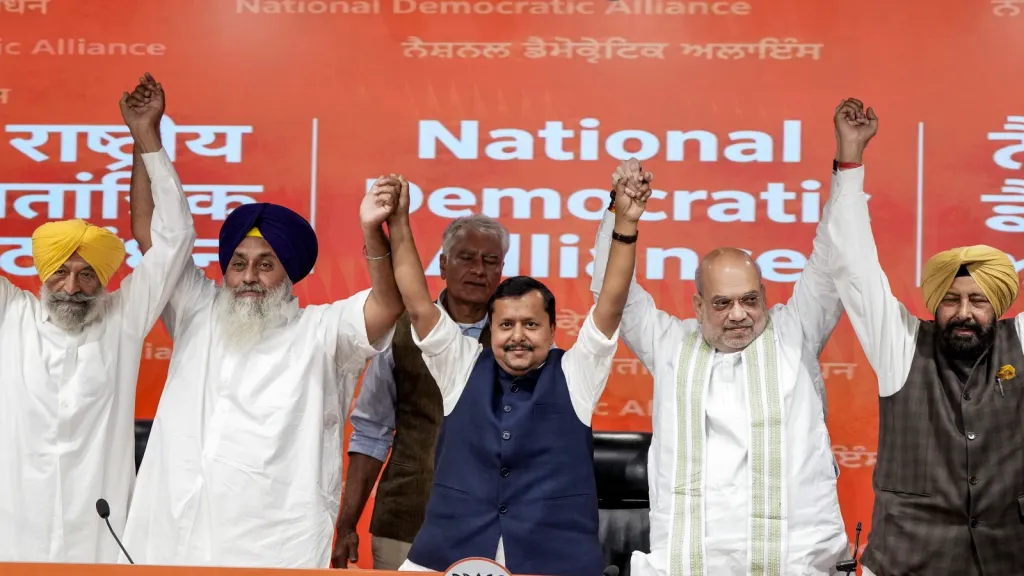
The political landscape of Punjab has entered a new phase after the Bharatiya Janata Party (BJP) and the Shiromani Akali Dal (SAD), led by Sukhbir Singh Badal, formally announced their decision to contest the 2027 Assembly elections together. The announcement on November 24, 2026, ended a six-year separation between two parties that had once governed the state together for a decade and remained among the most established political partnerships in Punjab.
The reunion did not happen simply because the two parties had decided to revive an old relationship. Behind the agreement were electoral calculations, concerns about their declining political influence, disagreements over who would lead a future government and the BJP’s difficulty in establishing itself as a strong independent alternative across Punjab.
According to BJP leaders familiar with the negotiations, Prime Minister Narendra Modi encouraged the party leadership to pursue an alliance with the Akalis. Union Home Minister Amit Shah subsequently played a central role in resolving disagreements that had prevented the discussions from moving forward. One of the most difficult questions was whether the BJP, encouraged by its improved vote share in the 2024 Lok Sabha elections, should demand the chief minister’s position.
The final arrangement moved away from that expectation. At the alliance announcement, Shah indicated that the Akali Dal would occupy the senior-partner position and that the chief minister would come from the regional party. The decision reflected a political compromise: the BJP would gain an established partner with a traditional support base in Punjab, while the Akalis would receive the national political backing needed to strengthen their position ahead of a difficult election.
How Modi’s push changed the BJP’s approach to Punjab
The BJP’s decision to reconsider its relationship with the Akali Dal came after the party spent years trying to expand its independent political presence in Punjab. The state has a distinct political and social structure in which religious identity, agricultural concerns, regional issues and the legacy of the farmers’ movement have a major influence on electoral choices.
Although the BJP has traditionally enjoyed support among sections of the Hindu electorate, it has struggled to build comparable influence among important Sikh voting groups, particularly in rural constituencies. Its former alliance with the Akali Dal helped overcome some of these limitations by combining the BJP’s urban support base with the Akalis’ established political network and influence among sections of the Sikh community.
After the alliance collapsed in 2020, the BJP attempted to establish itself independently. The party increased its organisational activity, developed its own political messaging and tried to strengthen its connection with Sikh voters. Prime Minister Modi also made several outreach efforts towards the Sikh community, with the national leadership seeking to change perceptions of the BJP and improve its acceptance in Punjab.
However, organisational expansion did not automatically translate into a convincing electoral alternative. The party continued to face challenges in constituencies where the Akali Dal had traditionally been influential. The BJP also had to compete with the Aam Aadmi Party (AAP) and the Congress, both of which had their own established political networks in the state.
Party insiders have indicated that Modi’s intervention gave the alliance discussions greater political importance. Rather than treating reconciliation as a decision that could be left entirely to the Punjab unit, the national leadership began viewing it as part of a broader strategy to rebuild the National Democratic Alliance (NDA) and improve the BJP’s prospects in a state where it had not managed to become a dominant force independently.
The renewed relationship was also connected to the BJP’s longstanding political association with the Badal family. Parkash Singh Badal, the former Punjab chief minister and SAD patriarch, had maintained a close relationship with the BJP leadership for years. His political legacy remained an important part of the historical connection between the two parties.
Why the BJP reconsidered going it alone
The most important factor behind the BJP’s change of strategy was the electoral arithmetic emerging from internal assessments. According to party sources, surveys suggested that neither the BJP nor the Akali Dal appeared strong enough individually to challenge the AAP and Congress effectively across the state. However, their combined political strength could create a more credible alternative.
One assessment reportedly suggested that both parties could win around a dozen seats each if they contested independently. The possibility of combining their support bases offered a different calculation, particularly if voters dissatisfied with the ruling AAP government were looking for an alternative capable of challenging it.
The BJP’s internal exercises reportedly examined multiple electoral combinations before the leadership moved towards an alliance. The party’s Punjab strategy involved assessments of constituency-level political conditions, the relative strength of its organisation and the possibility of recovering support lost after the breakup of the previous partnership.
These assessments were important because anti-incumbency does not necessarily benefit a single opposition party. When several parties compete for the same dissatisfied voters, opposition votes can become divided, allowing the ruling party to retain an advantage even when public dissatisfaction exists.
The BJP and SAD leadership appeared to recognise this problem. A combined electoral arrangement could bring together voters who might otherwise support different opposition parties or remain undecided. It could also help both organisations coordinate their political messaging and avoid competing directly in constituencies where one partner has a stronger local presence.
However, internal surveys are not election results. Their findings depend on methodology, timing, voter participation and changing political circumstances. The alliance may improve the parties’ electoral position, but its actual strength will become clearer only when candidates are selected, seat-sharing arrangements are finalised and voters respond to the combined campaign.
Amit Shah’s intervention resolved the chief minister question
Leadership arrangements were among the biggest obstacles to reviving the BJP-Akali relationship. The Punjab BJP unit had reasons to demand a larger role than it had enjoyed under the earlier alliance. The party’s vote share had increased from 9.63 per cent in the 2019 Lok Sabha elections to 18.56 per cent in 2024, strengthening the argument among some state leaders that the BJP deserved greater political authority.
For sections of the state leadership, the improved vote share indicated that the party should not simply return to its previous position as a junior partner. Some leaders believed the BJP should have a claim to the chief minister’s post if the alliance returned to power.
That position created a serious difficulty. The Akali Dal had historically been the dominant partner in the relationship and had led the Punjab government during the parties’ previous periods in power. Asking the regional party to surrender the chief minister’s position could have made an agreement much harder to achieve.
According to BJP insiders, Amit Shah intervened to move the negotiations towards a more practical arrangement. The national leadership recognised that securing an alliance was more important than pursuing demands that could prevent the partnership from being revived.
The final public announcement provided clarity on the leadership question. Shah described the Akali Dal as the senior partner, using the expression “bada bhai”, and indicated that the chief minister would come from the party occupying that position.
This was a significant concession to the Akalis. It acknowledged their regional political identity and historical position within Punjab while allowing the BJP to return to a partnership that could expand its electoral reach. For the BJP, the arrangement also avoided the risk of losing a potential ally over a disagreement about the distribution of power before the election had even taken place.
It is important to distinguish between the reported negotiations and the formal announcement. The internal discussions explain how the parties reached an agreement, while Shah’s public remarks established the broad leadership understanding. The detailed division of constituencies and other organisational responsibilities remained matters for subsequent discussions.
Why the Akali Dal needed the BJP again
The alliance is not only an opportunity for the BJP. The Akali Dal also has strong reasons to return to the partnership after years of political setbacks.
The party was once one of Punjab’s most influential political forces. Under Parkash Singh Badal, it governed the state in partnership with the BJP from 2007 to 2017. That decade in power gave the alliance a strong organisational presence, particularly in rural Punjab, where the Akali Dal had established networks and a longstanding political identity.
Its position weakened after the 2017 Assembly election, when the party lost power and its seat tally fell sharply. The separation from the BJP in 2020 was followed by another difficult election in 2022. The Akali Dal won only three of the 117 Assembly seats, while the BJP secured two. The AAP, meanwhile, won 92 seats and formed the government under Bhagwant Mann.
The Akali Dal’s difficulties have also involved challenges within its traditional political space. Breakaway groups, disagreements over leadership, religious and Panthic issues and the influence of rival political movements have complicated its efforts to consolidate support. The party has had to confront questions about its political direction and its ability to reconnect with voters who once regarded it as a natural choice in Punjab.
Returning to the NDA offers the Akalis access to the BJP’s national organisation, campaign resources and political network. It also provides a route to challenge the AAP and Congress through a broader alliance rather than attempting to rebuild their electoral strength entirely on their own.
For Sukhbir Singh Badal, the agreement is particularly significant because it restores a partnership closely associated with his father’s political legacy. The reunion also gives the Akali Dal an opportunity to position itself as the principal regional partner in a larger coalition rather than as a smaller opposition party competing independently.
What caused the original BJP-Akali alliance to collapse?
The BJP and the Akali Dal had maintained a long political relationship before their separation in September 2020. Their alliance was based partly on complementary electoral support: the BJP traditionally contested a limited number of seats where it had a stronger urban presence, while the Akali Dal focused on a much larger share of constituencies across the state.
The partnership broke down over the Centre’s three farm laws, which became the focus of widespread protests by farmers, particularly in Punjab and neighbouring Haryana. The legislation was intended to change aspects of agricultural marketing and trade, but many farmers and agricultural organisations feared it could weaken the existing procurement system and expose them to greater corporate influence.
The Akali Dal faced considerable political pressure because of its relationship with farming communities. In September 2020, the party withdrew from the NDA in opposition to the legislation. Harsimrat Kaur Badal, who was then a Union minister, resigned from the Union Cabinet, and the party formally ended its decades-long partnership with the BJP.
The dispute became a defining moment in Punjab Politics. The farmers’ agitation developed into a major national movement, and the relationship between the BJP and the Akali Dal remained damaged even after the Centre repealed the three farm laws in November 2021.
Although the repeal removed the immediate legislative dispute, it did not automatically restore political trust. Both parties needed time to reassess their positions, while the Akali Dal had to address the political consequences of its earlier association with the BJP and the farmers’ movement.
The latest reunion therefore represents more than the restoration of an old seat-sharing arrangement. It indicates that both parties have decided their electoral interests now justify putting aside a disagreement that once appeared too serious to overcome.
How the BJP and Akalis plan to challenge AAP and Congress
The alliance is expected to reshape the contest for the 117-seat Punjab Assembly. The AAP currently governs the state, while the Congress remains an important opposition force. Both parties will have to account for a combined BJP-Akali campaign rather than face two separate opponents with potentially competing support bases.
The BJP brings national political visibility, an established organisation outside Punjab and its traditional support among sections of urban voters. The Akali Dal contributes a regional identity, local political networks and connections with sections of the Sikh electorate. Whether these strengths can translate into a common electoral advantage will depend on how effectively the parties manage their differences.
At the alliance announcement, Amit Shah said both parties would contest the 117 Assembly constituencies. However, this does not mean that each party will field a candidate in every seat. The parties are expected to divide the constituencies between them through a seat-sharing arrangement, with the detailed allocation to be worked out separately.
The division of seats will be one of the first major tests of the renewed partnership. The BJP may seek a larger share than it received under the earlier arrangement, particularly because its leaders believe its electoral presence has improved. The Akali Dal, on the other hand, will want to protect its position as the senior regional partner and retain constituencies where it has a stronger local organisation.
Any disagreement over constituencies could create friction between local leaders, especially where both parties have active workers and competing candidates. The alliance will therefore need a process for resolving claims, managing expectations and preventing internal disputes from weakening the campaign.
Beyond seat-sharing, the parties will need a common programme addressing Punjab’s major concerns. These include agricultural income, employment opportunities, the state’s financial position, drug trafficking, law and order, rural development and the future of young people who continue to leave the state in search of work and education.
Drug menace, farmers and Hindu-Sikh unity become central themes
The BJP and the Akali Dal have already indicated that drug-related problems and Punjab’s wider social and economic challenges will be important parts of their political messaging. Amit Shah has highlighted the need to tackle the drug menace, while the alliance has been presented by its leaders as a partnership that can strengthen Hindu-Sikh unity.
The emphasis on Hindu-Sikh relations reflects the historical character of the old alliance. The BJP and the Akali Dal have often described their partnership as a political expression of cooperation between communities that have long shared social, economic and cultural connections in Punjab.
For the BJP, rebuilding confidence among Sikh voters is a major political objective. The Akali Dal’s participation could help the party reach sections of the electorate where it has struggled to establish an independent presence. For the Akalis, the partnership offers a way to combine their regional appeal with the BJP’s national reach.
Farmers will remain another sensitive issue. The events of 2020 and 2021 continue to shape how many voters view the BJP and its relationship with agricultural communities. The Akali Dal’s return to the alliance does not automatically resolve those concerns. Both parties will need to demonstrate that their renewed partnership can address farmers’ demands and protect Punjab’s agricultural interests.
The drug issue also requires more than election promises. Punjab has faced persistent concerns about substance abuse, trafficking networks and the social consequences of addiction. A credible political response will require effective policing, action against organised networks, treatment facilities, prevention programmes and support for affected families.
These issues could become important tests of the alliance’s credibility. Voters will be looking not only at the parties’ political claims but also at whether their proposed policies offer practical answers to problems affecting households across the state.
Will the reunited alliance be enough to change Punjab’s electoral arithmetic?
The BJP-Akali reunion gives both parties a stronger starting position than they had when contesting separately in 2022. However, the alliance should not be treated as a guaranteed electoral victory. Punjab’s political environment has changed considerably since the two parties last governed together, and their former support bases may not automatically return.
The AAP’s 2022 victory demonstrated that voters were willing to move away from the traditional political competition between the Congress and the Akali-BJP combination. The party’s performance also showed the importance of presenting a clear alternative to established political organisations.
The Congress, despite losing power in 2022, remains a significant political force. Its ability to consolidate opposition votes and capitalise on dissatisfaction with the state government could influence the outcome. The BJP-Akali alliance will have to compete with both parties while also addressing questions about its own record and leadership.
The Akali Dal’s organisational recovery will be especially important. An alliance can help the party expand its reach, but it cannot automatically restore the trust of voters who have shifted towards other political options. Similarly, the BJP must demonstrate that it can work with a regional partner without creating confusion over its political identity and local leadership.
The presence of multiple Akali factions and other regional political groups could further complicate the electoral contest. Reports that some breakaway groups may be open to joining the alliance suggest that the reunion could have implications beyond the two main parties. However, any such expansion would depend on formal political decisions and agreement among the organisations involved.
The parties must also ensure that their workers accept the arrangement. Leaders may agree on a common electoral strategy at the national level, but local rivalries can become difficult to manage when candidates and constituencies are involved. The success of the partnership will depend partly on whether the two organisations can coordinate their ground-level operations.
What happens next after the BJP-SAD reunion?
With the alliance formally announced, attention will now shift towards the practical details of the partnership. Seat-sharing negotiations, candidate selection, campaign leadership and a common political programme will determine how the agreement translates into an election strategy.
The understanding that the Akali Dal will be the senior partner and provide the chief ministerial face has resolved one major disagreement. But it does not settle every question about how power and responsibilities will be distributed if the alliance wins the election.
The BJP will want a meaningful share of constituencies and a role that reflects its expanded political ambitions. The Akali Dal will seek to preserve its regional leadership and avoid becoming dependent on a national party at the cost of its own identity. Balancing these priorities will require continued coordination between the leaderships.
The reunion also carries a larger message for the NDA. The return of a former long-term ally demonstrates the BJP’s willingness to revive relationships when electoral and political circumstances make cooperation advantageous. It may also strengthen the alliance’s presence in a state where it has struggled to convert national political influence into Assembly victories.
Ultimately, Modi’s reported push and Amit Shah’s intervention helped overcome the political disagreements that had kept the two parties apart. But the more difficult test lies ahead. The BJP and the Akali Dal must now convince Punjab’s voters that their partnership is not simply a return to an old political arrangement, but a credible response to the state’s current challenges.
After six years of separation, the two parties have restored their political partnership. Whether that reunion can recreate the electoral strength they once enjoyed will depend on the voters of Punjab, the credibility of their campaign and their ability to turn an agreement between party leaders into a workable alliance on the ground.
For breaking news and live news updates, like us on Facebook or follow us on Twitter and Instagram. Read more on Latest India on thefoxdaily.com.






COMMENTS 0