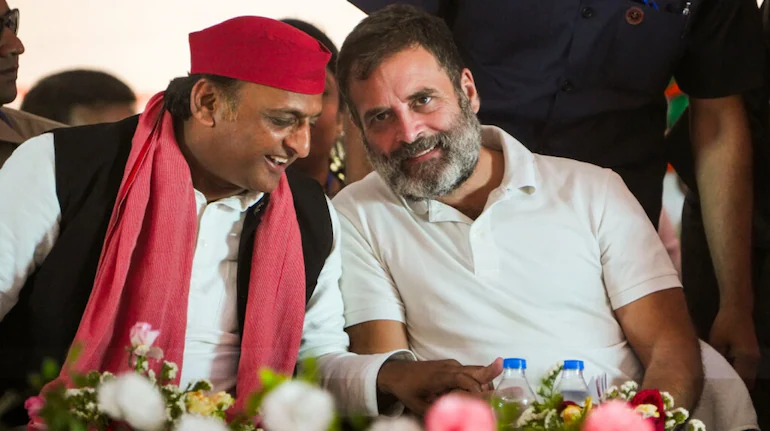
The seat-sharing negotiations between the Samajwadi Party (SP) and Congress ahead of the 2027 Uttar Pradesh Assembly elections have encountered a major disagreement over the number of constituencies each party should contest. The Congress has reportedly sought 131 seats in the 403-member Assembly, while the SP has responded with an offer of just 26 constituencies, according to reports.
The sharp difference between the two proposals highlights the difficult negotiations facing the INDIA Bloc partners as they attempt to build a joint electoral strategy against the ruling Bharatiya Janata Party (BJP) in Uttar Pradesh. While Congress is seeking a substantially larger share to expand its political presence across the state, the SP appears determined to allocate seats primarily on the basis of electoral strength and candidates’ chances of winning.
The proposed 26-seat list reportedly includes two constituencies won by Congress in the 2022 Assembly elections and four where the party finished second. The remaining 20 seats are spread across western Uttar Pradesh, the Braj region, central Uttar Pradesh and eastern parts of the state.
The disagreement comes as both parties conduct constituency-level assessments and exchange lists of their preferred seats. Their leaders have indicated that negotiations will continue, with the possibility of an agreement emerging after further discussions. However, the difference between Congress’s demand and the SP’s reported offer shows that the final arrangement could require significant compromises.
Why the SP has offered Congress only 26 seats
The Samajwadi Party’s reported proposal reflects its emphasis on the electoral performance of candidates rather than the numerical expectations of its alliance partner. The party is examining Congress’s requested constituencies and has reportedly asked for details about the candidates Congress intends to field and their prospects of winning.
According to reports, the SP’s proposed list contains 26 constituencies, including six seats where Congress demonstrated some electoral strength in the 2022 Uttar Pradesh Assembly elections. The remaining constituencies appear to have been selected as potential areas where the Congress could contest without directly challenging the SP’s stronger electoral positions.
The 20 additional constituencies reportedly included in the SP proposal are:
- Baghpat
- Modinagar
- Hapur
- Jewar
- Syana
- Khurja
- Khair
- Iglas
- Mant
- Agra North
- Fatehpur Sikri
- Bilgram-Mallanwan
- Govind Nagar
- Nanpara
- Gorakhpur Urban
- Khajani
- Padrauna
- Fazilnagar
- Pindra
- Varanasi Cantt
The reported list indicates that the SP is not simply offering Congress a collection of constituencies without considering the wider electoral map. The proposed seats cover different regions and political environments, giving Congress opportunities to contest beyond a limited geographical area.
However, the list does not necessarily represent a final agreement. Both parties are still examining their respective claims, and the allocation could change as negotiations progress. The final decision will depend on the leadership of the two parties and their assessment of the alliance’s overall electoral prospects.
Congress seeks 131 seats to expand its presence across Uttar Pradesh
Congress’s reported demand for 131 constituencies reflects its ambition to secure a substantial role in the next Uttar Pradesh Assembly election. The party is looking beyond its limited representation in the state legislature and wants to contest a wider range of constituencies where it believes its organisation, local leadership and alliance with the SP could make a difference.
Uttar Pradesh has 403 Assembly constituencies, making it the country’s largest state legislature. A demand for 131 seats would allow Congress to contest roughly one-third of the constituencies, giving it a significant opportunity to rebuild its political organisation and establish a stronger presence across the state.
For Congress, the negotiations are about more than the number of candidates it can field. Contesting a larger number of seats could help the party strengthen its local networks, give regional leaders greater political visibility and improve its ability to mobilise voters independently in future elections.
The party also has to consider its position within the INDIA bloc. A smaller allocation could limit its influence in the state, particularly if the SP emerges as the dominant partner in the alliance. Congress therefore has an incentive to negotiate a seat-sharing formula that gives it enough constituencies to demonstrate political relevance while maintaining cooperation with Akhilesh Yadav’s party.
However, the challenge is convincing the SP that a larger allocation would translate into additional victories rather than create electoral risks. That is where the two parties’ approaches appear to differ. Congress is seeking broader representation, while the SP is reportedly focusing on whether individual candidates can win their constituencies.
2022 Assembly election results complicate Congress’s demand
The electoral record of both parties in the 2022 Uttar Pradesh Assembly elections is an important factor in the negotiations. The SP won 111 seats and emerged as the principal opposition party, while Congress secured only two constituencies.
That difference gives the SP a stronger argument for demanding a larger share of the seats. From its perspective, the party has a much wider electoral base in Uttar Pradesh and would not want to surrender constituencies where it believes its candidates have a better chance of defeating the BJP.
Congress, meanwhile, faces the challenge of demonstrating that its current electoral position does not fully reflect its potential in a broader alliance. The party can argue that a joint campaign could improve its performance by combining its organisational presence and voter support with the SP’s stronger regional network.
The 2022 results also explain why the SP is reportedly asking Congress to provide details about its proposed candidates. A party’s past performance alone cannot determine whether it can win a particular constituency, but it offers a starting point for evaluating its political strength.
Candidate reputation, local organisation, caste and community equations, previous election margins and the ability to attract voters from both alliance partners are likely to influence the final decision.
The SP’s approach suggests that it wants to avoid allocating constituencies simply to satisfy a numerical demand. Instead, it wants the Congress to demonstrate why its candidates should be preferred in the seats it has requested.
Ram Gopal Yadav calls discussions encouraging
The first round of negotiations brought representatives of both parties together in New Delhi, where they exchanged their preferred constituency lists. Congress handed over its list of seats it wants to contest, while the SP presented its own proposal and began examining the Congress demands.
After the meeting, senior SP leader and Rajya Sabha MP Ram Gopal Yadav described the discussions as encouraging. He played down concerns about the short duration of the meeting, suggesting that complicated political issues require time to resolve.
Yadav expressed confidence that the two parties could reach an agreement within the next two to three days. His remarks indicated that the SP leadership was not treating the differences as a reason to abandon negotiations.
However, the reported gap between 131 seats sought by Congress and the SP’s offer of 26 makes the remaining discussions particularly important. The parties must find a formula that allows both to claim a meaningful role in the alliance without weakening their combined electoral prospects.
The negotiations also involve more than simply deciding how many seats each party will contest. The leaders must examine the political conditions in individual constituencies, assess possible candidates and determine whether transferring support between alliance partners could help defeat the BJP.
Rajeev Rai says candidate winnability will decide seat allocation
SP MP Rajeev Rai has repeatedly emphasised that the alliance’s primary objective is to win as many constituencies as possible. Speaking to ANI ahead of the next round of discussions, he said both parties had exchanged lists and would now examine the constituencies individually.
Rai said the SP had studied the list submitted by Congress and would present its assessment during the negotiations. He stressed that the objective was to defeat the BJP and that the alliance could achieve this only by selecting candidates with strong electoral prospects.
He also explained that the two parties had maintained communication throughout the process and were not meeting for the first time. According to Rai, the discussions were part of an ongoing exercise to assess all 403 Assembly constituencies.
He indicated that the negotiations would take time because the parties intended to evaluate the entire state rather than make decisions based on a limited number of seats.
The emphasis on winnability is politically significant. In a multi-party contest, seat allocation can determine whether opposition votes are consolidated behind one candidate or divided among competing parties. If two alliance partners select candidates in constituencies where they both have meaningful support, they risk weakening each other’s chances and potentially benefiting the BJP.
For the SP, therefore, the priority appears to be ensuring that the alliance fields the strongest possible candidate in every constituency. Congress, on the other hand, must establish that its proposed candidates can attract enough support to justify the seats it is seeking.
Why the 403-seat constituency assessment matters
Uttar Pradesh’s 403 Assembly constituencies present a complex political landscape. Electoral conditions vary considerably between western Uttar Pradesh, the central region, Bundelkhand, the Braj belt and eastern Uttar Pradesh.
A candidate’s prospects can depend on local political networks, community representation, previous election results, organisational strength and the performance of sitting legislators. A seat that appears favourable to one party at the state level may present a very different picture when examined at the constituency level.
This is why the SP and Congress are reportedly conducting a seat-by-seat assessment rather than relying entirely on a fixed numerical formula.
The exercise also has implications for the distribution of opposition votes. A successful alliance must ensure that supporters of both parties are willing to vote for whichever candidate receives the joint nomination. This requires more than an agreement between senior leaders; it also depends on cooperation between local workers and acceptance of candidates across party organisations.
If Congress receives a constituency where the SP has a stronger local organisation, the alliance would need to ensure that SP workers actively support the Congress candidate. The same challenge would arise in reverse if Congress supporters were asked to back an SP nominee.
Seat-sharing negotiations are therefore an early test of how effectively the two parties can coordinate their political machinery before the election campaign begins.
BJP targets SP-Congress alliance over Emergency and democracy
As the opposition parties continue their negotiations, the BJP has criticised their proposed alliance. Uttar Pradesh Deputy Chief Minister Brajesh Pathak took aim at both the SP and Congress, arguing that the parties should apologise to the country for the imposition of the Emergency in 1975.
Pathak also accused the two parties of having little connection with democracy and the Constitution. His remarks added a political confrontation to the ongoing seat-sharing discussions, with the BJP seeking to challenge the credibility of the opposition alliance.
The Emergency remains a significant political reference point in Indian politics. Declared in June 1975 by the government led by then Prime Minister Indira Gandhi, it lasted until March 1977 and is associated with restrictions on civil liberties, press censorship and the detention of political opponents.
Congress continues to face criticism over that period because it was the party leading the government when the Emergency was imposed. The BJP’s attack attempts to use that historical episode to question the political positions of Congress and its current partners.
For the SP and Congress, however, the immediate challenge is to demonstrate that their alliance can offer a credible electoral alternative in Uttar Pradesh. Their ability to settle constituency disputes and maintain a united public position will be important as the election approaches.
What the seat-sharing dispute means for the INDIA bloc
The negotiations in Uttar Pradesh carry significance beyond the two parties because of the state’s importance in national politics. With 80 Lok Sabha constituencies, Uttar Pradesh plays a major role in determining the balance of power in Parliament. Its Assembly elections are also an important test of the political strength of parties seeking to challenge the BJP.
The SP and Congress worked together under the INDIA bloc arrangement during the 2024 Lok Sabha elections in Uttar Pradesh. Their cooperation helped establish a joint opposition challenge, with the SP winning 37 parliamentary seats and Congress securing six in the state.
That performance demonstrated the potential benefits of coordination between the two parties. It also raised expectations that they could maintain their partnership in the next Assembly election.
However, the conditions of a parliamentary election and an Assembly election are not identical. Parliamentary contests are fought across larger constituencies, while Assembly elections depend more heavily on local candidates, regional political networks and constituency-level issues.
A formula that worked in the 2024 Lok Sabha election may therefore require adjustments before the 2027 Assembly contest. Both parties must decide how to translate their previous cooperation into a distribution of 403 constituencies.
The current disagreement also presents a test for the INDIA bloc’s broader political coordination. If its largest regional partners in Uttar Pradesh struggle to reach an agreement, it could raise questions about the alliance’s ability to manage competing demands in other states.
Can SP and Congress reach a seat-sharing agreement?
Despite the reported disagreement, leaders from both parties have expressed confidence that negotiations can produce an arrangement. Ram Gopal Yadav’s expectation of an agreement within two to three days and Rajeev Rai’s emphasis on continued discussions suggest that both sides remain interested in preserving the alliance.
Nevertheless, the difference between the Congress demand and the SP proposal is substantial. A settlement will require Congress to consider whether it can accept fewer constituencies than requested, while the SP will have to decide how much political space it is prepared to offer its ally.
Several factors could influence the final formula: the electoral performance of each party, the strength of proposed candidates, local political conditions, the importance of traditional strongholds and the need to avoid splitting opposition votes.
Congress may also seek constituencies where it believes its organisation can grow, even if its recent Assembly election performance has been limited. The SP, meanwhile, will want to protect its stronger seats and ensure that any concessions do not reduce its overall chances of defeating the BJP.
The reported offer of 26 seats should therefore be treated as a negotiating position rather than a confirmed final allocation. Until both parties formally announce an agreement, the number of constituencies each will contest remains subject to change.
Ultimately, the success of the SP-Congress alliance will depend less on the headline number of seats each party receives and more on whether the final arrangement produces competitive candidates, effective coordination and a united campaign. The negotiations are an early indication of how difficult that task could become as Uttar Pradesh moves towards the 2027 Assembly elections.
For breaking news and live news updates, like us on Facebook or follow us on Twitter and Instagram. Read more on Latest India on thefoxdaily.com.






COMMENTS 0