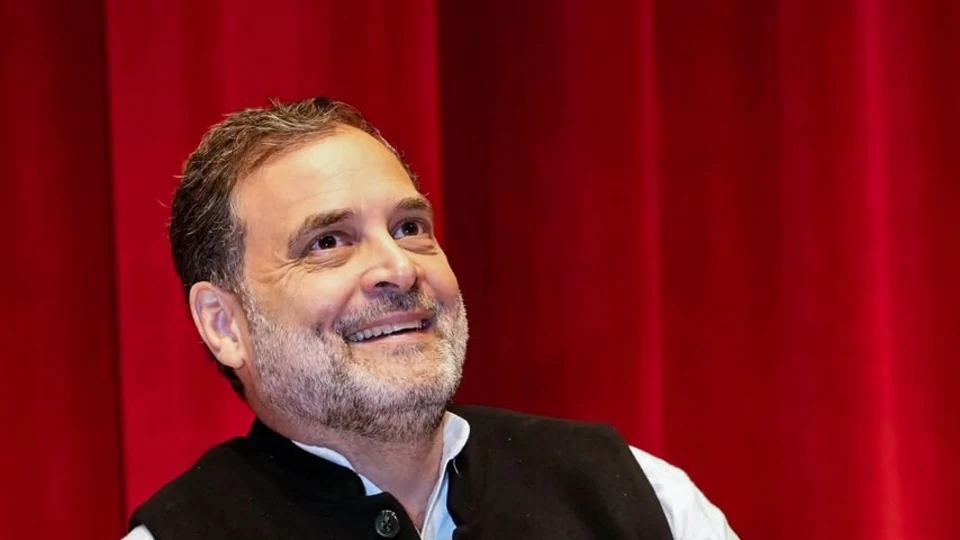
Congress leader and Leader of Opposition in the Lok Sabha Rahul Gandhi on Sunday launched a fresh attack on the Bharatiya Janata Party (BJP) and the Rashtriya Swayamsevak Sangh (RSS), describing them as “uncouth, greedy, casteist male chauvinists” and accusing them of having no understanding of India’s spiritual and religious traditions.
Gandhi made the remarks in a post on X, sharing an image of an ardhanareshwar sculpture depicting Lord Shiva and Goddess Parvati as a single divine form. The image, photographed at the Elephanta Caves, became the centrepiece of his criticism, which connected religious symbolism with questions of gender, equality and social attitudes.
His latest comments came days after his personal recollections about the affectionate relationship between his parents, former Prime Minister Rajiv Gandhi and Congress leader Sonia Gandhi, triggered online trolling and a political exchange between the Congress and the BJP.
What Rahul Gandhi Said About BJP and RSS
In his Sunday post, Gandhi argued that a deeper understanding of Indian spiritual and religious traditions had strengthened his criticism of the BJP and RSS.
“The deeper I go into Indian spiritual and religious traditions, the clearer it becomes. The BJP and RSS are uncouth, greedy, casteist male chauvinists with absolutely no understanding of our spiritual and religious traditions,” he wrote.
By sharing the Ardhanareshwar image alongside the statement, Gandhi appeared to highlight the representation of masculine and feminine principles within Hindu religious tradition. His criticism focused on what he considers a contradiction between the values represented in India’s spiritual heritage and the social attitudes he attributes to the BJP and RSS.
The remarks were political criticism rather than a reference to a specific policy or incident. Gandhi did not identify individual BJP or RSS leaders in the post, instead directing his comments at the two organisations and their understanding of Indian traditions.
Why Rahul Gandhi Shared the Ardhanareshwar Sculpture
Ardhanareshwar is a form of Lord Shiva and Goddess Parvati represented together as one composite figure. Traditionally, the image is divided into two halves, with one representing Shiva and the other representing Parvati.
The form is widely interpreted as symbolising the unity of Shiva and Shakti and the inseparable relationship between masculine and feminine aspects of existence. It is also associated with balance, complementarity and the idea that the two principles are interconnected rather than independent.
Gandhi’s decision to share the sculpture brought these themes into his political argument. By invoking a religious image associated with the union of masculine and feminine identities, he sought to challenge what he described as patriarchal attitudes within the BJP and RSS.
The Elephanta Caves, where the shared sculpture is located, are known for their historic rock-cut monuments and Shaivite artwork. The site is particularly recognised for its representations of Lord Shiva, making the image relevant to Gandhi’s reference to India’s spiritual and religious traditions.
How Rahul Gandhi’s Comments on His Parents Triggered Online Trolling
The latest political exchange began after Gandhi spoke about his parents’ relationship at the launch of Sonia Gandhi’s memoir, Belonging: A Journey of Love, in New Delhi.
During the event, Gandhi recalled how his parents displayed affection openly at home. He said his mother would sometimes sit on his father’s lap during meals and that, while growing up, he had assumed such expressions of affection were normal in every household.
He explained that he became surprised when he visited friends’ homes and noticed that their parents did not behave in the same way. The memory offered a personal account of the relationship between Rajiv and Sonia Gandhi, but it also attracted criticism and online trolling after excerpts from the event circulated on social media.
Gandhi subsequently responded by sharing images of Hindu sculptures depicting Lord Shiva and Goddess Parvati together. His posts connected the idea of affection between couples with wider themes of love, belonging and the relationship between masculine and feminine principles.
Rahul Gandhi Says Fear, Anger and Hatred Prevent People From Expressing Love
In an earlier social media post, Gandhi criticised what he described as an atmosphere of fear, anger and hatred among BJP and RSS supporters. He argued that these emotions prevented them from experiencing and expressing love openly.
He said he believed it was his responsibility, as someone who identifies with Hindu traditions, to help people move beyond those feelings and experience the joy of love and belonging.
“As a true Hindu, it is my duty to free them from this web, so that they too can start to experience the breathtaking beauty and joy of love and belonging in their lives. Satyam Shivam Sundaram (Truth, Goodness and Beauty in Sanskrit),” Gandhi wrote.
The post reflected the same themes that appeared in his latest criticism of the BJP and RSS. Rather than limiting the discussion to his parents’ personal relationship, Gandhi broadened it into an argument about social attitudes, religious values and the expression of affection.
What Rahul Gandhi Revealed About Rajiv and Sonia Gandhi’s Relationship
At the launch of his mother’s memoir, Gandhi spoke at length about the relationship between his parents and how their lives changed following the assassinations of his grandmother, former Prime Minister Indira Gandhi, and his father, Rajiv Gandhi.
He described the two family tragedies as the loss of important emotional anchors in his life. Indira Gandhi was assassinated in 1984, while Rajiv Gandhi was killed in a suicide bombing in 1991.
Recalling the impact of those events, Gandhi said:
“Suddenly, we saw our anchor (Indira Gandhi) get shot, and then we saw our biggest anchor (Rajiv Gandhi) get blown to pieces. I constantly have this argument with my mother. You have a perfect memory. She never forgets anything, except one thing. If you ask her, ‘What happened when Papa died?’ she has no memory of it. What you read in the book has been pieced together by my sister and her. This wonderful life, this wonderful love that they had, in one day, it disappeared.”
His account highlighted the personal consequences of political violence for the Gandhi family. He described how the loss of Rajiv Gandhi transformed the family’s everyday life and changed Sonia Gandhi’s role as a mother.
Why Sonia Gandhi’s Memoir Is Titled Belonging: A Journey of Love
Explaining the significance of the memoir’s title, Rahul Gandhi said his parents had shared a deep emotional bond before Rajiv Gandhi’s assassination forced Sonia Gandhi to begin a different chapter of her life.
He described the period following his father’s death as terrifying for his mother and said the relationship she had shared with Rajiv Gandhi had been central to her life.
“It was a terrifying period for her because she knew it was going to happen. So, the book, Belonging, she belonged to my father, and my father belonged to her. Then my father disappeared, and she began another journey. A different mother. The fun-loving mother, the smiling mother, disappeared. A new mother came…” he said.
His remarks presented the memoir as more than a record of public and political events. They highlighted the personal experience of loss, the changes within a family and the process of rebuilding life after a devastating tragedy.
Gandhi’s description also offered an explanation of how he understood the title Belonging: A Journey of Love. In his account, the word referred to the deep connection between his parents and the different journey Sonia Gandhi had to undertake after her husband’s death.
From a Family Memory to a Wider Political Debate
The controversy surrounding Gandhi’s remarks has evolved from a personal recollection into a broader political debate about gender roles, religious traditions and expressions of affection.
Gandhi’s supporters have presented his comments as an attempt to speak openly about love, equality and the emotional dimensions of family relationships. His critics have questioned the remarks and used them to attack his public communication.
By sharing images of Ardhanareshwar and other sculptures depicting Shiva and Parvati, Gandhi has sought to connect his argument with familiar symbols from Hindu religious traditions. His latest post specifically accuses the BJP and RSS of failing to understand the spiritual ideas represented by such imagery.
The political significance of the exchange lies in the way both sides are interpreting questions of religion, culture and social values. Gandhi has framed his criticism around the relationship between spiritual traditions and gender equality, while the earlier controversy over his parents’ relationship has provided the immediate context for the latest confrontation.
For now, Gandhi’s Sunday post marks another escalation in the verbal exchange between the Congress and the BJP-RSS camp. By invoking the Ardhanareshwar tradition, he has shifted the discussion beyond his family’s personal memories to a wider argument about love, belonging, gender and the interpretation of India’s religious heritage.
For breaking news and live news updates, like us on Facebook or follow us on Twitter and Instagram. Read more on Latest India on thefoxdaily.com.




COMMENTS 0