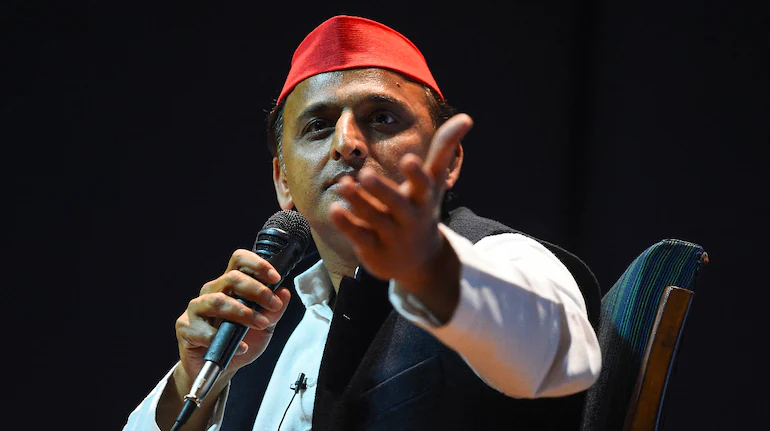
Political tensions in Uttar Pradesh have intensified after Samajwadi Party (SP) chief Akhilesh Yadav took a swipe at the Bharatiya Janata Party (BJP) over its ‘Mathura next’ pitch. Responding to Deputy Chief Minister Keshav Prasad Maurya’s remarks about the party’s plans for Mathura, Yadav challenged BJP leaders attending a meeting in the temple town to take a dip in the Yamuna River and drink its water.
The sarcastic remark was aimed at highlighting concerns over the condition of the Yamuna, whose pollution has repeatedly become a political issue. Yadav suggested that BJP leaders should begin their Mathura visit by bathing in the river and performing a traditional ritual involving drinking a small quantity of its water.
The exchange comes as the BJP holds a two-day organisational meeting in Mathura to discuss its preparations for the 2027 Uttar Pradesh Assembly elections. With religious identity, river pollution and electoral strategy intersecting, the political conversation has once again brought Mathura into the centre of state politics.
What Keshav Prasad Maurya Said About ‘Mathura Next’
Maurya’s remarks came during the BJP’s two-day brainstorming meeting at the Pandit Deendayal Upadhyaya Cow Research Centre in Parkham village, Mathura. The meeting is focused on the party’s organisational strategy and preparations for the next Uttar Pradesh Assembly elections.
Speaking to reporters on November 16, Maurya referred to Ayodhya and suggested that Mathura would be the party’s next focus. He also challenged Yadav to demonstrate his devotion to Lord Krishna by visiting the deity’s birthplace and participating in Kar Seva.
Maurya said that Ayodhya was now with the BJP and that Mathura was next. He added that if Yadav was a true devotee of Lord Krishna, he should visit the birthplace of the deity and take part in Kar Seva, suggesting that he could accompany the SP leader himself.
The remarks brought the BJP’s religious and cultural agenda into the political discussion ahead of the 2027 polls. Ayodhya and Mathura hold major religious significance, and references to these cities have frequently featured in political debates in Uttar Pradesh.
Akhilesh Yadav’s Yamuna Challenge to BJP Leaders
Responding to Maurya, Yadav used sarcasm to question the BJP’s claims about its plans for Mathura. Rather than directly engaging with the invitation to participate in Kar Seva, he challenged the leaders visiting the region to first experience the condition of the Yamuna River.
Speaking to reporters, Yadav said that those who had travelled to Mathura-Vrindavan should begin their programme by bathing in the river and performing aachman, a traditional ritual in which a small quantity of water is taken into the mouth. He added that if anyone fell ill afterwards, they could call a good doctor.
The remark was a pointed political attack on the condition of the Yamuna. By turning the discussion towards river pollution, Yadav sought to shift attention from the BJP’s religious messaging to questions about environmental conditions and the government’s responsibility for maintaining the river.
His challenge also gave the opposition an opportunity to question the gap between political claims about religious heritage and the condition of places and natural resources associated with that heritage.
Yamuna Pollution Becomes a Political Flashpoint
The Yamuna is closely associated with the religious and cultural identity of Mathura and Vrindavan. The river is an important part of the region’s spiritual landscape, attracting pilgrims and visitors throughout the year.
However, concerns about pollution have repeatedly raised questions about water quality and the effectiveness of river-cleaning efforts. Untreated sewage, wastewater and other pollutants have contributed to the river’s environmental challenges in different stretches.
Yadav’s comment used these concerns to challenge the BJP’s political messaging around Mathura. His suggestion that visiting leaders should drink the river water was not a formal environmental proposal but a satirical remark intended to draw attention to the pollution issue.
The exchange also highlights how environmental concerns can become politically significant when they involve places of religious importance. For residents, pilgrims and local businesses, the condition of the river is not merely a political talking point but an issue connected to public health, tourism and the area’s cultural identity.
Why Mathura Matters for the 2027 Uttar Pradesh Elections
Mathura’s political importance extends beyond its religious significance. Located in western Uttar Pradesh, the region has remained a stronghold of the BJP in the last two Assembly elections. The party’s decision to hold an important organisational meeting there reflects the attention it is giving to its electoral preparations.
Western Uttar Pradesh has a complex political and social landscape, with sizeable Muslim and Dalit populations alongside communities that have traditionally played an important role in the region’s electoral contests.
The BJP and the Samajwadi Party are both seeking to strengthen their support among different voter groups. The political calculations in the region could become more complicated with the emergence of new alliances and attempts by smaller parties to expand their influence.
Owaisi-Chandrashekhar Azad Alliance Adds Another Political Dimension
The reported alliance between Asaduddin Owaisi and Chandrashekhar Azad through the Samajik Parivartan Morcha has added another dimension to the political competition in western Uttar Pradesh.
The two leaders are seeking to build support among Muslim and Dalit voters, constituencies that are also important to the electoral strategies of the BJP and the Samajwadi Party.
Their political outreach could influence local contests by introducing additional competition for votes and challenging established party calculations. However, the alliance’s eventual electoral impact will depend on its organisational strength, candidate selection and ability to convert political support into votes.
For the BJP, maintaining its influence in western Uttar Pradesh will remain important as it prepares for the 2027 Assembly elections. The Samajwadi Party, meanwhile, will look to consolidate opposition support and prevent rival political formations from weakening its position.
BJP’s Mathura Meeting Focuses on 2027 Poll Preparations
The BJP’s two-day meeting at the Pandit Deendayal Upadhyaya Cow Research Centre in Parkham village is part of its broader preparations for the next Assembly elections. Such organisational meetings allow party leaders to discuss political strategy, review local challenges and coordinate activities ahead of an election campaign.
Holding the meeting in Mathura also gives the party an opportunity to reinforce its political presence in a region with considerable religious and electoral significance.
Maurya’s ‘Mathura next’ remark has added a sharper political dimension to the gathering. It has also prompted a response from the SP leadership, turning what was an organisational meeting into a subject of wider political debate.
Religious Politics and Governance Likely to Shape the Election Debate
The exchange between Maurya and Yadav reflects two competing approaches to political messaging. Maurya’s remarks placed emphasis on religious identity and the BJP’s stated political priorities in Ayodhya and Mathura. Yadav responded by highlighting the condition of the Yamuna and questioning the government’s record on an issue affecting the region.
Both approaches could feature in the wider political debate ahead of the 2027 Uttar Pradesh Assembly elections. Religious identity remains an important element of the state’s politics, but issues involving pollution, infrastructure, employment, public services and local development are also likely to influence voter decisions.
The Yamuna challenge has therefore become more than a personal exchange between two political leaders. It has brought together questions of religious symbolism, environmental responsibility and electoral competition in western Uttar Pradesh.
As the BJP continues its preparations and opposition parties work to strengthen their alliances, Mathura is likely to remain an important political talking point. Whether the ‘Mathura next’ slogan translates into a wider electoral strategy will become clearer as the 2027 campaign approaches.
For breaking news and live news updates, like us on Facebook or follow us on Twitter and Instagram. Read more on Latest India on thefoxdaily.com.


COMMENTS 0