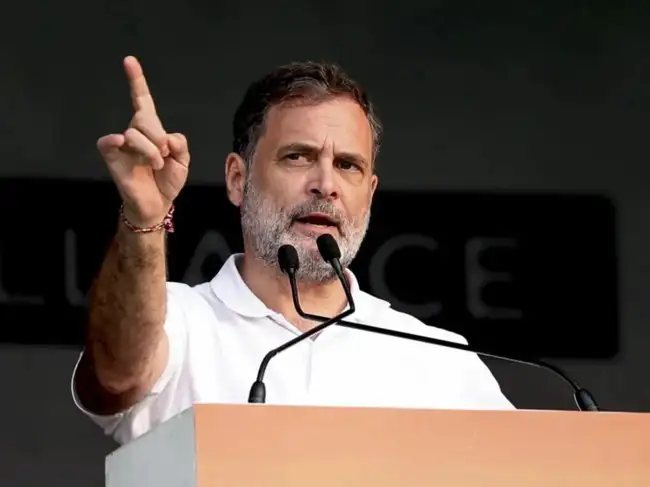
Congress leader and Leader of Opposition in the Lok Sabha Rahul Gandhi launched a fresh attack on the Bharatiya Janata Party (BJP) and the Rashtriya Swayamsevak Sangh (RSS) on Sunday, describing them as “uncouth, greedy, casteist male chauvinists” and accusing them of having little understanding of India’s spiritual and religious traditions.
Gandhi shared an image of an Ardhanareshwar sculpture depicting Lord Shiva and Goddess Parvati in a combined form, using the symbolism to underline his criticism of what he described as patriarchal attitudes. His remarks came amid an ongoing political controversy over comments he made about the relationship between his parents, Sonia Gandhi and former Prime Minister Rajiv Gandhi.
The latest statement has extended a political debate that began with Gandhi’s remarks on love, affection and relationships. While the Congress has defended his comments as an attempt to encourage a conversation about equality and emotional openness, BJP leaders have criticised his earlier remarks.
What Did Rahul Gandhi Say About BJP and RSS?
In a post on social media platform X on Sunday, Gandhi linked his understanding of Indian spiritual and religious traditions to his criticism of the BJP and RSS.
“The deeper I go into Indian spiritual and religious traditions, the clearer it becomes,” he wrote.
He then described the BJP and RSS as “uncouth, greedy, casteist male chauvinists” and alleged that they had “absolutely no understanding of our spiritual and religious traditions.”
Alongside the message, Gandhi shared a photograph of a sculpture representing Ardhanareshwar, the composite form of Lord Shiva and Goddess Parvati. The image became central to his argument about the place of women and equality in India’s spiritual traditions.
Gandhi’s remarks were directed at both the BJP and the RSS, although he did not identify specific leaders or policies in the post. His criticism was framed around what he views as a contradiction between India’s spiritual traditions and the social attitudes he attributes to the two organisations.
What Is Ardhanareshwar and Why Did Rahul Gandhi Share the Sculpture?
Ardhanareshwar is a significant form in Hindu religious tradition that represents Lord Shiva and Goddess Parvati as one combined divine figure. The form is commonly depicted with one half representing Shiva and the other representing Parvati, bringing masculine and feminine aspects together in a single image.
The symbolism is often understood as representing the inseparability of Shiva and Shakti, as well as the complementary relationship between masculine and feminine principles. It also offers a visual expression of unity, balance and the idea that neither aspect exists independently of the other.
By sharing the sculpture, Gandhi appeared to connect his criticism of the BJP and RSS with the broader themes of gender equality and respect within relationships. His post suggested that India’s religious and philosophical traditions contain ideas about balance and shared identity that, in his view, are not reflected in the attitudes of the two organisations.
The sculpture also connects with an earlier post in which Gandhi shared an image of Goddess Parvati sitting on Lord Shiva’s lap. That earlier image was part of his argument about affection, love and the freedom to express emotions within personal relationships.
How the Controversy Over Sonia and Rajiv Gandhi’s Relationship Began
The latest exchange follows a controversy surrounding Gandhi’s remarks at the launch of his mother Sonia Gandhi’s memoir, Belonging: A Journey of Love.
During the event, Gandhi recalled the close relationship between his parents and described how they would sit together during family meals. He said that his mother would sit on his father’s lap, something he had considered normal while growing up.
He recalled being surprised when he visited friends’ homes and did not see their parents displaying similar affection. Gandhi said he would ask his friends why their mothers were not sitting on their fathers’ laps.
He also spoke about the devastating impact of losing two important figures in his family. His grandmother, former Prime Minister Indira Gandhi, was assassinated in 1984, while his father, Rajiv Gandhi, was killed in a suicide bombing in 1991.
His description of his parents’ relationship attracted criticism from political opponents and triggered debate over the appropriateness of sharing such personal family memories at a public event.
Some BJP leaders took aim at Gandhi over the remarks, while supporters defended his account as a personal recollection of affection between his parents. The disagreement subsequently developed into a wider political argument about love, family relationships and traditional attitudes towards gender roles.
Rahul Gandhi’s Earlier Message on Fear, Anger and Hatred
After the initial criticism, Gandhi issued another message arguing that fear, anger and hatred had created a barrier among supporters of the BJP and RSS, preventing them from openly experiencing and expressing love.
He said he believed it was his responsibility, as someone who identifies with Hindu traditions, to help people move beyond those emotions so they could experience love and belonging.
In that message, Gandhi wrote that fear, anger and hatred had woven a web in the hearts of BJP and RSS supporters, stopping them from expressing affection. He said he wanted them to experience what he described as the beauty and joy of love and belonging.
He ended the message with the phrase “Satyam Shivam Sundaram”, a Sanskrit expression commonly associated with truth, auspiciousness and beauty.
The latest Ardhanareshwar post continues the same line of argument by bringing religious symbolism into the political discussion. Rather than limiting his criticism to a specific political issue, Gandhi has connected his comments to broader questions about gender, affection and the interpretation of Indian spiritual traditions.
Congress Backs Rahul Gandhi’s Remarks on Love and Equality
The Congress party supported Gandhi’s earlier comments and presented them as an effort to encourage a wider discussion about affection and equality in personal relationships.
In a public response, the party argued that love should not have to be hidden and that expressing affection should not be treated as a weakness. It also emphasised that equality begins with treating one’s partner as an equal.
The party’s defence placed the discussion within a broader argument about relationships and social attitudes towards women. Congress leaders have sought to counter criticism of Gandhi’s remarks by describing them as a personal account of the relationship between his parents rather than an attempt to make an inappropriate political statement.
The party’s response also echoed the themes of Gandhi’s subsequent social media messages, which connected emotional openness with equality and respect.
BJP Leaders Had Earlier Criticised Rahul Gandhi
Gandhi’s comments about his parents also drew criticism from BJP leaders, including Assam Chief Minister Himanta Biswa Sarma.
Sarma shared a video of Gandhi’s remarks and posted a sarcastic response directed at Sonia Gandhi. He suggested that the comments had caused embarrassment and questioned Gandhi’s political standing.
His response became part of the wider political exchange surrounding the launch of Sonia Gandhi’s memoir. While Congress supporters defended Gandhi’s account as an expression of family affection, BJP critics used the episode to question his public remarks and political communication.
The latest criticism of the BJP and RSS has added another dimension to the dispute. Gandhi has now shifted the focus towards the interpretation of religious traditions and the relationship between spiritual values and gender equality.
Why Rahul Gandhi’s Ardhanareshwar Post Matters in the Political Debate
Gandhi’s use of the Ardhanareshwar image reflects how religious and cultural symbolism can become part of political messaging in India. The image carries meanings related to unity, the relationship between masculine and feminine principles, and the place of both within a shared divine form.
By invoking that symbolism, Gandhi has sought to frame his criticism of the BJP and RSS as a debate about the interpretation of India’s religious and philosophical heritage. His comments also connect with wider discussions about patriarchy, caste and the treatment of women in society.
However, his characterisation of the two organisations remains a political allegation and reflects his own assessment. The BJP and RSS have not been shown in the supplied material to have issued a specific response to Sunday’s Ardhanareshwar post.
The exchange also demonstrates how a personal anecdote can develop into a larger political controversy when it involves prominent political families and competing interpretations of social values. The Congress has defended Gandhi’s emphasis on affection and equality, while BJP leaders have previously challenged his comments about his parents.
For now, Gandhi’s latest post has brought the focus back to the relationship between India’s spiritual traditions and contemporary debates over gender and social attitudes. By sharing the Ardhanareshwar sculpture, he has continued his criticism of the BJP and RSS while placing the discussion within a broader argument about love, equality and the meaning of India’s religious heritage.
For breaking news and live news updates, like us on Facebook or follow us on Twitter and Instagram. Read more on Latest India on thefoxdaily.com.






COMMENTS 0