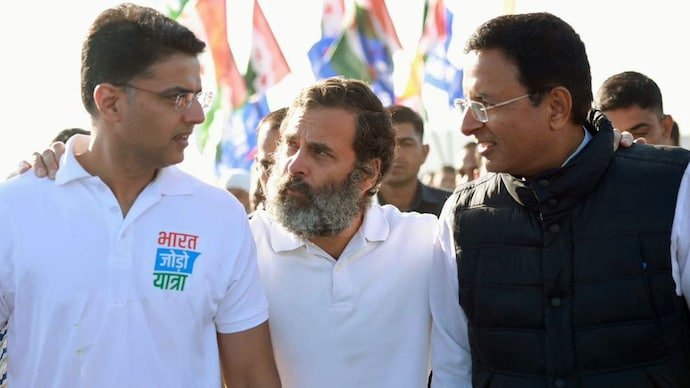
The Congress organisational reshuffle announced on September 5, 2026, involves a relatively small number of state-level changes, but its political significance is much larger than the list of appointments suggests.
The party has moved six senior functionaries across key states, placing Sachin Pilot in charge of Punjab, giving Randeep Singh Surjewala additional responsibility for Gujarat while retaining Karnataka, and shifting Bhupesh Baghel from Punjab to Assam. Sukhdeo Bhagat has been assigned Chhattisgarh, Dr Sirivella Prasad Maharashtra and P.V. Mohan Andhra Pradesh.
At first glance, these are routine organisational appointments. Politically, however, they reveal a hierarchy of trust inside the Congress and indicate which leaders the high command sees as election managers, troubleshooters or potential members of a broader national organisational bench.
The biggest question is not simply why these leaders have been moved. It is whether the Congress leadership, particularly the Rahul Gandhi-led political structure, is finally prepared to give its state managers enough authority to solve problems before internal conflicts become election liabilities.
Why Sachin Pilot’s Punjab assignment is the biggest signal
The most consequential appointment is undoubtedly Sachin Pilot’s move to Punjab.
Pilot has been brought in ahead of the Punjab Assembly election, expected early next year. The state remains one of the few large northern states where the Congress has a realistic route back to power, despite the party’s setbacks in recent years.
That makes Punjab both an opportunity and a serious organisational test.
The Congress does not lack political space in Punjab. Its bigger problem has been an inability to prevent competing leaders from converting that space into internal warfare.
Pilot’s immediate responsibility is therefore likely to be as much about managing Congress leaders as it is about fighting the Aam Aadmi Party (AAP) on the electoral battlefield.
Punjab’s internal war created the opening for Pilot
The state unit has been dealing with tensions involving Punjab Congress president Amrinder Singh Raja Warring and former Chief Minister Charanjit Singh Channi, who has been given a prominent role in the election campaign structure.
The dispute has reportedly included demands for changes in the state leadership and rival camps asserting themselves at party events.
The conflict created an uncomfortable position for the Congress high command because both Warring and Channi have been associated with Rahul Gandhi’s political rise in different ways.
Warring’s relationship with Rahul dates back to the Youth Congress era. Rahul supported his advancement in the organisation, and Warring became national president of the Indian Youth Congress in 2014.
Channi, too, was elevated at a critical moment with the backing of the central leadership. When Captain Amarinder Singh was removed as Punjab chief minister in September 2021, Channi emerged as the unexpected replacement.
The political irony is difficult to miss. Two leaders who received important opportunities under the Congress high command are now competing with one another, leaving the leadership to bring in another trusted figure to manage the conflict.
Punjab could become Pilot’s test for bigger ambitions
For Pilot, the Punjab assignment has significance beyond the 2027 election.
His political career has been heavily influenced by the prolonged conflict he had with former Rajasthan chief minister Ashok Gehlot. That confrontation became a central feature of Rajasthan Congress politics and, for a period, threatened to overshadow the party’s contest with the BJP.
That experience gives Pilot an unusual perspective on factional politics. He knows how difficult it is to operate inside a party when rival leaders possess independent political bases and the central leadership struggles to impose a settlement.
Punjab consequently offers him an opportunity to demonstrate a different skill: not simply mobilising his own supporters, but managing several competing centres of power without allowing them to undermine the party’s electoral campaign.
That could become particularly important when Rajasthan approaches its next Assembly election in 2028.
If Pilot can stabilise Punjab, supervise candidate selection and produce a competitive Congress campaign against the AAP, he would have a stronger argument for greater responsibility in Rajasthan. Punjab could effectively become a practical examination of whether Pilot can turn political influence into organisational management.
Pilot’s Amarinder connection adds another layer
There is another historical connection between Pilot and Punjab that makes the appointment interesting.
Pilot has maintained a cordial personal relationship with former Punjab chief minister Amarinder Singh. Amarinder’s removal in 2021 triggered the sequence of leadership changes that ultimately brought Channi to the chief minister’s office before the Congress suffered a heavy defeat in the 2022 Assembly election.
Amarinder is no longer a Congress leader, so his relationship with Pilot does not provide a straightforward organisational advantage.
It does, however, give Pilot a personal understanding of the political history behind Punjab Congress’s internal instability.
The central leadership will now expect him to learn from that history rather than repeat it. The challenge is to prevent disagreements between individual leaders from becoming larger disputes over the organisation itself.
Surjewala’s Gujarat appointment looks like a reward
If Pilot’s Punjab assignment can be read as both a promotion and a test, Randeep Singh Surjewala’s Gujarat role looks much more like a vote of confidence.
Surjewala will take charge of Gujarat while continuing as Congress general secretary in charge of Karnataka.
The decision is significant because Karnataka is one of the Congress’s most important examples of successful state-level electoral management in recent years. The party won 135 of the 224 Assembly seats in 2023, returning to power after a closely watched campaign.
Surjewala subsequently played a major role in navigating the sensitive leadership arrangement involving Siddaramaiah and D.K. Shivakumar.
That process eventually culminated in Shivakumar becoming Karnataka chief minister in June 2026 after Siddaramaiah stepped down. The leadership transition took place without the kind of public rupture that has often damaged Congress governments.
Why Karnataka matters for Surjewala’s new role
Karnataka and Gujarat present almost opposite organisational challenges.
In Karnataka, Surjewala has had to manage a Congress government with several powerful leaders and competing political interests. Siddaramaiah, Shivakumar, Congress president Mallikarjun Kharge and other senior figures all possess significant political weight.
Gujarat offers the opposite problem. The Congress does not have too many competing centres of power because its central challenge is that it has become electorally weak.
The party has not formed a government in Gujarat since 1995. Its Assembly tally fell to just 17 seats in 2022, while the BJP retained overwhelming dominance.
Congress did manage to win a Lok Sabha seat in Gujarat in 2024, ending the BJP’s clean sweep of the state, but that was not enough to fundamentally alter the political balance.
Surjewala’s job, therefore, is not merely to settle factions. It is to build an organisation that can begin to look like a serious challenger.
Gujarat is a much bigger gamble than another state assignment
Gujarat holds an unusually important place in Indian politics because it is the political home state of Prime Minister Narendra Modi and Union Home Minister Amit Shah.
For the Congress, making the 2027 Assembly election competitive would therefore have symbolic as well as electoral value.
The party currently faces the problem of political scarcity: limited organisational strength, a weak electoral base and a BJP that has been dominant in the state for decades.
Surjewala’s experience in Karnataka may now be put to a different use. Instead of managing an abundance of power, he has to organise a revival from a substantially weaker position.
His apparent ability to work as a high-command representative rather than develop into an independent state power centre could also be an advantage in Gujarat.
Why retaining Karnataka makes Surjewala even more important
The Congress could have shifted Surjewala to Gujarat completely. Instead, the party has chosen to make Gujarat an additional responsibility while retaining his Karnataka charge.
That is arguably one of the clearest signals in the reshuffle.
The leadership appears to view him as one of its limited number of senior organisational managers who can be trusted with politically sensitive assignments without necessarily demanding a separate power base in the state.
In a party where election management frequently overlaps with leadership disputes, that is a valuable skill.
Why Bhupesh Baghel’s move to Assam is different
Bhupesh Baghel’s transfer from Punjab to Assam carries a very different political message.
It is difficult to interpret the move as a simple promotion following the turmoil in Punjab. Baghel had been expected to manage the state’s factional disputes, but the conflict continued to grow.
Reports of tensions between Warring and the Channi camp created pressure on the high command to change the person overseeing the state.
Moving Baghel to Assam therefore looks more like a reset than a reward for success in Punjab.
At the same time, Assam is not an unfamiliar political assignment for Baghel.
Baghel and Priyanka Gandhi’s Assam connection
Baghel has previously been involved in Congress election operations in Assam, making his transfer less of a leap into unknown territory.
His political relationship with Priyanka Gandhi Vadra is also relevant.
The Congress has repeatedly paired Baghel with Priyanka in election campaigns. The two worked in parallel during the 2022 Uttar Pradesh campaign, and they were again part of the Congress strategy in Himachal Pradesh, where the party returned to power later that year.
Baghel was also involved in Congress’s organisational and electoral efforts in Assam before the latest reshuffle.
That familiarity could help him work with Gaurav Gogoi, who faces the task of rebuilding the party’s position after the Congress’s latest Assembly setback in Assam.
Assam is an organisational rebuilding project
The challenge facing Baghel in Assam is different from Punjab.
There is less emphasis on controlling a handful of dominant factions and more on rebuilding an organisation that has suffered repeated electoral setbacks and defections.
The Congress has now lost three successive Assembly elections in Assam. Several prominent leaders have left the party over the years, while competing internal groups have weakened organisational cohesion.
The latest election defeat further damaged confidence within the state unit.
Baghel enters with the credibility of a former chief minister and experience in booth-level organisation. His direct working relationship with senior Congress leaders could also give him access to the high command while dealing with the state unit.
Sukhdeo Bhagat gets a long-term Chhattisgarh assignment
The appointment of Sukhdeo Bhagat as Chhattisgarh in-charge reveals another dimension of the reshuffle: the Congress is not only moving established senior leaders but also creating opportunities for a broader organisational bench.
Bhagat is a former Jharkhand Congress president and a tribal leader who currently represents the Lohardaga Scheduled Tribe-reserved constituency in the Lok Sabha.
He also has experience in the state administrative service, giving him a profile that combines politics with an understanding of government machinery.
His political journey has included a period outside the Congress before he returned to the party.
Sending a tribal leader from neighbouring Jharkhand to Chhattisgarh is politically significant because Adivasi representation is an important part of Rahul Gandhi’s broader political messaging.
Chhattisgarh does not face an immediate Assembly election, with the next contest due in 2028. That gives Bhagat time to understand the state, rebuild organisational networks and prepare the party without the pressure of an election immediately around the corner.
Why Sirivella Prasad’s Maharashtra appointment stands out
Dr Sirivella Prasad’s appointment as Maharashtra in-charge is among the more unexpected changes.
He has worked in the Congress organisation as an AICC secretary and in co-charge roles in states including Tamil Nadu and Jharkhand. Maharashtra, however, represents a significant increase in political responsibility.
The state has 48 Lok Sabha seats and an unusually complicated political structure. The Congress operates alongside allies associated with the Uddhav Thackeray-led Shiv Sena faction and Sharad Pawar’s Nationalist Congress Party faction, while the BJP and its partners remain major competitors.
Within the Congress itself, Maharashtra has several senior leaders with independent political influence.
Prasad’s lack of deep-rooted factional baggage in the state could therefore work in his favour.
Maharashtra will test whether neutrality is enough
An outsider can sometimes function more effectively as the high command’s representative because he does not arrive with longstanding local alliances.
But Maharashtra could also demonstrate the limits of that approach.
Political negotiations in the state involve heavyweight regional parties, complex alliance equations and Congress leaders with established constituencies. A new in-charge must therefore be neutral enough to avoid becoming part of one faction but authoritative enough to make difficult decisions.
Prasad’s appointment will test whether the Congress can balance both requirements.
P.V. Mohan gets one of Congress’s toughest rebuilding jobs
P.V. Mohan’s appointment as Andhra Pradesh in-charge follows a similar philosophy of giving an organisational leader a substantially bigger responsibility.
Mohan has risen through the NSUI and Youth Congress structures and has held organisational responsibilities at the AICC level. He has also worked as a co-in-charge in Kerala before moving into a larger role.
Andhra Pradesh presents a very different challenge from Maharashtra.
The biggest problem is not managing too many Congress leaders. It is rebuilding a party that has become almost marginal in a state where it once had a dominant political presence.
The Congress failed to win an Assembly seat in Andhra Pradesh in the 2024 election.
Mohan’s assignment is therefore less about managing existing political power and more about creating an organisation capable of competing again.
The reshuffle reveals three categories of Congress managers
Taken together, the appointments appear to divide the Congress’s organisational leaders into several broad categories.
Pilot is being tested in a high-conflict, election-bound state. Surjewala is being rewarded with additional responsibility after demonstrating an ability to manage complex political transitions. Baghel is being repositioned into a state where his existing networks and relationship with the central leadership can be used for organisational reconstruction.
Bhagat, Prasad and Mohan, meanwhile, represent the effort to develop a broader bench of state managers.
That could become increasingly important for the Congress because the party will face a succession of Assembly elections while simultaneously trying to revive weak state organisations.
Rahul Gandhi’s larger organisational dilemma
Behind the reshuffle is a question that has troubled the Congress for years: how much authority should the central leadership give its state managers?
AICC general secretaries and state in-charges are expected to manage local leaders, coordinate campaigns, oversee candidate selection and report problems to the high command.
But organisational responsibility without political authority can produce limited results.
Punjab is the clearest example. The central leadership can appoint Pilot, but if he lacks the authority to settle disputes between powerful state leaders, his appointment alone cannot prevent factionalism.
The same applies in Gujarat. Surjewala can create an election strategy, but turning around a weak organisation requires decisions about leadership, candidate recruitment, resources and political messaging.
The reshuffle therefore matters not only because of who has received which state, but because it could signal whether the Congress is preparing to let these leaders exercise greater authority.
Punjab is the immediate political laboratory
Among all the assignments, Punjab offers the clearest test of the new model.
Pilot has to manage the Warring-Channi divide, coordinate with other power centres, oversee candidate selection and build a campaign capable of challenging the AAP.
He also has to avoid turning the state organisation into another battlefield over leadership.
The challenge is particularly important because Punjab has already demonstrated what happens when internal divisions grow faster than electoral strategy. The Congress entered the 2022 election after a dramatic leadership crisis and suffered a major defeat.
The party cannot afford a repeat performance in 2027.
The Gujarat challenge is almost the opposite
Surjewala faces a state where internal factionalism is not the central obstacle because the Congress lacks the electoral strength it once possessed.
His task is to rebuild credibility among voters who have repeatedly chosen the BJP and establish a narrative that makes the Congress relevant again.
That requires more than attacking the ruling party. It requires a state organisation with enough strength to recruit candidates, mobilise workers and fight elections across constituencies.
The 2027 Gujarat election will therefore provide a measurable test of whether the Congress can convert an experienced high-command manager into a genuine organisational revival.
Assam tests whether the Congress can rebuild after defeat
Baghel’s Assam assignment is another important test, but it has a longer organisational horizon.
The Congress needs to recover from an electoral defeat, deal with leadership uncertainty and rebuild confidence among workers.
Baghel’s experience in election management and his existing relationship with senior Congress figures could make him a useful choice for the task.
But Assam will ultimately test whether the party can convert organisational experience into a sustained local structure rather than relying on election-time interventions.
What the reshuffle says about Congress’s bench strength
The six appointments reveal both the strengths and weaknesses of the Congress.
The party still has senior leaders with extensive experience in election management, coalition negotiations and organisation building. But the reshuffle also shows how concentrated those responsibilities remain among a relatively small group.
Surjewala’s decision to retain Karnataka while taking Gujarat is especially telling. Baghel is being moved from one challenging state to another rather than removed from election responsibilities altogether. Pilot is being given a state where success or failure can directly affect his future political standing.
At the same time, leaders such as Bhagat, Prasad and Mohan are being pushed toward larger responsibilities, suggesting an attempt to expand the pool of people capable of running state organisations.
The real test will be authority, not appointments
The Congress has frequently changed state in-charges when internal problems become too severe. The effectiveness of the latest reshuffle will therefore depend on whether this exercise is different.
Pilot cannot resolve Punjab’s divisions simply by acting as another mediator. He needs enough authority to impose organisational discipline when necessary.
Surjewala cannot rebuild Gujarat without the power to influence difficult organisational decisions.
Baghel cannot revive Assam if the state unit remains divided and reluctant to accept central coordination.
The same principle applies to every new in-charge.
Ultimately, the value of a Congress organisational manager depends not just on access to Rahul Gandhi, Mallikarjun Kharge or the wider high command, but on the ability to turn that access into decisions that are implemented on the ground.
Congress reshuffle: who gets what responsibility?
| Leader | New responsibility | Political significance |
|---|---|---|
| Sachin Pilot | Punjab in-charge | High-stakes test of faction management ahead of the 2027 Assembly election |
| Randeep Singh Surjewala | Gujarat in-charge; retains Karnataka | Vote of confidence after managing Karnataka’s electoral and leadership challenges |
| Bhupesh Baghel | Assam in-charge | Reset after Punjab infighting and a renewed organisational challenge in Assam |
| Sukhdeo Bhagat | Chhattisgarh in-charge | Opportunity to build a longer-term organisation ahead of the 2028 election |
| Dr Sirivella Prasad | Maharashtra in-charge | Fresh face tasked with navigating a complex state and alliance structure |
| P.V. Mohan | Andhra Pradesh in-charge | Major rebuilding assignment for a Congress organisation that has become marginal |
What comes next for Pilot, Surjewala and Baghel?
The next few months will reveal whether the Congress’s latest reshuffle is a genuine attempt to strengthen its state-level leadership or simply another round of personnel changes.
For Pilot, the immediate benchmark is Punjab unity. Candidate selection, coordination between competing leaders and the relationship between the state organisation and the central leadership will indicate whether he has been given real authority.
For Surjewala, the challenge is larger in Gujarat. The 2027 Assembly election will provide a clear measurement of whether an experienced Congress strategist can revive a party that has spent years on the margins of the state’s politics.
Baghel’s Assam assignment will be judged by organisational rebuilding and his ability to work with the state’s leadership after a difficult election.
Behind all three assignments lies the same strategic question for the Congress: can the high command build state-level managers who are empowered to make decisions, rather than leaders who merely carry instructions from Delhi?
Rahul Gandhi’s bet is ultimately on Congress managers
The latest Congress reshuffle is best understood as a test of management as much as a reshuffle of personnel.
Sachin Pilot has been sent to Punjab because the party needs someone capable of controlling competing leaders before they destroy another campaign. Randeep Singh Surjewala has been trusted with Gujarat because his Karnataka record has strengthened his reputation as a high-command troubleshooter. Bhupesh Baghel has been moved to Assam because the Congress needs to convert his organisational experience into a rebuilding exercise after setbacks.
The other appointments point to a parallel effort to develop a deeper organisational bench.
But the success of the strategy will not be determined by how impressive the appointments look on paper. It will depend on whether these leaders are empowered to take difficult decisions, enforce discipline and shape candidate selection rather than simply report problems to the central leadership.
For Pilot, Punjab could become a qualifying examination for his longer-term ambitions in Rajasthan. For Surjewala, Gujarat is an opportunity to prove that his Karnataka success can be replicated in a state where the Congress starts from a much weaker position. For Baghel, Assam is a chance to turn a difficult transfer into a meaningful organisational comeback.
The Congress has changed its managers. The harder question now is whether it is ready to change the way those managers are allowed to operate.
For breaking news and live news updates, like us on Facebook or follow us on Twitter and Instagram. Read more on Latest India on thefoxdaily.com.






COMMENTS 0