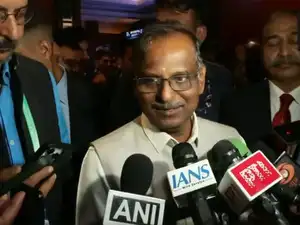
India’s ambitious Gaganyaan human spaceflight programme is moving towards its next major milestones, with the Indian Space Research Organisation (ISRO) maintaining that the mission has not been delayed. ISRO Chairman V Narayanan has said preparations are in the final phase and that the components required for the launch vehicle are ready, addressing questions about the programme’s progress and the timeline for sending Indian astronauts into space.
The Gaganyaan programme is one of India’s most important space ambitions. It aims to demonstrate the country’s ability to send a human crew into low-Earth orbit aboard an Indian launch vehicle and bring them safely back to Earth. Achieving this capability would place India among a small group of countries that have independently developed human spaceflight systems.
Narayanan’s remarks also highlighted a broader transformation underway in India’s space sector. Alongside the development of the human-rated launch vehicle, ISRO is increasingly involving private companies in manufacturing and production. He also pointed to progress in semiconductor technology, particularly the Vikram processor, as an example of how collaboration between India’s space programme and domestic industry can strengthen technological capabilities.
While the chairman has described Gaganyaan preparations as being in an advanced stage, the programme still involves several demanding technical and safety milestones. Human spaceflight requires extensive testing of launch systems, crew escape arrangements, life-support equipment, spacecraft operations and recovery procedures before astronauts can fly.
ISRO Chairman Says Gaganyaan Mission Has Not Been Delayed
V Narayanan has rejected the suggestion that the Gaganyaan programme has been delayed, saying preparations are progressing and the mission is in its final phase. His statement comes as ISRO continues work on the systems required to demonstrate India’s human spaceflight capability.
The chairman’s emphasis on readiness is significant because Gaganyaan is more complex than a conventional satellite launch. A human-rated mission must meet much stricter safety requirements, since the spacecraft must protect astronauts during launch, orbital operations, re-entry and landing.
ISRO has been developing the programme through a series of preparatory missions and technology demonstrations. These activities are intended to validate the systems that will eventually support a crewed flight, rather than relying on a single launch to prove the entire architecture.
Narayanan’s statement that rocket components are ready indicates progress in the manufacturing and preparation of launch vehicle hardware. However, component readiness is only one part of mission readiness. Integration, testing, qualification and verification must also be completed before a human-rated rocket and spacecraft can be cleared for flight.
The distinction matters because the final launch schedule depends on the successful completion of technical checks and safety assessments. ISRO’s position is that the programme is progressing without delay, but the exact date of a crewed mission should be understood in the context of the remaining testing and certification requirements.
What Is India’s Gaganyaan Mission?
Gaganyaan is India’s human spaceflight programme, designed to demonstrate the country’s capability to send astronauts into low-Earth orbit and return them safely to Earth. The mission is being developed by ISRO with support from Indian research institutions, industry partners and other national organisations.
The planned crewed mission is designed to carry Indian astronauts, known as Gagannauts, into an orbit around 400 kilometres above Earth for a short-duration mission. The spacecraft is intended to remain in orbit for approximately three days before returning the crew safely to a landing location in Indian waters.
The programme involves several interconnected systems:
- Human-rated launch vehicle: A modified version of ISRO’s LVM3 rocket, designed to meet the additional safety and reliability requirements of carrying astronauts.
- Orbital module: The spacecraft system that will carry the crew and support operations in orbit.
- Crew module: The pressurised capsule in which astronauts will live during the mission and which will protect them during atmospheric re-entry.
- Service module: The supporting spacecraft section responsible for providing essential functions during the orbital phase.
- Crew escape system: A safety arrangement designed to rapidly move astronauts away from the launch vehicle if an emergency occurs during the early stages of flight.
- Recovery systems: Parachutes and associated equipment intended to ensure the crew module can descend safely and be recovered after splashdown.
These systems must work together under demanding conditions. The launch vehicle must generate enough thrust to place the spacecraft in orbit, while the crew module must maintain a safe environment for astronauts. During the return journey, the capsule must withstand extreme heating and decelerate safely before landing.
Gaganyaan is therefore not simply a rocket development project. It is a complete human spaceflight system involving launch operations, crew training, spacecraft technology, mission control, emergency procedures and recovery operations.
Why Human-Rating the LVM3 Rocket Is Critical
One of the most important elements of Gaganyaan is the human-rated launch vehicle. ISRO plans to use a modified version of its Launch Vehicle Mark-3, or LVM3, for the crewed mission.
The LVM3 is India’s heavy-lift launch vehicle and has been used for missions involving communication satellites and other payloads. However, a rocket that successfully launches satellites cannot automatically be considered safe for carrying astronauts.
Human-rating involves additional engineering, testing and safety measures intended to reduce the risk of failure. These requirements can include improvements in system reliability, redundancy, monitoring, structural performance and the ability to respond to emergencies.
The launch vehicle must also work with the crew escape system. If an emergency occurs during the launch phase, the escape system is designed to separate the crew module from the rocket and move it away from danger.
ISRO’s work on the human-rated LVM3 therefore extends beyond preparing the rocket’s engines and structural components. It includes validating how the entire vehicle behaves under different flight conditions and ensuring that emergency systems can function when required.
Narayanan’s statement that the rocket components are ready is an important indication of progress, but the final approval for a crewed launch will depend on the successful completion of the complete testing and qualification process.
Gaganyaan’s Uncrewed Test Flights: Why They Matter Before Astronauts Fly
Before sending astronauts into space, ISRO must demonstrate that the spacecraft, launch vehicle and recovery systems can operate safely without a human crew on board. This is why uncrewed missions form a critical part of the Gaganyaan programme.
These missions allow engineers to test the performance of the spacecraft under actual flight conditions. They can examine launch behaviour, orbital operations, separation mechanisms, re-entry performance, parachute deployment and recovery procedures.
One of the major preparatory activities is the Integrated Air Drop Test, which is designed to validate the crew module’s parachute-based deceleration system. The test involves releasing a test article from an aircraft and evaluating how its parachutes deploy and control the descent.
Another important milestone is the Test Vehicle Abort Mission, which is intended to demonstrate the performance of the crew escape system. The system must be capable of separating the crew module from the launch vehicle during an emergency and ensuring a safe recovery.
These demonstrations help engineers identify potential weaknesses before the programme moves towards a crewed flight. A successful test does not automatically certify every system, but it provides data that can be used to improve designs and validate performance.
For a human spaceflight programme, this step-by-step approach is essential. The objective is not simply to reach orbit but to demonstrate that the complete mission can be performed with the required level of astronaut safety.
Private Sector Participation Is Expanding India’s Space Programme
Alongside the Gaganyaan programme, Narayanan has highlighted the growing contribution of private companies to India’s space sector. The involvement of domestic industry is becoming increasingly important as ISRO manages more complex missions and seeks to expand its manufacturing capacity.
Historically, ISRO and its associated government institutions played the central role in developing and manufacturing major launch vehicle systems. Private companies participated as suppliers of components, materials and specialised equipment. India’s space-sector reforms have opened the door to a wider role for private enterprises in manufacturing, launch services and other space-related activities.
This change is important because large space programmes require extensive industrial support. Rockets contain thousands of components, including engines, electronic systems, sensors, structural assemblies, valves, communication equipment and specialised materials.
Producing these components at scale requires a network of companies with advanced manufacturing capabilities and strict quality-control systems. A larger industrial base can help improve production capacity, support multiple missions and reduce the pressure on ISRO’s own manufacturing facilities.
Private participation can also encourage innovation. Companies working on propulsion, satellite platforms, launch systems, electronics and space applications can develop specialised technologies that support both government missions and commercial customers.
For Gaganyaan, the participation of industry partners is particularly relevant because human-rated hardware requires strict manufacturing standards. Every component must meet demanding specifications, and quality assurance must be maintained throughout the production and testing process.
How Vehicle Production Is Changing in India’s Space Sector
Narayanan’s comments about changes in vehicle production point to a broader shift in how India is preparing to manufacture launch systems. As the country’s space programme expands, ISRO is increasingly looking at industrial partnerships to support the production of launch vehicle hardware.
The objective is to move beyond a model in which government facilities handle most major manufacturing activities and towards a wider industrial ecosystem capable of producing complex systems under ISRO’s technical supervision.
This approach can help increase production capacity and make it easier to support a higher frequency of launches. It can also allow ISRO scientists and engineers to concentrate more on research, design, mission development and advanced technology rather than handling every manufacturing requirement internally.
However, transferring production responsibilities to private companies does not remove the need for strict government oversight. Space launch vehicles operate under extreme mechanical, thermal and vibration conditions. Even a small manufacturing defect can affect mission performance.
For this reason, industrial partners must follow detailed technical specifications, testing procedures and quality standards. ISRO’s role in design approval, system qualification and mission assurance remains essential.
The broader goal is to build a manufacturing ecosystem that can support India’s future launch requirements, including human spaceflight, satellite deployment, space exploration and commercial missions.
Vikram Processor: How India Is Building Its Semiconductor Capabilities
Another important area highlighted by Narayanan is India’s progress in semiconductor technology through collaboration on the Vikram processor. The processor is associated with ISRO’s efforts to develop domestic microelectronics for applications in space and other demanding environments.
Semiconductors are essential to modern space systems. Launch vehicles, satellites and spacecraft rely on electronic components for navigation, communication, data processing, control systems and monitoring equipment.
These components must operate reliably under conditions that are very different from those experienced by ordinary consumer electronics. Space systems can be exposed to radiation, temperature extremes, vibration and other environmental stresses that affect electronic performance.
The Vikram processor is an example of efforts to develop indigenous technology for such applications. It was developed through collaboration involving ISRO’s Semiconductor Laboratory and other Indian technology partners, with the aim of strengthening domestic capabilities in specialised microprocessors.
Building semiconductor technology within India is strategically important because space missions require reliable electronic components that can meet precise performance and qualification standards. Dependence on imported components can create supply-chain vulnerabilities, particularly when technologies are subject to export restrictions or geopolitical constraints.
Domestic development can help build technical expertise, strengthen manufacturing and testing capabilities, and support a wider ecosystem of semiconductor research. However, developing a processor is only one part of the challenge. Producing reliable chips at scale requires advanced fabrication facilities, specialised materials, testing infrastructure and sustained investment.
Why Indigenous Semiconductors Matter for Gaganyaan and Future Space Missions
Human spaceflight depends on a wide range of electronic systems working together. Computers and processors are used to monitor spacecraft health, process sensor information, support navigation and control operations, and manage communication between the spacecraft and mission control.
For these systems, reliability is more important than simply achieving high processing speed. A processor must operate consistently under demanding conditions and continue functioning when exposed to environmental stresses that could damage ordinary electronics.
Indigenous semiconductor development can help India build greater control over critical technologies used in its space programme. It also allows engineers to work more closely with domestic manufacturers and research institutions when developing specialised components.
The benefits can extend beyond Gaganyaan. India’s future satellite missions, launch vehicles, navigation systems and deep-space exploration projects will all require advanced electronics. Domestic capabilities could support these programmes while creating opportunities for Indian companies to develop technologies for international markets.
Nevertheless, semiconductor self-reliance is a long-term objective. A single processor or successful collaboration does not mean that India has eliminated its dependence on imported chips. The wider challenge involves building a complete ecosystem covering design, fabrication, packaging, testing and advanced semiconductor manufacturing.
How Gaganyaan Fits Into India’s Long-Term Space Ambitions
Gaganyaan is intended to establish the technological foundation for India’s future human spaceflight activities. Once the country demonstrates that it can independently send astronauts into orbit and recover them safely, it will have a wider set of capabilities for more ambitious missions.
One of the long-term goals discussed by the Indian government is the development of the Bharatiya Antariksh Station, India’s proposed space station. The project is intended to create a platform for scientific research, technology demonstrations and sustained human activity in low-Earth orbit.
India has also announced a long-term ambition of sending an Indian astronaut to the Moon by 2040. Achieving such a goal would require substantial progress in launch vehicle technology, crewed spacecraft, life-support systems, space operations and deep-space navigation.
Gaganyaan is an important foundational step towards these ambitions, but it is not a direct demonstration of all the technologies required for a lunar landing. Missions beyond low-Earth orbit involve additional challenges, including longer-duration life support, radiation protection, deep-space communication and more complex propulsion and landing systems.
The experience gained through Gaganyaan could help Indian engineers develop the knowledge and infrastructure needed for future programmes. It can also strengthen the country’s ability to conduct scientific experiments in space and develop technologies for long-duration human missions.
What Challenges Remain Before India’s First Crewed Gaganyaan Flight?
Even with rocket components ready and preparations advancing, a crewed spaceflight requires several layers of testing and verification. ISRO must demonstrate that every critical system can perform reliably under actual mission conditions.
Spacecraft safety: The crew module must maintain a safe and stable environment throughout the mission. Its structure, pressure systems, thermal protection and internal equipment must meet human-safety requirements.
Launch vehicle reliability: The human-rated LVM3 must demonstrate that its propulsion, structural and control systems can operate within the required safety margins.
Emergency escape capability: The crew escape system must be tested across relevant flight conditions to show that astronauts can be moved away from the rocket during an emergency.
Life-support systems: The spacecraft must provide a controlled environment for the crew, including oxygen supply, carbon dioxide removal, temperature regulation and other essential functions.
Re-entry and recovery: The crew module must withstand the heat and forces associated with returning through Earth’s atmosphere. Its parachute systems must then slow the capsule sufficiently for a safe landing and recovery.
Crew training and mission operations: Astronauts must be prepared for launch, orbital activities, emergency situations and return procedures. Ground teams must also demonstrate their ability to manage the mission from launch through recovery.
These requirements explain why ISRO’s statement about the mission entering its final phase should not be interpreted as meaning that every technical milestone has already been completed. The programme must still demonstrate the readiness of the complete system before astronauts are cleared to fly.
Gaganyaan Mission: What Happens Next?
The next phase of the programme will focus on completing the remaining validation activities and preparing the systems required for the planned mission sequence. Uncrewed demonstrations, integrated testing and qualification exercises will provide the evidence needed to establish that the spacecraft and launch vehicle can operate safely.
The readiness of rocket components is an important milestone, but the final launch decision will depend on the performance of the integrated system. ISRO must be satisfied that the launch vehicle, crew module, escape system, life-support equipment and recovery arrangements meet the required standards.
At the same time, the growing involvement of private companies could help strengthen the industrial capacity needed to support Gaganyaan and future missions. Domestic manufacturing partnerships may become increasingly important as India moves towards more frequent launches and complex space projects.
The Vikram processor and related semiconductor development efforts represent another part of this transition. Building specialised electronic components within the country can support the reliability and technological independence required for advanced space systems.
Narayanan’s message is therefore about more than the immediate progress of one mission. His remarks reflect India’s broader effort to combine human spaceflight, industrial participation and indigenous technology development into a stronger national space ecosystem.
Gaganyaan remains a major test of India’s ability to carry out human spaceflight independently. If the remaining safety and qualification milestones are completed successfully, the programme will mark an important step towards the country’s longer-term ambitions in orbital research, space stations and human exploration beyond low-Earth orbit.
For breaking news and live news updates, like us on Facebook or follow us on Twitter and Instagram. Read more on Latest India on thefoxdaily.com.





COMMENTS 0