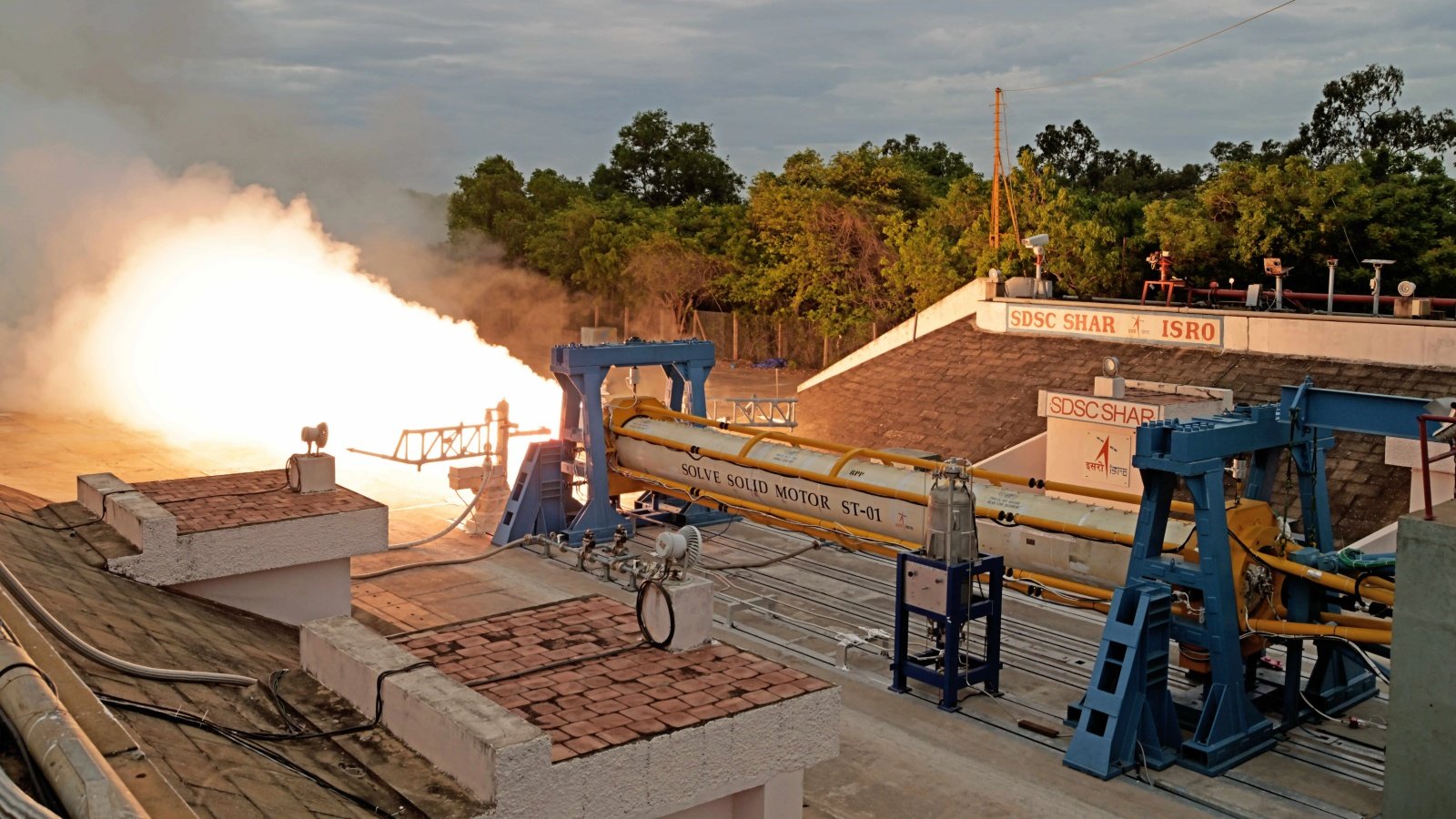
The ISRO Gaganyaan parachute test has achieved another important milestone in India‘s first human spaceflight programme. The Indian Space research Organisation (ISRO) successfully carried out Integrated Parachute Tests designed to validate the sophisticated recovery system that will ensure astronauts return safely to Earth. Conducted at the Satish Dhawan Space Centre in Sriharikota, the test demonstrated the performance of multiple parachutes that will slow the Crew Module during its descent before a controlled splashdown in the sea.
WHO conducted the test? The Indian Space Research Organisation (ISRO). What was tested? The Integrated Parachute System for the Gaganyaan Crew Module. When? The tests were conducted on July 3 and announced by ISRO afterward. Where? At the Satish Dhawan Space Centre, Sriharikota, Andhra Pradesh. Why is the test important? It validates one of the most critical safety systems required for India’s first crewed space mission. How was the test performed? Using a specially developed Sub-Orbital Launch Vehicle for Experiments (SOLVE), which released the Crew Module under controlled flight conditions to evaluate the parachute deployment sequence.
What Is the Gaganyaan Mission?
Gaganyaan is India’s first indigenous human spaceflight programme aimed at sending Indian astronauts into low Earth orbit aboard an Indian spacecraft launched by an Indian rocket.
The mission represents one of the most ambitious scientific and technological projects undertaken by ISRO.
Its primary objectives include:
- Demonstrating India’s human spaceflight capability.
- Developing advanced crew safety technologies.
- Building expertise in human-rated launch systems.
- Expanding India’s long-term space exploration capabilities.
- Strengthening indigenous aerospace technologies.
Successful execution would place India among a select group of nations that have independently developed the capability to send humans into space.
Why the Integrated Parachute Test Is So Important
While launching astronauts safely into orbit is a major challenge, bringing them back safely is equally critical.
The parachute system serves as the Crew Module’s final line of protection before splashdown.
Its responsibilities include:
- Reducing descent speed.
- Maintaining vehicle stability.
- Ensuring controlled deployment.
- Protecting astronauts from excessive landing forces.
- Enabling safe recovery by rescue teams.
Even small deviations in parachute performance can significantly affect landing safety, making extensive testing essential.
Understanding the Crew Module
The Crew Module is the pressurized spacecraft that will carry astronauts throughout the mission.
It is specifically engineered to protect the crew during every phase of flight.
The module performs multiple functions:
- Supporting astronauts during launch.
- Providing a habitable environment in orbit.
- Shielding the crew during atmospheric re-entry.
- Surviving extreme temperatures.
- Facilitating ocean splashdown.
The recovery system forms an integral part of the module’s overall safety architecture.
What Is SOLVE?
ISRO is developing the Sub-Orbital Launch Vehicle for Experiments (SOLVE), a specialized solid-motor-based test rocket designed specifically for validating critical technologies.
Unlike operational launch vehicles, SOLVE allows engineers to conduct repeated experiments under carefully controlled conditions.
Its capabilities include:
- Testing crew escape technologies.
- Evaluating parachute systems.
- Validating recovery mechanisms.
- Assessing flight dynamics.
- Supporting future human spaceflight experiments.
Such dedicated experimental vehicles reduce development risks before actual crewed missions.
How the Integrated Parachute System Works
The parachute deployment process occurs in carefully planned stages rather than all at once.
Each parachute serves a distinct purpose.
| Parachute Stage | Primary Function | Importance |
|---|---|---|
| Drogue parachutes | Stabilize the Crew Module. | Ensures proper orientation. |
| Pilot parachutes | Deploy larger parachutes. | Initiates recovery sequence. |
| Main parachutes | Reduce descent velocity. | Provides safe splashdown. |
| Final descent | Controlled landing in sea. | Protects astronauts during recovery. |
The successful deployment of approximately ten parachutes during testing demonstrated the reliability of this complex sequence.
Testing at High Altitude
During the experiments, the Crew Module was separated from the launch vehicle at altitudes ranging between 10 and 17 kilometers.
This altitude allows engineers to simulate critical phases of the module’s descent through Earth’s atmosphere.
By recreating operational conditions, ISRO can evaluate:
- Deployment timing.
- Parachute inflation characteristics.
- Aerodynamic stability.
- Descent speed.
- Overall system performance.
Why Multiple Parachutes Are Necessary
Human-rated spacecraft typically employ several parachutes rather than relying on a single canopy.
This approach offers multiple advantages:
- Built-in redundancy.
- Improved stability.
- Gradual reduction in speed.
- Greater reliability.
- Enhanced crew safety.
Multiple parachutes also help distribute aerodynamic loads more evenly during descent.
Timeline of the Gaganyaan Programme
| Stage | Development | Objective |
|---|---|---|
| Programme announcement | Human spaceflight initiative launched. | Develop indigenous crewed mission. |
| System development | Crew Module and launch systems designed. | Build human-rated spacecraft. |
| Abort and recovery testing | Crew safety systems validated. | Enhance mission reliability. |
| Integrated parachute testing | Recovery sequence successfully demonstrated. | Validate safe splashdown capability. |
| Future missions | Uncrewed and crewed flights. | Operational human spaceflight. |
How Gaganyaan Compares with Other Human Spaceflight Programmes
| Feature | Gaganyaan | Established Human Space Programmes |
|---|---|---|
| Crew safety | Multiple redundant systems. | Similar layered safety philosophy. |
| Landing method | Ocean splashdown. | Used by several international missions. |
| Parachute recovery | Multi-stage deployment. | International standard approach. |
| Technology | Indigenously developed. | Nation-specific systems. |
Why Human Spaceflight Requires Extensive Testing
Unlike satellite launches, crewed missions require exceptionally high levels of reliability because human lives are involved.
Every critical system undergoes repeated verification before astronauts are cleared for flight.
These include:
- Launch vehicle reliability.
- Crew escape systems.
- Life support equipment.
- Navigation systems.
- Thermal protection.
- Recovery mechanisms.
Integrated testing helps engineers identify potential issues long before operational missions begin.
The Broader Impact on India’s Space Programme
The technologies being developed for Gaganyaan extend well beyond a single mission.
Advances in materials, avionics, guidance systems, crew safety, and recovery technologies can contribute to future scientific, commercial, and strategic space initiatives.
The programme also strengthens India’s domestic aerospace ecosystem by encouraging collaboration between ISRO, research institutions, academia, and industry.
A Unique Insight: Recovery Systems Often Receive Less Attention Than Launches—But They Save Lives
Public attention during space missions usually focuses on spectacular rocket launches. However, aerospace engineers often consider landing and recovery systems equally important.
The final minutes of a mission involve intense aerodynamic forces, rapidly changing atmospheric conditions, and complex deployment sequences. Every parachute must open at precisely the right moment, withstand enormous mechanical loads, and work flawlessly under challenging conditions.
Successful recovery testing therefore represents not merely another engineering milestone but a direct Investment in astronaut safety and mission reliability.
Future Outlook
The successful Integrated Parachute Test brings ISRO another step closer to realizing India’s first indigenous human spaceflight mission. Future development is expected to include additional integrated system tests, uncrewed demonstration missions, and further validation of life-support, navigation, and crew safety technologies before astronauts are launched into orbit.
As the Gaganyaan programme progresses, the knowledge gained from these experiments will also support India’s long-term ambitions in space exploration, including advanced crewed missions, orbital infrastructure, and future deep-space initiatives.
Conclusion
The successful ISRO Gaganyaan parachute test represents a significant advancement in India’s journey toward independent human spaceflight capability. By validating the complex recovery system responsible for safely returning astronauts to Earth, ISRO has demonstrated another critical component of mission readiness.
Although the parachute deployment occurs during the final stage of a mission, it remains one of the most vital aspects of astronaut safety. Combined with the development of the SOLVE experimental launch vehicle and continued testing of human-rated technologies, this achievement reinforces India’s steady progress toward joining the world’s leading human spaceflight nations while strengthening the country’s broader space Technology ecosystem.
For breaking news and live news updates, like us on Facebook or follow us on Twitter and Instagram. Read more on Latest India on thefoxdaily.com.






COMMENTS 0