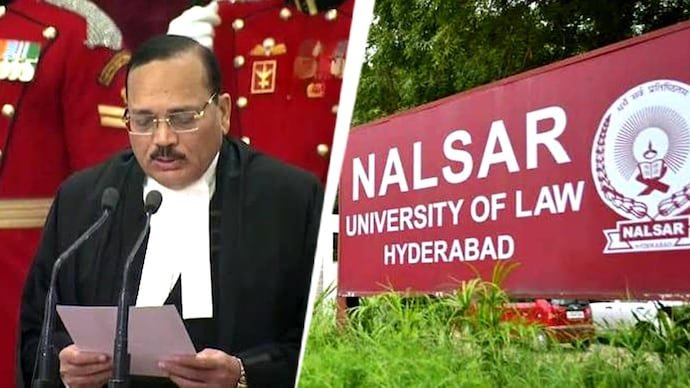
The Bar Council of India (BCI) has withdrawn its controversial decision to prevent students graduating from NALSAR University of Law in 2026 from enrolling as advocates, bringing a dramatic reversal to a dispute that began over students’ objections to the proposed invitation of Chief Justice of India Surya Kant as the university’s convocation chief guest.
The BCI initially directed that no student WHO obtained a law degree from NALSAR in 2026 would be enrolled with any State Bar Council until further orders. The decision immediately raised concerns because enrolment with a State Bar Council is an important step for law graduates seeking to enter legal practice.
Hours later, following an emergency discussion, the council modified the order. It said every student from the 2026 graduating batch would be entitled to enrol with the State Bar Council of their choice.
The BCI said its decision was based on the assessment that the vast majority of the students were innocent and had not intended to participate in any alleged effort to disrespect the Chief Justice. At the same time, it kept the wider dispute open and said it would wait for an inquiry report from the NALSAR Vice-Chancellor before deciding whether further action was necessary.
The reversal came after more than 450 NALSAR students expressed objections to the proposed invitation of CJI Surya Kant, citing concerns about remarks and judicial proceedings that they believed raised questions about constitutional values and the treatment of protesters.
Why the BCI initially stopped NALSAR graduates from enrolling
The controversy escalated when a section of the NALSAR graduating batch opposed the proposed invitation of the CJI to the university’s 2026 convocation.
The students’ objection was not framed as opposition to the office of the Chief Justice itself. Instead, they said their concerns related specifically to conduct attributed to Justice Surya Kant during recent judicial proceedings and whether that conduct was compatible with the values they believed their law school should represent at its convocation.
More than 450 students from the 2026 batch signed a representation addressed to the university’s Vice-Chancellor, Registrar, professors and other authorities.
The students acknowledged that the date and chief guest for the convocation had not yet been formally finalised, but they wanted their concerns recorded before a final decision was taken.
The dispute subsequently reached the BCI, which reacted sharply to what it viewed as a move to disrespect the Chief Justice.
In its initial communication, the BCI chairman directed that no NALSAR student graduating in 2026 would be enrolled as an advocate by any State Bar Council until further orders.
The breadth of that decision meant that students who may not have participated in the protest or the representation could also have faced consequences for the actions of others.
BCI makes a U-turn within hours
The BCI reconsidered the enrolment decision after an emergency discussion among its members.
In the revised communication, the council said it had thoroughly discussed the earlier directive and concluded that the vast majority of the 2026 graduating students were innocent.
The council said these students had not been inclined to participate in what it described as a move of disrespect.
As a result, the earlier restriction was modified and the entire graduating batch was allowed to seek enrolment with State Bar Councils.
The BCI also stressed that students should not suffer for an action in which they were not involved.
This distinction became central to the council’s revised position. Rather than maintaining a blanket restriction against an entire graduating class, the BCI indicated that any further action would depend on the findings of an inquiry.
The immediate effect is that the 2026 NALSAR graduates can proceed with the professional enrolment process instead of having their entry into legal practice placed on hold.
BCI alleges teachers and outsiders influenced students
While withdrawing the enrolment restriction, the BCI did not close the matter.
The council alleged that “a handful of teachers and outsiders” had been instrumental in instigating students.
However, the BCI did not identify the individuals it was referring to or provide detailed evidence for the allegation in the communication described in the supplied material.
Instead, it said it would wait for the inquiry report being prepared by the NALSAR Vice-Chancellor.
The inquiry could therefore become the next significant stage of the dispute.
For now, the BCI’s position effectively separates the professional rights of the graduating students from the question of whether particular individuals were responsible for encouraging the protest or objection to the CJI’s invitation.
What did NALSAR students object to?
The students’ representation centred on the proposed invitation of CJI Surya Kant to preside over the university’s 2026 convocation.
The students referred to recent judicial developments involving a hearing concerning alleged police action against protesters during a march from Delhi’s Jantar Mantar on July 20, 2026.
According to the students’ representation, the issue came before the Supreme Court during a July 23 hearing. The students alleged that the CJI declined to watch video material that was said to show police excesses, quoting him as saying that the court was not interested in watching videos and did not have time to do so.
The students also alleged that submissions by the petitioner’s counsel were subsequently cut short.
They further referred to remarks attributed to the CJI concerning the Jantar Mantar protest and an alleged comparison of Indian youth to “cockroaches”.
These claims formed the basis of the students’ concerns about whether the proposed chief guest was an appropriate representative for a law school’s convocation.
Students say their objection was about constitutional values
The NALSAR students attempted to distinguish their position from a broader political or personal campaign against the Chief Justice.
They said their objection was not directed at the constitutional office held by the CJI. Instead, they described their concern as being specific to their graduating batch and the conduct attributed to the Chief Justice in recent proceedings.
For law students, they argued, a convocation is not merely a ceremonial event at which degrees are handed out.
They said it should also reflect the values they have been taught throughout their legal Education, including Constitutional Rights, access to justice and reasoned engagement with grievances.
The students argued that accepting degrees from a dignitary whose reported conduct appeared dismissive of allegations concerning police action against protesters would conflict with those principles.
The argument turned the dispute into a broader debate about the relationship between legal education, institutional symbolism and judicial accountability.
Why the enrolment issue was so serious for students
The BCI’s original directive created a separate issue from the dispute over the convocation.
Law graduates generally need to complete the relevant enrolment process with a State Bar Council before beginning professional legal practice. A blanket restriction affecting an entire graduating batch could therefore have had consequences extending beyond the immediate controversy.
Students who had simply completed their degrees could potentially have faced delays in beginning their Careers, regardless of whether they had participated in the representation concerning the CJI.
That is why the BCI’s subsequent clarification that no student would be made to suffer without fault was significant.
The revised order protects the professional position of the graduating batch while allowing the council to continue examining the circumstances surrounding the protest.
It also avoids turning a dispute over a university ceremony into a professional penalty affecting hundreds of newly qualified law graduates.
The key issue now moves to the NALSAR inquiry
The BCI’s U-turn does not mean the underlying controversy has been resolved.
The council has explicitly said it will await the NALSAR Vice-Chancellor’s inquiry report before deciding whether additional action is necessary.
That makes the inquiry important for determining what happened, who participated and whether the allegations concerning instigation by teachers or outsiders have a factual basis.
Until that process is completed, the competing accounts remain central to the dispute.
The students say their representation reflected concerns about constitutional values and the conduct attributed to the CJI. The BCI, meanwhile, has characterised part of the episode as a move to disrespect the Chief Justice and has raised allegations about outside influence.
The inquiry is expected to provide the factual basis on which any further decision can be made.
A dispute involving the judiciary, legal education and professional regulation
The NALSAR controversy is significant because several institutions with different responsibilities have become involved in the same dispute.
NALSAR is responsible for the university Environment and its convocation. The Supreme Court is headed by the Chief Justice whose proposed invitation triggered the students’ objections. The BCI regulates important aspects of the legal profession, including the enrolment of law graduates through State Bar Councils.
That overlap has raised questions about how professional consequences should be handled when students express disagreement with a proposed university event.
The BCI’s reversal suggests that the council recognised the difficulty of imposing a collective professional consequence on an entire graduating class when, by its own later assessment, most students were not involved in the alleged misconduct.
It also highlights the importance of distinguishing between individual responsibility and collective punishment, particularly when the affected individuals are at the beginning of their professional careers.
The students’ concerns remain politically and institutionally sensitive
The controversy is not simply about who should hand out law degrees at a convocation.
For the students who signed the representation, the choice of chief guest was connected to the values associated with legal education. Their argument was that a law school should be able to engage critically with questions involving constitutional rights and access to justice.
For the BCI, however, the conduct of students and any alleged attempt to disrespect a constitutional authority raised a different institutional concern.
That difference in perspective explains why the dispute escalated so quickly.
The disagreement also illustrates the difficult line between legitimate institutional criticism and conduct that a regulatory body may regard as improper or disrespectful.
What happens next for the NALSAR 2026 batch?
The most immediate uncertainty for NALSAR’s graduating students has now been removed.
Under the BCI’s revised decision, all students graduating in 2026 can enrol with the State Bar Council of their choice. Their professional prospects will not be collectively blocked while the inquiry continues.
The next major development will be the inquiry report from the NALSAR Vice-Chancellor.
Depending on what that report establishes, the BCI could decide that no further action is necessary or could consider action against specific individuals if it believes the findings warrant it.
For the graduating batch, the distinction is crucial. The revised BCI order means that students who had no role in the controversy do not have to wait indefinitely to begin their professional careers.
Why the BCI reversal matters
The rapid sequence of events has transformed the NALSAR CJI invite controversy into a wider debate about accountability, student expression and professional consequences.
The BCI initially responded with a sweeping restriction affecting the entire 2026 graduating class. It then reconsidered that position after an emergency discussion and concluded that the vast majority of students were innocent.
That reversal places the focus on individual responsibility rather than collective punishment while leaving the underlying allegations open for Investigation.
For now, the immediate message to NALSAR’s 2026 graduates is clear: their law degrees will not prevent them from seeking enrolment as advocates.
But the dispute over the CJI’s proposed invitation, the students’ objections and the allegations concerning outside influence remain unresolved. The Vice-Chancellor’s inquiry will determine whether the controversy ends with the BCI’s withdrawal of the enrolment restriction or develops into another round of institutional action.
For a university whose students are training for careers in law, the episode has also become an unusually direct lesson in the tensions between dissent, institutional authority and professional regulation.
For breaking news and live news updates, like us on Facebook or follow us on Twitter and Instagram. Read more on Latest India on thefoxdaily.com.





COMMENTS 0