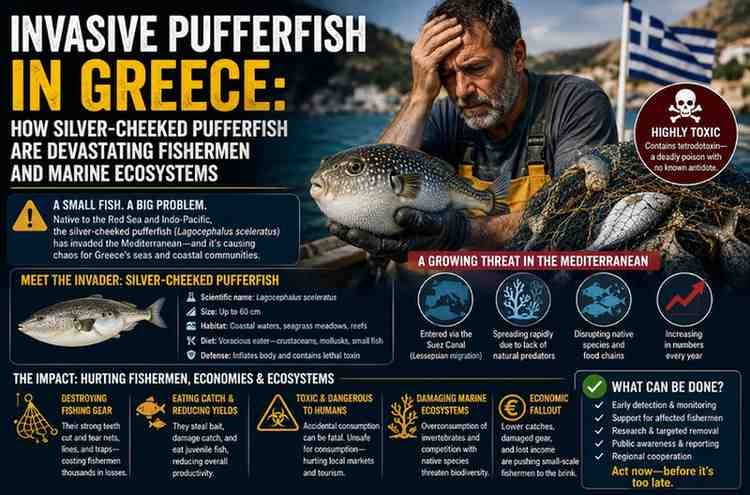
Off the coast of Crete, a fish barely the length of a forearm is doing more damage to Greece’s fishing industry than storms or overfishing combined. What: the silver-cheeked pufferfish, Lagocephalus sceleratus, is tearing through nets, devouring commercially valuable catch, and inflicting an estimated €8,500 in losses per fishing vessel every year. Who: small-scale fishermen across Crete, the Dodecanese, and increasingly the Cyclades and Attica are bearing the brunt. When: the species was first recorded in Greek waters around 2005 and has exploded in number over the past two decades, with the crisis intensifying sharply through 2026. Where: the invasion began around Crete and the Dodecanese and has since spread into the Saronic Gulf, the Euboean Gulf, and beyond. Why: the fish entered the Mediterranean through the Suez Canal from the Red Sea and, lacking natural predators, has multiplied largely unchecked. How: its beak-like jaw, strong enough to bite through wood and metal, lets it demolish fishing gear in days and consume commercially important species faster than fishermen can restock.
A Fish With No Business Being There
The silver-cheeked pufferfish, also known in Greece as lagokefalos, is native to the Red Sea, the Indian Ocean, and parts of the Pacific. It reached the Mediterranean through what marine biologists call a Lessepsian migration the movement of species from the Red Sea into the Mediterranean via the Suez Canal, a route named after the canal’s engineer, Ferdinand de Lesseps. It was first spotted in Greek waters roughly two decades ago, around Crete and the Dodecanese islands, and has since spread widely enough that researchers monitoring aquatic Invasive Species through the ELNAIS network, run by the Hellenic Centre for Marine Research (HCMR), now log confirmed sightings across the Cyclades, Attica, the Saronic Gulf, and the Euboean Gulf.
Typically measuring 40 to 60 centimetres, the fish is an aggressive, omnivorous predator with essentially no natural enemies in Mediterranean waters. That absence of predators is the single biggest reason its population has surged so quickly nothing in the local ecosystem is positioned to keep its numbers in check the way it might be in its native range.
Nets Shredded in Days, Not Months
For fishermen, the most immediate damage isn’t ecological it’s financial and immediate. The pufferfish’s jaw carries two sets of fused, beak-like teeth powerful enough to tear through wood, metal, and heavy-duty fishing rope. Multiple fishermen working out of the port of Ierapetra in southeastern Crete have described nets becoming completely unusable after just five days at sea, riddled with dozens of new holes that take days to repair, only to be shredded again on the next haul.
According to Nota Peristeraki, a marine biologist at HCMR who has led research into the species’ economic impact, the combined damage to gear and the lost income from consumed catch amounts to roughly €8,500 per fishing vessel every year a figure substantial enough to threaten the viability of small, family-run fishing operations that dominate Greece’s coastal fleet. Some fishermen describe the toll in blunter terms, warning that a careless hand near a caught pufferfish’s jaw risks losing a finger entirely.
Eating the Catch Before the Fishermen Can
Beyond gear damage, the pufferfish is a direct competitor for the same seafood Greek fishermen depend on to earn a living. Its diet includes fish, crustaceans, squid, octopus, and cuttlefish species that make up a significant share of commercial catch value in Greek coastal fisheries. As the fish grows, its energy demands increase, and researchers studying the species have noted that this growing biomass places direct, compounding pressure on exactly the species fishermen are trying to sell.
The result is catch that’s frequently found partially devoured before it ever reaches the boat rays, seabream, and other netted fish showing up shredded or half-eaten, a visible, daily reminder for crews of what they’re up against every time they haul in a line.
Toxic and Nearly Impossible to Dispose Of
Making matters worse, the pufferfish isn’t just a nuisance once caught it’s genuinely dangerous. Its tissue contains tetrodotoxin, a potent neurotoxin capable of causing paralysis, respiratory failure, and death if ingested. Public health officials, including Greece’s Hellenic Red Cross, have issued first-aid guidance in response to reports of bites, and marine biologists have repeatedly warned holidaymakers and residents alike against attempting to eat the species under any circumstances.
That toxicity creates a secondary, almost bureaucratic burden for fishermen: under current EU waste regulations, pufferfish caught in nets are classified as Category 1 hazardous waste, meaning incineration is effectively the only permitted disposal method. For fishermen already losing money on damaged gear and depleted catch, safely disposing of the very fish causing the damage adds yet another cost and logistical headache to an already difficult day at sea.
How Greece’s Crisis Compares Across the Mediterranean
Greece isn’t alone in this fight the same Lessepsian invader is causing measurable economic damage across the eastern Mediterranean, though the scale varies by country and fishing structure.
| Country | Estimated Economic Impact | Primary Damage Type |
|---|---|---|
| Greece | ~€8,500 per fishing vessel, per year | Net destruction and lost catch, concentrated around Crete and the Dodecanese |
| Cyprus | ~€4,173 per small-scale fisher, per year | Gear damage forcing fishers to change nets, shorten trips, or relocate fishing grounds |
| Türkiye | ~€2 million in total annual losses across the small-scale fishing sector | Combined loss of fishing gear and labour hours spent on repairs |
The comparison is telling: Greece’s per-vessel losses are notably higher than Cyprus’s, which suggests either a denser local pufferfish population around Crete specifically, or a Greek coastal fleet that relies more heavily on the lighter, cheaper nets this species is especially good at destroying. Either way, the pattern across all three countries is consistent wherever the silver-cheeked pufferfish has established itself, small-scale fishing economies absorb the cost.
Why This Is Bigger Than One Invasive Species
The pufferfish boom is a visible symptom of a larger shift already reshaping Mediterranean marine ecosystems: warming waters. Rising sea temperatures have made the Mediterranean increasingly hospitable to warm-water species migrating in from the Red Sea and beyond, accelerating a process scientists have tracked for years but which is now producing economically disruptive consequences at scale. The pufferfish is simply the most dramatic current example.
It’s also not an isolated case. A responsible seafood guide published in April 2026 by the World Wildlife Fund (WWF), covering more than a hundred species found on the Greek market, added 13 invasive species that weren’t present in its previous edition from 2015. Alongside the pufferfish, newcomers now established in Greek waters include Atlantic shrimp and blue crab in the northern Aegean, and lionfish another aggressive, venomous invader further south. That’s a meaningfully fast rate of ecological turnover for a single decade, and it signals that Greek fisheries management will likely need to keep adapting to new invasive arrivals rather than treating the pufferfish as a one-time anomaly to solve and move past.
What’s Actually Being Done About It
Greek fishermen have been vocal in demanding government support, specifically a subsidy scheme to make hunting and removing the pufferfish financially worthwhile rather than purely a defensive cost. Greece’s Agriculture Ministry has drafted such a scheme and submitted it to the European Commission for approval. As proposed, it would target the species’ breeding periods specifically the logic being that removing pufferfish before or during reproduction has a disproportionately large effect on slowing population growth and would require every catch to be logged, stored, and destroyed under specific handling rules, given the toxicity concerns outlined earlier.
Fishermen, for their part, argue that with the right institutional framework and financial backing, the population is genuinely controllable, even if eliminating it entirely may be unrealistic given how thoroughly it has established itself. The core tension is straightforward: fishermen are currently being asked to absorb the cost of managing an invasive species problem that isn’t of their making, while waiting on a subsidy program still under review.
Real-World Impact: A Sector Already Under Pressure
Greece’s fishing industry isn’t a marginal economic sector — it’s described by industry observers as a pillar of the country’s agricultural exports, and small-scale coastal fishing in particular supports a large number of family-run operations with limited capital reserves to absorb repeated equipment losses. An €8,500 annual hit per vessel is significant for a large commercial trawler; for a small family boat working out of a port like Ierapetra, it can be the difference between a sustainable livelihood and abandoning the profession altogether, a possibility more than one fisherman interviewed on the docks has openly considered.
There’s a slower-moving consequence too: as gear costs rise and catch volumes fall, some fishers may shift toward larger, more reinforced nets, shorter fishing trips, or entirely different fishing grounds adaptive behaviours already observed among small-scale fishers in Cyprus dealing with the same species. That kind of behavioural shift changes the economics and even the geography of an entire coastal fishing culture, not just the balance sheet of individual crews.
Conclusion: A Small Fish With an Outsized Bill
The silver-cheeked pufferfish is a textbook case of how a single invasive species, arriving through a shipping route built for entirely different purposes, can quietly reshape a national industry over twenty years. What started as isolated sightings around Crete in the mid-2000s has become a Mediterranean-wide economic problem, with Greece currently absorbing the heaviest documented losses per vessel. With a government subsidy scheme still pending EU approval and warming Mediterranean waters showing no sign of reversing, the more realistic near-term outlook isn’t eradication it’s active population management, likely modeled on the breeding-season removal strategy Greece has proposed. If that plan clears regulatory approval and reaches Greek ports, the next few years will be the real test of whether fishermen can turn today’s most destructive invader into tomorrow’s managed catch.
For breaking news and live news updates, like us on Facebook or follow us on Twitter and Instagram. Read more on Latest Lifestyle on thefoxdaily.com.





COMMENTS 0