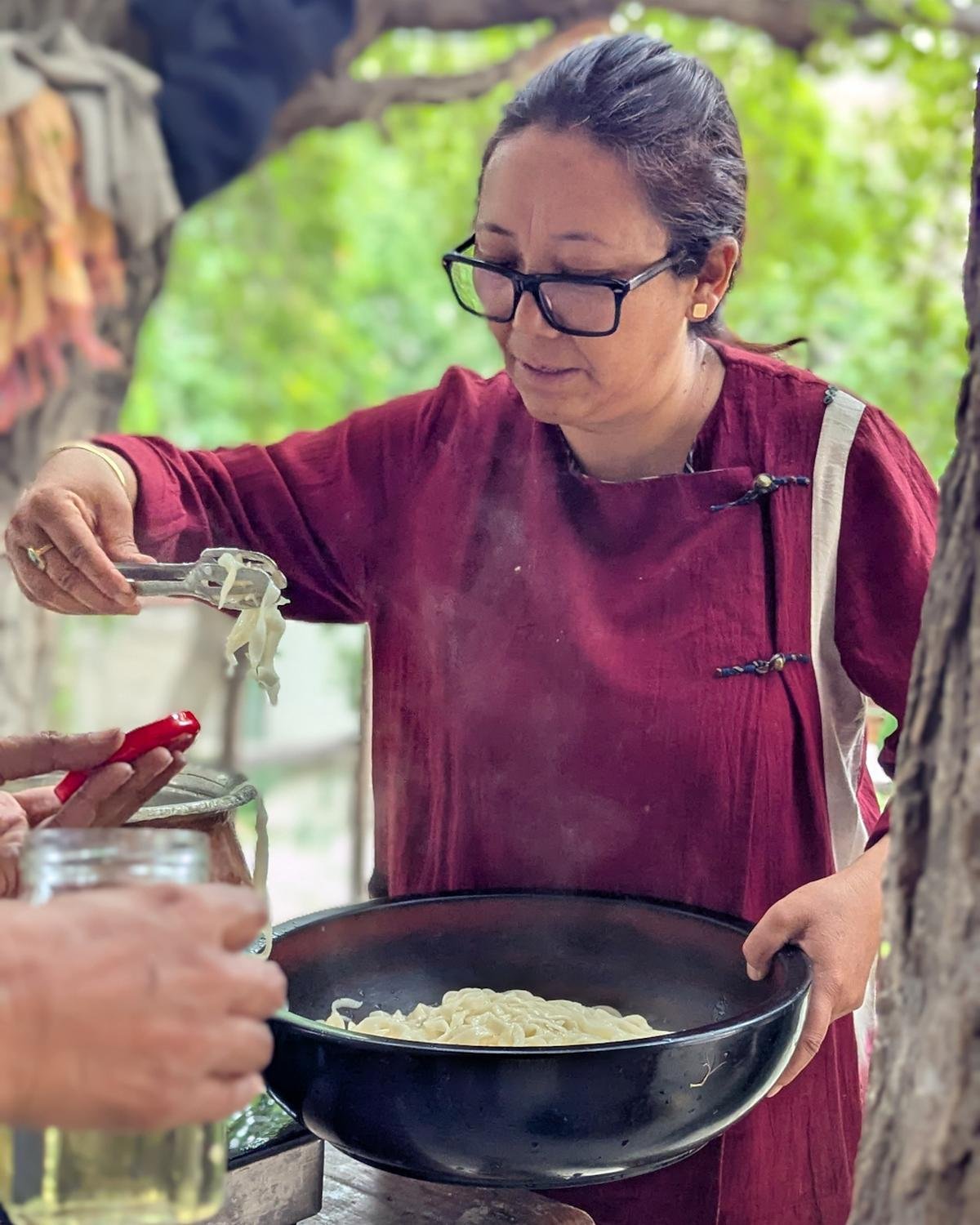
Chef Nilza Wangmo Ladakhi food
Related keywords: Nilza Wangmo Alchi Kitchen, Ladakhi food Chennai, The Hindu Lit For Life Unplugged, Ladakh cuisine, traditional Ladakhi food, Zhouyu Chennai, Ladakhi feast, food culture of Ladakh, Leh ingredients, Himalayan cuisine
What happens when the food of one of India’s highest inhabited regions travels to one of its coastal culinary capitals? At The Hindu Lit For Life Unplugged, the answer arrives on a plate.
Chef Nilza Wangmo of Alchi Kitchen brings a traditional Ladakhi feast to Chennai, creating an unusual meeting between the high-altitude food culture of Ladakh and the humid, coastal environment of Tamil Nadu’s capital. For the event at Zhouyu, ingredients were carried from Leh, allowing Wangmo to preserve flavours and culinary techniques closely connected to the landscape where the food originates.
The occasion is more than a special meal. It offers a rare opportunity to understand Ladakh through food — not as a picturesque Himalayan destination, but as a place where climate, altitude, agriculture, preservation and community have shaped what people eat.
Who is Chef Nilza Wangmo?
Chef Nilza Wangmo is the founder of Alchi Kitchen, a culinary destination associated with the food traditions of Ladakh. Her cooking focuses on dishes rooted in the region’s food culture rather than treating Ladakhi cuisine simply as another variation of Himalayan cooking.
That distinction is important because Ladakh has a culinary identity shaped by circumstances that are unusually demanding.
The region’s high altitude, cold climate, short growing season and historically limited access to fresh produce have influenced everything from the ingredients available to households to the ways food is stored and prepared.
Wangmo’s cooking offers a way to understand those conditions through taste.
Why bringing Ladakhi food to Chennai is significant
Chennai and Ladakh represent two dramatically different food environments.
Chennai’s cuisine has developed around a warm coastal climate, abundant access to rice, lentils, seafood, vegetables, coconut and a wide variety of spices. Ladakh’s traditional food culture developed under very different conditions, where cold temperatures and altitude impose practical limits on agriculture and food availability.
Putting these cuisines side by side makes one fact immediately clear: food is often a record of geography.
What grows locally, what can be stored, what is expensive to transport and what provides enough energy for the climate all influence the eventual cuisine.
The Ladakhi feast at Zhouyu therefore becomes a lesson in adaptation.
A cuisine shaped by altitude
Ladakh’s landscape is often described through mountains, monasteries and dramatic valleys. But the same geography also determines the region’s food system.
At high elevations, agriculture faces a shorter growing period and difficult weather conditions. Traditional communities have consequently developed ways of making the most of available grains, vegetables, dairy and meat, while preservation plays an important role.
This is why Ladakhi food cannot be understood simply through a list of dishes.
The cuisine represents a practical response to the environment.
Food has to nourish people living in cold conditions. Ingredients need to be used efficiently. Seasonal produce must often be preserved. Cooking methods have developed around what is locally available.
In this context, a traditional Ladakhi meal becomes a story about survival as much as flavour.
The journey from Leh to Chennai
One of the defining details of the event is that ingredients were carried from Leh to Chennai for the feast.
That decision says something important about culinary authenticity.
When a regional cuisine travels, the easiest approach is often substitution. A chef can use ingredients that look similar or are readily available in the destination city. Sometimes that works. But in a cuisine where specific grains, herbs, dairy products or preserved ingredients contribute to the character of a dish, substitutions can alter the experience considerably.
By bringing ingredients from Leh, Wangmo and the event organisers were able to retain a stronger connection with the source region.
The journey of those ingredients is therefore part of the story of the meal itself.
Ladakhi food is a reflection of seasonality
Modern urban food culture often makes seasonality almost invisible.
Supermarkets and global supply chains allow people to access many ingredients throughout the year. Traditional Ladakhi food developed before such systems existed.
The availability of food was closely connected to the seasons.
Fresh ingredients that could not be grown during the coldest months had to be preserved. Grains and other staples became important because they could be stored. Dried foods offered another way of extending the usefulness of seasonal produce.
This created a cuisine in which preservation was not simply a technique but part of everyday life.
Why preservation matters in Ladakh’s food culture
Preservation is sometimes treated as a secondary culinary technique. In high-altitude food cultures, it can be central to the entire food system.
Drying, fermenting and storing ingredients allow communities to bridge periods when fresh produce is limited.
These practices also create flavours that cannot be reproduced simply by using fresh ingredients.
Fermentation, for example, can transform texture and taste while also helping extend shelf life. Drying concentrates flavours and makes food easier to store and transport.
Such techniques demonstrate that traditional cuisines are often highly sophisticated responses to environmental constraints.
The importance of Ladakhi grains
Grains have historically played an important role in Ladakhi food, particularly because they can be stored and provide substantial energy.
Barley is especially significant to the region’s agricultural and culinary traditions. Its resilience makes it well suited to challenging growing conditions, and it has long been incorporated into Ladakhi food and drink.
Recognising the importance of such grains also helps correct a common misconception about Himalayan cuisine: that it is primarily about meat-heavy dishes designed for cold weather.
The reality is more varied.
Traditional Ladakhi food includes grains, vegetables, dairy products, meat, soups and preserved ingredients, with diets influenced by geography, community and season.
The food of Ladakh is not just “Tibetan food”
Another reason Wangmo’s work is important is that regional Himalayan cuisines are often grouped together too casually.
Ladakh shares historical and cultural connections with the wider Himalayan and Tibetan world, but Ladakhi cuisine has developed its own local characteristics.
The distinction matters because culinary identity is rarely confined to political boundaries or broad cultural categories.
Local ingredients, agricultural practices, religious traditions, trade routes and household habits all contribute to the way a cuisine evolves.
Calling every Himalayan dish “Tibetan food” can therefore erase meaningful regional differences.
Chef Nilza Wangmo’s work helps place Ladakhi cuisine in its own context.
Zhouyu becomes a meeting point between two food cultures
The choice of Chennai as the setting creates an intriguing culinary contrast.
Chennai’s food culture is deeply connected to rice, lentils, tamarind, chillies, curry leaves, coconut and the abundance of ingredients available in a tropical coastal environment.
Ladakh, by contrast, developed under conditions where the growing season is short and winter preservation is essential.
The feast therefore creates a conversation without requiring the two cuisines to be fused.
That is an important distinction.
Not every culinary exchange needs to produce fusion food. Sometimes the most interesting cultural exchange happens when one cuisine is allowed to speak in its own voice.
A unique angle: geography can be tasted
The most compelling way to understand Wangmo’s Chennai event may be to think of it as geography made edible.
Every cuisine contains traces of its environment.
In coastal Tamil Nadu, the sea, tropical agriculture and monsoon patterns have shaped food traditions. In Ladakh, altitude, cold, limited rainfall and a short growing season have played a similar role.
When diners taste a traditional Ladakhi dish, they are therefore tasting the consequences of a landscape.
This is why transporting ingredients from Leh is more meaningful than simply importing a menu. The ingredients carry part of the environmental story with them.
Comparison: Ladakhi food and Chennai food
| Food culture | Ladakh | Chennai |
|---|---|---|
| Climate influence | Cold, high-altitude environment | Warm, coastal tropical environment |
| Growing conditions | Short agricultural season | Longer growing conditions with tropical crops |
| Staple traditions | Strong role for grains such as barley | Rice is a major staple |
| Preservation | Important for surviving periods of limited fresh produce | Important, but alongside abundant fresh ingredients |
| Food identity | Shaped strongly by altitude and Himalayan geography | Shaped by coastal ecology and South Indian culinary traditions |
Why food festivals and chef collaborations matter
Special dining events can sometimes appear to be short-lived experiences, but they can have a broader cultural role.
Regional cuisines that remain relatively unknown outside their home areas need platforms where people can encounter them without travelling thousands of kilometres.
A chef-led event provides that bridge.
Instead of reading about Ladakhi cuisine, diners can experience its flavours, textures and ingredients directly. The chef can also provide context that a restaurant menu alone cannot communicate.
This is particularly valuable for cuisines that have not yet entered the mainstream Indian restaurant landscape.
From tourism imagery to culinary understanding
Ladakh is one of India’s most recognisable travel destinations. Photographs of monasteries, barren mountains, blue skies and high-altitude roads have helped create a powerful global image of the region.
Food offers a different way into Ladakh.
Instead of asking what the landscape looks like, it asks how people have lived within it.
That shift is significant. A bowl of food can reveal information about agriculture, climate, trade, preservation and household practices that a scenic photograph cannot.
Wangmo’s cooking therefore contributes to a deeper form of cultural storytelling.
The role of Alchi Kitchen
Alchi Kitchen is closely associated with Wangmo’s approach to presenting Ladakhi food. Its importance lies in treating local cuisine as something worth documenting, preserving and presenting on its own terms.
This becomes especially important as food cultures change.
Modernisation, tourism, changing diets and improved access to outside ingredients can transform what people eat. Such changes are not necessarily negative, but they can make traditional recipes and techniques less common.
Restaurants and chefs who document and serve regional food can therefore play a role similar to cultural archivists.
They keep dishes in circulation.
The challenge of preserving traditional cuisine
Preserving a cuisine does not mean freezing it in time.
Food traditions have always changed through migration, trade and technological development. The challenge is ensuring that change does not completely erase the knowledge that came before it.
For Ladakhi cuisine, that means maintaining knowledge of traditional ingredients, recipes, preservation methods and the cultural context surrounding food.
Chef-led events can contribute to that process by creating curiosity among diners who may have never encountered these traditions.
Why carrying ingredients from Leh changes the experience
The ingredient journey from Leh to Chennai also highlights an important truth about culinary storytelling: authenticity is not only about ingredients.
It is about context.
A chef could potentially recreate a dish using substitutes and still produce something delicious. But when ingredients are sourced from the region itself, diners receive a stronger connection to the original food system.
At the same time, authenticity should not become a rigid rule that prevents cuisines from evolving. Regional cooking has always adapted to availability.
The value of Wangmo’s approach is that it allows diners to experience the traditional reference point before considering how that food might evolve elsewhere.
Prediction: regional Indian cuisines will increasingly move beyond their home states
India’s culinary diversity is enormous, but restaurant culture often highlights a relatively limited selection of regional cuisines.
Events such as this suggest another direction: chefs and cultural institutions may increasingly bring lesser-known regional food traditions to metropolitan audiences through temporary collaborations and curated dining experiences.
That could benefit both diners and regional food communities.
Urban audiences gain access to cuisines they may not otherwise encounter, while chefs from smaller or geographically remote food cultures gain visibility and new audiences.
The challenge will be to maintain context and avoid reducing regional cuisines to novelty.
Why Ladakhi food deserves a larger conversation
Ladakhi cuisine has a compelling story because it demonstrates how food adapts to extremes.
It is not simply a collection of recipes. It reflects the relationship between people and a difficult environment.
Its grains tell a story about agriculture. Its preserved foods speak of seasons. Its warming preparations reflect climate. Its ingredients reveal local availability and historic trade.
That makes Ladakhi food valuable not only as cuisine but as cultural knowledge.
Conclusion: A meal that carries a landscape
Chef Nilza Wangmo’s Ladakhi feast in Chennai is significant because it brings an entire food culture into conversation with a city thousands of kilometres away.
At Zhouyu, the ingredients carried from Leh do more than create a traditional meal. They carry traces of the high-altitude landscape from which the cuisine emerged.
The event also demonstrates why regional food deserves to be understood through more than dishes and flavours. Ladakhi cooking is a record of adaptation, seasonality, preservation and community.
For Chennai diners, the experience offers a chance to encounter Ladakh without reducing it to a travel postcard. For Ladakhi cuisine, it creates another platform through which its traditions can be recognised and appreciated.
And for Indian food culture more broadly, it is a reminder that some of the country’s most interesting culinary stories are still waiting to travel.
For breaking news and live news updates, like us on Facebook or follow us on Twitter and Instagram. Read more on Latest Lifestyle on thefoxdaily.com.

COMMENTS 0