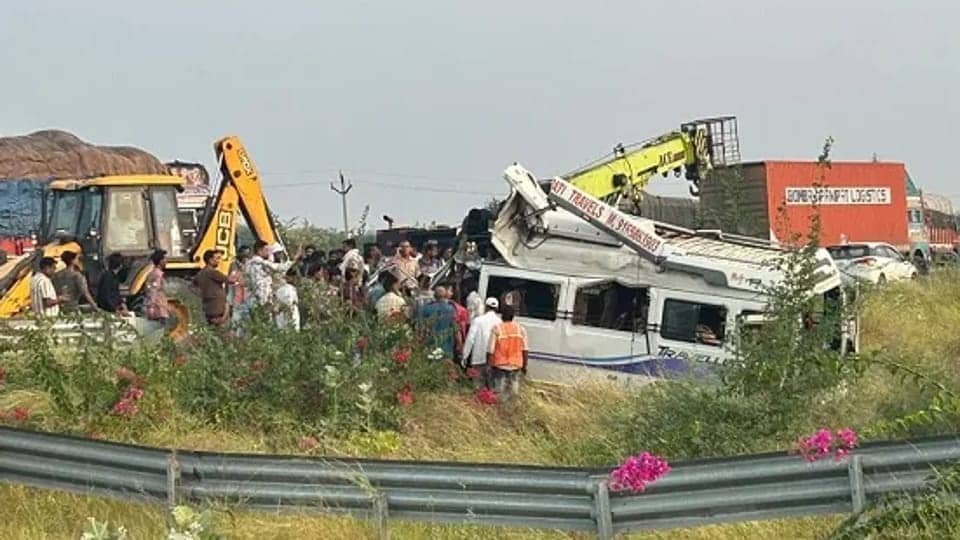
At least seven people were killed and 10 others injured after a tempo traveller carrying pilgrims plunged nearly 20 feet off the Delhi-Mumbai Expressway in Rajasthan’s Kota district on Saturday morning. The vehicle reportedly broke through a road divider before falling into a seasonal drain and crashing into a wall, leaving several passengers trapped inside the badly damaged vehicle.
The accident occurred at around 7 am, when the group was travelling from Madhya Pradesh to the Khatu Shyam temple in Rajasthan’s Sikar district. Four passengers died at the scene, while three others succumbed to their injuries while being taken to hospital, according to police.
The tempo traveller was carrying approximately 20 passengers, most of whom were residents of Betul district in Madhya Pradesh. They had begun their journey on Friday night for a pilgrimage to the popular Khatu Shyam temple in Reengus.
Emergency responders, police personnel, local residents and National Highways Authority of India (NHAI) rescue teams rushed to the accident site to assist survivors and recover the damaged vehicle. The injured were taken to hospitals in Kota, where several passengers were reported to be in critical condition.
The tragedy has once again drawn attention to the risks associated with long-distance road journeys, particularly overnight travel when driver fatigue can become a serious safety concern. However, investigators have yet to establish whether fatigue, vehicle-related problems, road conditions or another factor contributed to the crash.
How the accident happened on the Delhi-Mumbai Expressway
According to Seemliya Station House Officer Nand Singh, the tempo traveller had crossed the Karadiya toll plaza and was heading towards Sultanpur when the driver reportedly lost control of the vehicle.
The vehicle broke through the divider and plunged approximately 20 feet into a seasonal drain before hitting a wall. The force of the impact severely damaged the front portion of the tempo traveller, complicating efforts to reach passengers trapped inside.
The accident took place at approximately 7 am on Saturday, when the vehicle was nearing the end of its overnight journey from Madhya Pradesh towards Rajasthan’s Khatu Shyam temple.
Police said four passengers died at the spot. Three more died while being transported to hospital, bringing the death toll to seven. Ten injured passengers were taken for medical treatment.
Although police suspect that the driver may have fallen asleep while driving, officers have not confirmed this as the cause. The investigation will need to establish the circumstances immediately preceding the crash before a definitive explanation can be given.
The distinction is important because a vehicle leaving the road can result from several factors, including driver fatigue, loss of control, mechanical failure or other unexpected circumstances. The available information does not establish whether any of these factors, individually or together, caused this particular accident.
Rescue operation: Villagers and emergency teams rushed to help
Local villagers and passers-by were among the first to reach the accident site and begin assisting the injured passengers. Their response was followed by the arrival of police officers, NHAI rescue personnel and emergency ambulance teams.
The vehicle’s severe damage and its position inside the drain made the rescue operation particularly challenging. An NHAI crane was deployed to retrieve the wrecked tempo traveller.
Sultanpur Block Chief Medical Officer Rajesh Samar said four ambulances were immediately dispatched to the scene after authorities received information about the accident.
The injured passengers were subsequently transported to the New Hospital attached to Kota Medical College and MBS Hospital for treatment.
Several of the injured were reported to be in critical condition. Their medical condition will be an important factor in determining whether the casualty figures change as treatment continues.
The response involved several stages of emergency assistance: reaching the crash site, extracting passengers from the wreckage, transporting the injured and arranging hospital treatment. In serious road accidents, these stages can be complicated when vehicles are badly damaged or come to rest below road level.
The deployment of a crane indicates that recovering the vehicle required specialised equipment rather than a straightforward roadside removal. However, further details about the duration of the rescue operation and the specific injuries sustained by individual passengers were not provided in the available account.
Who were the passengers travelling to Khatu Shyam temple?
The tempo traveller was carrying a group of pilgrims from Madhya Pradesh, most of them residents of Betul district. The group had departed on Friday night and was travelling towards Khatu Shyam temple in Reengus, located in Rajasthan’s Sikar district.
Khatu Shyam temple is a prominent pilgrimage destination in Rajasthan, attracting devotees from different parts of India. Group travel by minibuses, tempo travellers and other passenger vehicles is one way visitors organise journeys to religious destinations.
For the passengers involved in Saturday’s accident, what began as a religious journey ended in a devastating road tragedy. The deaths are likely to have a profound impact on the families and communities connected to the victims.
The available information does not identify all the deceased passengers or establish their individual places of residence beyond the report that most passengers came from Betul district. Details about the identities of the victims and arrangements for the injured were not included in the initial account.
The incident also highlights the particular vulnerability of groups travelling together in a single vehicle. When a vehicle carrying numerous passengers crashes, multiple people can be injured at once, placing immediate demands on local emergency services and nearby hospitals.
For families awaiting information about relatives travelling on the route, identifying victims and establishing contact with survivors becomes an important part of the response following such an accident.
Driver fatigue suspected, but investigators have not confirmed the cause
Police suspect that the driver may have fallen asleep at the wheel, raising the possibility that fatigue contributed to the accident. The passengers had left Betul on Friday night, and the crash occurred at around 7 am the following morning.
This timing makes driver alertness a relevant line of investigation. Overnight journeys can place additional demands on drivers, especially when driving continues into the early morning hours, when normal sleep patterns may affect alertness.
Nevertheless, the departure time alone does not prove that the driver was sleep-deprived or that fatigue caused the vehicle to leave the expressway. Police have said the exact cause has yet to be established.
Why driver fatigue matters during long-distance journeys
Driver fatigue can reduce concentration, slow reactions and make it harder to respond to unexpected situations. Severe sleepiness may also cause brief episodes of involuntary sleep, commonly known as microsleeps, during which a driver temporarily loses awareness of the road.
These risks are especially serious when a vehicle is travelling at highway speeds. A brief lapse in attention can reduce the time available to respond to a bend, a change in traffic conditions or another hazard.
For commercial and group passenger travel, effective fatigue management includes adequate rest before departure, appropriate breaks and arrangements that prevent drivers from continuing when they are too tired to drive safely.
Passengers may also play a role in recognising warning signs, such as repeated yawning, difficulty keeping the driver’s attention focused or inconsistent vehicle positioning. Such signs should prompt a safe stop rather than an attempt to continue the journey.
These are general road-safety considerations, not findings about the driver involved in the Kota accident. Establishing the actual cause will require investigators to examine the available evidence and circumstances surrounding the crash.
Why expressway safety involves more than high-speed driving
The Delhi-Mumbai Expressway is a major road corridor intended to improve connectivity between important economic centres. Expressways are designed to facilitate faster movement over long distances, but high-speed travel also means that drivers must maintain concentration and control throughout their journeys.
In Saturday’s accident, the vehicle reportedly broke through a divider before plunging into a seasonal drain. That sequence raises questions about the circumstances in which the driver lost control and the extent to which the road’s protective features were involved.
However, the available information does not establish whether the divider or other infrastructure failed to meet safety requirements. It would therefore be premature to attribute the crash to a defect in the expressway’s design or maintenance.
A thorough investigation could examine the vehicle’s condition, the driver’s actions, the road layout at the accident location and any available physical or electronic evidence. The results would help distinguish between a driver-related incident, a mechanical problem and other possible explanations.
The crash also illustrates why road safety depends on several layers of protection. Safe vehicle operation, appropriate speed, driver alertness, vehicle maintenance, road engineering and rapid emergency response all contribute to reducing the risk and consequences of serious collisions.
Even where roads are designed for high-speed traffic, drivers remain responsible for maintaining control of their vehicles and responding appropriately to changing conditions. At the same time, investigations into serious crashes should establish the facts before responsibility is assigned.
What pilgrims and families should consider before overnight road trips
Long-distance religious journeys often involve travel at night to reach a destination early in the morning. While this can make travel more convenient, it requires careful planning to ensure that drivers remain alert and vehicles are suitable for the journey.
Several practical precautions can help reduce risks during group travel:
- Plan adequate rest: Drivers should be properly rested before beginning a long journey, and schedules should allow sufficient time for sleep.
- Avoid driving through severe fatigue: If a driver becomes drowsy, the journey should stop at a safe location so the driver can rest or another qualified driver can take over.
- Check the vehicle before departure: Tyres, brakes, lights, steering and other essential components should be inspected before a long trip.
- Use seat belts: Passengers should wear seat belts wherever they are provided, including in passenger vehicles used for group travel.
- Avoid unnecessary pressure on drivers: Travel schedules should not encourage speeding or continued driving when rest is needed.
- Keep emergency information accessible: Passengers should know how to contact emergency services and communicate their location if an incident occurs.
These measures cannot eliminate every road risk, but they can reduce preventable hazards. Their importance is particularly clear when several passengers depend on one driver to transport them safely over a long distance.
Ashok Gehlot expresses grief over the Kota accident
Former Rajasthan chief minister Ashok Gehlot expressed grief following reports of the accident in Kota district.
In a post on X, Gehlot described the deaths in the minibus accident in the Simliya police station area as deeply saddening and heartbreaking. He offered condolences to the bereaved families and wished the injured passengers a speedy recovery.
His response reflected the wider concern following the deaths of seven people during what was intended to be a pilgrimage to Khatu Shyam temple.
As rescue and medical efforts continued, the immediate priorities remained treatment for the injured, support for the affected families and an investigation into the circumstances that led to the crash.
Police investigation underway after seven deaths
Police have begun investigating the accident to determine why the tempo traveller left the Delhi-Mumbai Expressway and plunged into the seasonal drain.
The suspected possibility of driver fatigue is one aspect of the investigation, but it has not been established as the definitive cause. Further findings will be needed before conclusions can be drawn about the sequence of events or the factors responsible.
The condition of the injured passengers is another important concern. Several were reported to be critical after being taken to hospitals in Kota, although the initial report did not provide a subsequent medical update.
The accident underscores the potentially devastating consequences of a single-vehicle crash involving a group of passengers on a high-speed road. It also highlights the importance of driver alertness, safe journey planning, effective vehicle maintenance and timely emergency assistance.
For the families of the seven people who died, the tragedy has turned a journey of faith into a period of grief. As authorities work to establish what happened, the investigation will be central to understanding the cause of the crash and identifying any lessons that could help prevent similar incidents in the future.
For breaking news and live news updates, like us on Facebook or follow us on Twitter and Instagram. Read more on Latest India on thefoxdaily.com.






COMMENTS 0