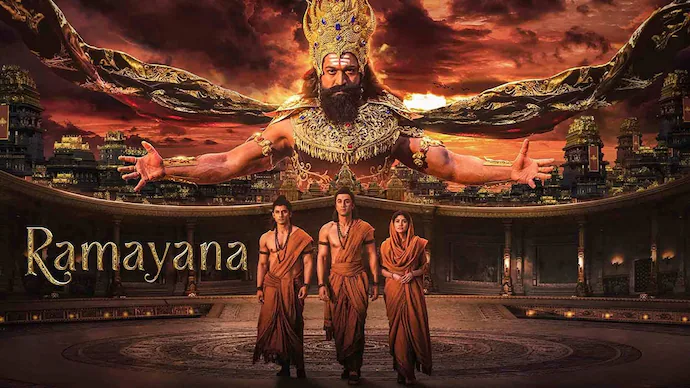
Stories about the battle between good and evil have remained relevant across generations, but few epics carry the cultural, religious and emotional significance of the Ramayana. Its characters, conflicts and moral questions are deeply embedded in India’s collective imagination. Bringing such a familiar story to the big screen is therefore both an enormous creative opportunity and a demanding responsibility.
Director Nitesh Tiwari and producer Namit Malhotra take on that challenge with Ramayana: Part 1, an ambitious cinematic adaptation designed on a massive scale. Featuring Ranbir Kapoor as Ram, Sai Pallavi as Sita and Yash as Ravana, the film attempts to combine traditional storytelling with contemporary filmmaking technology and international-level visual effects.
In terms of production ambition, the film makes a strong impression. Its elaborate environments, fantastical creatures, large-scale action and visual effects create an expansive cinematic world. Yet the experience is not equally successful in every department. While the spectacle frequently holds attention, the storytelling often feels more concerned with covering familiar incidents than exploring the relationships and moral conflicts that make the epic enduring.
The result is a mixed cinematic experience: technically impressive, visually ambitious and occasionally gripping, but emotionally restrained where it could have been far more powerful.
Ramayana: Part 1 Delivers a Major Visual Effects Achievement
One of the film’s biggest strengths is its visual presentation. The production aims to establish a mythological world that feels enormous, fantastical and suitable for a story involving divine figures, extraordinary warriors and supernatural beings.
The special effects are particularly effective in bringing several memorable elements of the epic to life. Jatayu, the legendary bird who attempts to rescue Sita, receives a compelling visual treatment. The Pushpaka Vimana, the flying vehicle associated with Ravana, also makes an impressive appearance.
Other visual highlights include a flying elephant, fantastical creatures and a striking tornado sequence. These moments demonstrate the scale of the production and the filmmakers’ willingness to use advanced visual technology to create images that would be difficult to achieve through conventional filmmaking.
Not every visual creation is equally convincing. Kumbhakarna, for instance, does not make the same impression as some of the film’s other computer-generated characters. Nevertheless, these inconsistencies do not undermine the overall achievement of the visual effects work.
The film’s action sequences are another major attraction. They give both Ram and Ravana opportunities to demonstrate their physical abilities, combat skills and contrasting approaches to power. The choreography, visual effects and scale of these encounters help maintain interest even when the narrative follows events that audiences already know.
For viewers seeking a large-scale mythological spectacle, the production offers plenty to appreciate. The challenge is that technical achievement alone cannot provide the emotional depth expected from a story as complex as the Ramayana.
Nitesh Tiwari Moves Away From His Earlier Storytelling Strengths
Ramayana: Part 1 represents a significant departure for director and co-writer Nitesh Tiwari. He previously earned recognition for films such as Dangal and Chhichhore, which relied heavily on human relationships, emotional conflicts and the development of their characters.
Those strengths are less consistently visible in this mythological adaptation. Tiwari and screenwriter Shridhar Raghavan have a wealth of material involving family relationships, personal sacrifices, loyalty, ambition and difficult moral decisions. However, several of these possibilities receive limited attention.
The storytelling often feels cautious, as though the filmmakers are reluctant to interpret familiar characters beyond the versions audiences already recognise. That approach may help avoid controversy when adapting a religiously significant epic, but it also limits opportunities for meaningful character development.
Instead of allowing important relationships to unfold naturally, the film frequently moves from one major event to another. The result is an adaptation that sometimes resembles a checklist of familiar episodes rather than a dramatic exploration of the people and decisions behind them.
This becomes particularly noticeable in scenes that should carry considerable emotional weight. Ram and Sita’s first meeting, the challenge involving Lord Shiva’s bow Pinaka and their subsequent union are presented largely through songs and conventional romantic staging.
These sequences do not always generate the emotional momentum needed to balance the film’s large-scale action. The relationship between the two characters could have provided a stronger emotional foundation for the events that follow, but the treatment remains relatively restrained.
Ram and Sita’s Relationship Needed Greater Emotional Depth
Ram and Sita are at the heart of the Ramayana, and their relationship provides much of the emotional meaning behind the larger conflict. Their bond involves love, trust, duty and sacrifice, particularly when their comfortable life in Ayodhya is replaced by the uncertainty of exile.
In the film, Sai Pallavi plays Sita opposite Ranbir Kapoor’s Ram. Their first encounter and eventual union establish the foundation of their relationship, but the narrative does not always give these moments enough space to develop.
One of the most important opportunities for emotional storytelling comes when Ram is informed that he must give up his claim to the throne of Ayodhya and spend 14 years in exile. The decision involves competing responsibilities, family loyalty and the demands of duty.
Sita declares that she is duty-bound to accompany Ram, even though their life in the forest will be uncertain and difficult. Her decision reflects the strength of her commitment and willingness to share the consequences of his exile.
However, the film gives much less attention to Urmila, Lakshman’s wife. Lakshman decides to accompany Ram and Sita into exile, leaving Urmila behind. Her sacrifice and the emotional consequences of that separation offer considerable dramatic possibilities.
The limited exploration of Urmila’s position illustrates a wider weakness in the screenplay. The story includes several characters whose choices deserve greater attention, but the film often moves forward without fully examining the personal cost of those decisions.
By focusing primarily on the major events, the narrative misses opportunities to show how duty affects different members of the royal family. A deeper examination of these relationships could have made the exile sequence considerably more affecting.
Yash’s Ravana Emerges as the Film’s Most Compelling Character
If the film has one character who consistently commands attention, it is Ravana, played by Yash. The actor approaches the role with considerable energy and presence, creating an antagonist whose ambition and personality dominate several of the film’s most memorable sequences.
Ravana is presented as more than a conventional villain. The screenplay attempts to explore the circumstances, motivations and personal grievances that shape his character. His ambition is connected to a desire for justice, revenge and the restoration of pride among his people.
The film also touches upon the marginalisation of Ravana’s community and his determination to challenge the existing order. These elements provide a broader context for his rise and help explain why he becomes the formidable figure at the centre of the conflict.
This treatment gives the character greater complexity than a straightforward portrayal of evil. His motivations are not presented as entirely detached from questions of power, identity and social position.
Yash makes the most of the opportunity. Whether performing the Shiv Tandava, roaring in moments of anger or demonstrating Ravana’s extraordinary abilities, he brings a commanding physicality to the role.
The actor’s performance is particularly effective when Ravana’s confidence and sense of superiority take centre stage. His scenes frequently possess an energy that makes them stand out from the more restrained portions of the film.
One especially interesting storytelling moment involves the different voices and motivations operating within Ravana’s mind. It offers a glimpse into the internal conflicts behind his outward confidence and ambition.
Across the film’s three-hour runtime, Ravana receives one of the more clearly defined character journeys. His development gives the audience an opportunity to understand how personal ambition and a desire for revenge can gradually shape a powerful but destructive personality.
Ranbir Kapoor’s Ram Is Restrained and Occasionally Stiff
Ranbir Kapoor faces a very different challenge as Ram. Unlike Ravana, whose character allows for dramatic expressions of anger, ambition and aggression, Ram is associated with composure, discipline and adherence to duty.
Kapoor approaches the role with a measured performance, emphasising serenity and restraint. His portrayal reflects the character’s reputation as an ideal figure whose decisions are guided by responsibility and moral principles.
However, this restraint sometimes becomes stiffness. The performance appears particularly cautious in scenes where Ram is expected to express emotion or establish a stronger personal connection with the audience.
It is possible to interpret this as a deliberate choice. Ram is a deeply revered figure, and portraying him on screen carries expectations that are different from those associated with an ordinary fictional character. An actor playing the role must balance dramatic expression with the cultural and religious significance attached to it.
Nevertheless, the result occasionally feels too controlled. Kapoor appears more comfortable when the character is involved in physical action, particularly during sequences involving archery, combat and movement through the forest.
These moments allow him to display a more dynamic side of Ram. His precision with the bow and physical confidence provide some of the film’s more engaging action sequences.
The narrative also suggests that Ram’s character will become more active in the subsequent instalment, particularly as the story moves towards the journey to Lanka and the confrontation with Ravana.
That possibility may explain why the first part gives him a comparatively restrained journey. However, the foundation of a two-part epic still needs to establish a strong emotional connection with its central protagonist, and the film does not always achieve that.
Why the Film Feels More Like a Sequence of Events Than a Complete Drama
The Ramayana contains numerous episodes that audiences recognise, from Ram and Sita’s union to the exile and the developments that eventually lead to the conflict with Ravana. The familiarity of these events creates an unusual challenge for filmmakers.
Simply reproducing well-known incidents is unlikely to surprise viewers. The more important task is to explore the emotional and moral questions surrounding them and provide a fresh cinematic experience without losing the essence of the original narrative.
Ramayana: Part 1 succeeds more consistently in recreating the scale of the epic than in exploring its underlying complexities. The screenplay moves between major incidents, but several transitions lack the emotional development needed to make the characters’ decisions feel fully realised.
The film’s caution is understandable given the religious importance of the source material. However, respect for an epic does not necessarily require avoiding difficult questions or reducing characters to familiar descriptions.
The story offers opportunities to examine the meaning of duty, the burden of leadership, the consequences of ambition and the sacrifices made by people who remain outside the central conflict. Exploring these themes could have added considerable depth without changing the essential events.
Instead, the film often relies on visual spectacle to maintain audience interest. This approach works during action sequences and major set pieces, but it becomes less effective in scenes that depend on emotional engagement.
How Ravana’s Character Changes the Film’s Balance
The contrast between Ram and Ravana is one of the most interesting aspects of the film. Ram represents composure and duty, while Ravana is driven by ambition, pride and a determination to establish his own power.
However, the screenplay gives Ravana a more active and clearly defined character journey. His motivations, conflicts and ambitions are explored through scenes that allow Yash to display different dimensions of the character.
As a result, Ravana frequently appears more dramatically engaging than Ram. When the story shifts from Ravana’s energetic sequences to Ram’s quieter scenes, the change in pace can feel abrupt.
This imbalance is not necessarily a problem in itself. An antagonist can be fascinating without undermining the hero, particularly when the story explores the reasons behind the conflict. But the protagonist needs an equally compelling internal journey to ensure that the audience remains emotionally invested in the eventual confrontation.
The film hints at the larger struggle that will define the next instalment. Ram’s determination to bring Sita back, expressed through the declaration “Main Vaapas Laaunga”, provides a glimpse of the more intense conflict ahead.
That moment offers a stronger sense of purpose and anticipation. It also suggests that the filmmakers intend to give Ram a more active role as the narrative moves towards Lanka.
Does Ramayana: Part 1 Set Up the Next Instalment Successfully?
As the first part of a larger cinematic adaptation, the film has the responsibility of introducing its central characters, establishing the world and preparing audiences for the main conflict. It also needs to create enough dramatic momentum to make viewers interested in returning for the next instalment.
On the technical side, it makes a strong case for the scale of the project. The visual effects, action sequences and production design establish a mythological world that feels expansive and cinematic.
The performances are more uneven. Yash gives Ravana a commanding presence, while Kapoor’s portrayal of Ram is restrained and occasionally limited by the character’s cautious treatment. Sai Pallavi’s Sita is central to the emotional foundation of the story, but the screenplay could have explored her relationship with Ram and her personal decisions in greater depth.
The film’s final stretch offers a glimpse of the conflict to come. Ram’s determination to bring Sita back gives the story a clear direction and builds anticipation for the eventual confrontation between the two central figures.
Although the ending does not depend entirely on a conventional cliff-hanger, it creates curiosity about how the next chapter will handle the journey to Lanka, the alliances formed along the way and the battle against Ravana’s formidable forces.
Final Verdict: A Grand Visual Spectacle With Missed Emotional Opportunities
Ramayana: Part 1 is an ambitious attempt to bring one of India’s most significant epics to the big screen using large-scale production and advanced visual effects. Its impressive imagery, elaborate action sequences and Yash’s energetic portrayal of Ravana make it an engaging spectacle at several points.
However, the film does not fully match its technical ambition with equally strong storytelling. The screenplay moves through familiar events without consistently examining the relationships, sacrifices and moral dilemmas that give the Ramayana its lasting emotional power.
Ranbir Kapoor brings composure to Ram, but the performance sometimes feels overly restrained. Sai Pallavi’s Sita and the wider family relationships also deserved more space, particularly in moments involving exile and personal sacrifice.
Yash’s Ravana emerges as the most fully developed character, creating an interesting imbalance between the film’s hero and antagonist. His motivations and ambition give the narrative some of its strongest dramatic moments.
Ultimately, the first instalment succeeds more as a visual achievement than as a complete emotional drama. It establishes the scale of the cinematic universe and lays the groundwork for the larger battle, but leaves considerable storytelling potential unexplored.
The promise of a more intense confrontation between Ram and Ravana gives the next instalment a strong foundation. Whether the filmmakers can combine the same visual ambition with deeper character development and emotional complexity will determine the lasting impact of this adaptation.
For breaking news and live news updates, like us on Facebook or follow us on Twitter and Instagram. Read more on Latest India on thefoxdaily.com.






COMMENTS 0