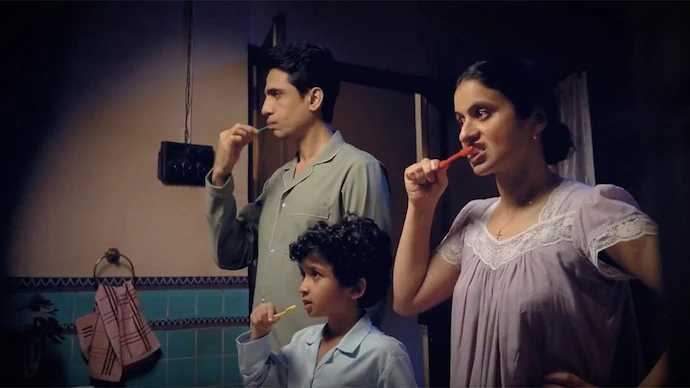
Little Thomas review: Kaushal Oza’s family drama follows a seven-year-old boy who believes he can reunite his feuding parents and fulfil his dream of having a baby brother. Featuring charming performances by Hridansh Parekh, Rasika Dugal and Gulshan Devaiah, the film captures the amusing logic of childhood and the nostalgia of 1990s Goa. However, an underdeveloped screenplay prevents its promising premise from becoming a deeply moving family story.
There is a telling moment in Little Thomas when Desmond, played by Gulshan Devaiah, attempts to place a figurine of a couple on top of a multi-tiered cake. The structure collapses, and he eventually realises that the figurine is too heavy. The scene neatly captures the film’s central weakness: an abundance of charm cannot compensate for a story that struggles to support its own ambitions.
Directed by Kaushal Oza, Little Thomas looks at family relationships through the eyes of a child who cannot understand why the two people he loves most seem unable to get along. The premise offers plenty of room for humour, tenderness and emotional complexity. While the film succeeds in capturing the unpredictable innocence of childhood, it does not explore the consequences of parental conflict with the depth its story demands.
Little Thomas Plot: A Seven-Year-Old’s Mission to Bring His Parents Together
Set in 1990s Goa, Little Thomas centres on seven-year-old Thomas, played by Hridansh Parekh. The young boy has two wishes: he wants his parents to stop fighting, and he desperately wants a baby brother.
Thomas believes the solution might be surprisingly simple. If his parents, Jessie (Rasika Dugal) and Desmond (Gulshan Devaiah), kiss the way couples do in English films, they might become affectionate again and give him the sibling he dreams of having.
Unfortunately, the adults in his life have more pressing concerns. Jessie and Desmond’s marriage is strained, their arguments are frequent, and the family bakery is struggling. Their relationship has reached a point where the warmth Thomas hopes to see between them has been replaced by tension and frustration.
Unable to understand the reasons behind their unhappiness, Thomas tries to make sense of the adult world using the limited knowledge available to him. When his parents fail to explain where babies come from, he turns to other people with his questions, leaving the adults around him scrambling to find suitable answers.
This is where the film finds some of its most entertaining material. Thomas approaches complicated subjects with the directness of a child who does not yet understand why certain questions make grown-ups uncomfortable. His attempts to solve problems that are far beyond his understanding are frequently funny, but they also reveal how children absorb the atmosphere of their homes without fully understanding the emotions shaping it.
Hridansh Parekh Is the Film’s Biggest Strength
The most immediately appealing element of Little Thomas is Hridansh Parekh’s performance. As the young protagonist, he brings an unaffected charm to a character whose curiosity drives much of the narrative.
With his expressive eyes, crooked, toothy smile and earnest manner, Parekh makes Thomas easy to root for. More importantly, he gives the boy’s determination a convincing emotional foundation. Thomas is not simply asking questions to create comic situations; he genuinely believes that he can repair his family if he understands what is going wrong.
That sincerity helps keep the character endearing, even when the screenplay repeatedly returns to his cuteness instead of developing the story. Parekh’s performance feels natural enough to make Thomas’s peculiar logic believable, allowing the humour to emerge from his perspective rather than from exaggerated reactions alone.
The performance also gives the film its emotional centre. Thomas cannot articulate the complexities of a troubled marriage, but his desire to see his parents happy is immediately understandable. His innocence makes the distance between what he wants and what he can actually control particularly poignant.
However, the film sometimes appears so invested in its young star that it relies on his appeal to carry scenes that need stronger dramatic development. Parekh does much of the heavy lifting, but even a promising child actor cannot compensate for a screenplay that repeatedly circles the same ideas.
1990s Goa Setting Adds Nostalgia and Local Flavour
The period setting is another of Little Thomas’s more effective features. Rather than treating the 1990s as a decorative backdrop, the film incorporates everyday details that help establish the world Thomas inhabits.
The references to Coca-Cola becoming more accessible, refrigerators remaining a luxury in many homes and shopkeepers negotiating cooling charges evoke a time when familiar conveniences did not necessarily come easily. These details lend the setting a sense of lived experience, particularly for viewers who remember the social and economic changes of that period.
The casual use of Goan expressions and colloquial dialogue also adds texture. Phrases such as “kya karta hai” and “hum nahi karega” contribute to the film’s informal atmosphere, making its characters feel rooted in a particular social environment rather than placed in a generic nostalgic landscape.
Such touches work because they do not demand too much attention. They emerge naturally from the setting and help build a recognisable everyday world around Thomas and his family. The result is a warm portrait of a time when small domestic details could become memorable experiences.
Yet atmosphere alone cannot supply the dramatic momentum the film lacks. The 1990s setting makes Little Thomas inviting, but it cannot resolve the screenplay’s larger problem: the story has more to say about family relationships than it ultimately manages to express.
Childhood Questions Provide the Film’s Funniest Moments
One of the film’s sharpest observations is that children can ask the most straightforward questions at the most inconvenient moments. Their curiosity is often innocent, but the answers adults give them can reveal as much about parental anxiety as about childhood itself.
A particularly amusing example comes when Thomas asks about his origins. Desmond tells him that he came from Malaysia because his T-shirt carries the words “Made in Malaysia”. It is a ridiculous explanation, but it feels recognisable precisely because parents sometimes invent answers when they are unprepared for a child’s difficult questions.
The humour works because Thomas’s father is not necessarily trying to deceive him out of malice. He is attempting to escape an awkward conversation with an explanation that seems sufficient in the moment. The scene captures the improvisational nature of parenting, where adults sometimes have to respond before they have figured out what they want to say.
These exchanges reflect the film’s strongest instinct: understanding how children interpret the world through fragments of information, overheard conversations and observations that adults might dismiss as insignificant.
Thomas’s belief that a kiss could restore his parents’ relationship is another example. He draws conclusions from the films he watches and applies them to his own family, assuming that the right gesture might fix everything. The idea is charming, but it also carries a sadness that the film does not fully explore.
A Promising Family Drama That Never Goes Deep Enough
Underneath its humour and nostalgic setting, Little Thomas has the foundations of a compelling family drama. Children living with unhappy parents often experience the tension long before they understand its causes. They may blame themselves, attempt to mediate arguments or imagine that a small change in their behaviour could bring the household back to normal.
Thomas embodies this emotional confusion. He sees that Jessie and Desmond are unhappy with each other, but he does not have the maturity to understand why. His attempts to reunite them are therefore both touching and heartbreaking: he believes that the fate of his family rests on a problem he can somehow solve.
The film occasionally hints at the loneliness behind his cheerful determination. When affection gives way to arguments, a child can feel the absence of emotional security without knowing how to describe it. Thomas’s quest for a baby brother is also tied to his desire for a happier home, where the adults around him might once again seem connected.
Unfortunately, the screenplay rarely allows these feelings to develop fully. The conflicts between Jessie and Desmond establish that their marriage is in trouble, but the narrative often moves away from the discomfort before it can acquire real weight.
Instead, the film frequently returns to a familiar cycle: Thomas does something cute, a comic situation follows, and the adults react. Although individual moments can be enjoyable, their repetition weakens the overall narrative. Encounters between Thomas and his young friends also sometimes feel arranged to produce particular scenes rather than emerging organically from the story.
The result is a film that entertains in patches but struggles to build a lasting emotional connection. It recognises the complexity of its subject without consistently engaging with it, leaving viewers to imagine the deeper family drama that might have emerged from the same premise.
Rasika Dugal Brings Restraint to Jessie
Rasika Dugal brings welcome nuance to Jessie, a woman caught between the practical demands of keeping her family afloat and the emotional strain of a marriage that appears to be losing its warmth.
Jessie is not simply an unhappy wife waiting for her circumstances to improve. Her frustration suggests a person who has responsibilities, disappointments and dreams of her own. Dugal conveys this through a restrained performance that makes the character feel believable, even when the screenplay does not provide enough space to examine her inner life.
She is particularly effective in suggesting the exhaustion that can accompany a relationship in which affection has gradually been displaced by arguments. Jessie’s difficulties are not always explicitly explored, but Dugal gives the character enough emotional texture to prevent her from becoming merely one half of a quarrelling couple.
The limitation lies in the writing. There are indications that Jessie has sacrificed parts of her own aspirations while managing the pressures of family life, yet the film does not fully develop these tensions. A more layered screenplay could have made her struggles central to the drama rather than allowing them to remain largely in the background.
Gulshan Devaiah Makes Desmond Likeable
Gulshan Devaiah is equally engaging as Desmond, an idealistic man whose personal dreams do not always align with the practical realities of family life. He brings warmth and a degree of vulnerability to the character, avoiding the easy choice of turning him into a caricature of an irresponsible husband.
Desmond’s interactions with Thomas are among the film’s more appealing moments. His improvised explanation about Malaysia captures the awkwardness of a parent confronted with a question he is not ready to answer. The scene also suggests a father who is trying, however clumsily, to navigate the unpredictable demands of raising a curious child.
Devaiah and Dugal work well together, making the strained relationship between Jessie and Desmond feel credible. Their performances suggest the history and frustration behind the couple’s arguments, even when the screenplay does not explore the underlying issues in sufficient detail.
Their chemistry gives the film a stronger foundation than its writing sometimes allows. Both actors bring a degree of complexity to characters who could otherwise have been reduced to familiar roles in a story about a child trying to save his parents’ marriage.
Little Thomas Review: Final Verdict
Little Thomas has an appealing premise, an impressive young lead and several genuinely funny observations about childhood and parenting. Its 1990s Goa setting adds warmth, while Hridansh Parekh’s performance makes Thomas’s innocent determination easy to embrace. Rasika Dugal and Gulshan Devaiah also bring credibility to a marriage under strain.
However, the film’s reliance on cuteness becomes increasingly apparent as the story progresses. Instead of allowing its central conflict to deepen, the screenplay repeatedly returns to familiar comic situations and the charm of its young protagonist. The emotional consequences of growing up amid parental arguments remain largely unexplored, weakening what could have been a more affecting family drama.
Kaushal Oza understands the appeal of seeing the adult world through a child’s eyes. The stronger film, however, would have used that perspective not only to generate humour but also to examine how children experience the fragility of relationships they cannot control.
Ultimately, Little Thomas is a pleasant but underdeveloped family film. It offers moments of tenderness and laughter, but its promising story struggles to carry the weight of its own embellishments. Like the cake that collapses under an overly heavy figurine, the film has plenty of charm but not quite enough structural strength.
For breaking news and live news updates, like us on Facebook or follow us on Twitter and Instagram. Read more on Latest Entertainment on thefoxdaily.com.






COMMENTS 0