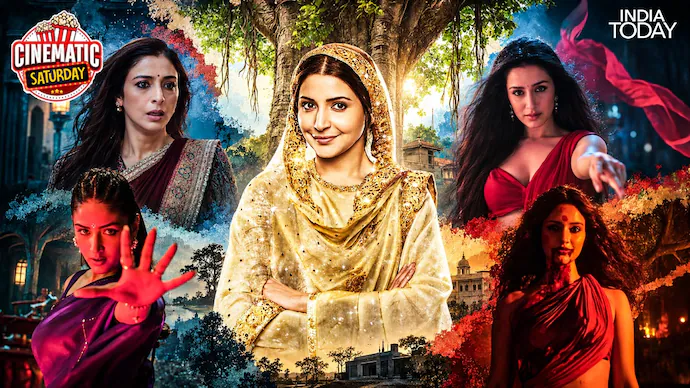
From Stree and Bulbbul to Bhool Bhulaiyaa and the newly released Nayyi Navelli, female spirits have become some of Hindi cinema’s most memorable supernatural characters. But why do bhootnis consistently command more attention than their male counterparts?
Indian Cinema has always had a fascination with the supernatural. Haunted mansions, mysterious forests, abandoned villages and unexplained apparitions have provided filmmakers with endless opportunities to frighten, entertain and intrigue audiences. Yet, within this sprawling world of cinematic horror, one pattern stands out: female ghosts frequently take centre stage, while male spirits often remain secondary characters, frightening creatures or sources of comic relief.
Whether it is a mysterious woman in a flowing red outfit, a vengeful spirit with a tragic past or a supernatural figure who challenges deeply rooted social conventions, the bhootni has developed into a distinctive presence in Bollywood storytelling. Films such as Raaz, Haunted 3D, Bhool Bhulaiyaa, Phillauri, Stree, Phone Bhoot and Bulbbul demonstrate how female supernatural characters can move effortlessly between horror, comedy, romance and social commentary.
With Yami Gautam’s Nayyi Navelli releasing on October 16, the enduring popularity of female phantoms offers another opportunity to examine a curious cinematic tradition. Why are audiences so fascinated by supernatural women? How have traditional beliefs about femininity influenced the way ghosts are portrayed? And why do filmmakers continue to find commercial and creative potential in the bhootni?
The answers lie in a combination of cultural folklore, gender expectations, emotional storytelling, visual spectacle and the commercial appeal of characters who can frighten audiences while challenging the rules of the living world.
1. The Cultural Psychology Behind the Female Ghost
Long before computer-generated imagery transformed supernatural cinema, Indian folklore had established a rich vocabulary of spirits, witches and mysterious women. The chudail, for instance, occupies a prominent place in many regional folk traditions. Often portrayed as a dangerous female spirit, she has historically been associated with death, injustice, fear and the consequences of violating social expectations.
These stories vary considerably across regions, but some share a recurring theme: a woman who dies under tragic circumstances, experiences injustice or exists outside accepted social conventions may return as a supernatural presence. Her appearance becomes a vehicle for expressing anxieties that society may otherwise struggle to acknowledge openly.
Women who challenge expectations surrounding marriage, sexuality, obedience or family responsibilities have sometimes been portrayed as threatening figures in traditional narratives. In certain stories, the chudail becomes a symbol of the fear surrounding female independence. The supernatural label can turn a woman who refuses to conform into someone who must be feared, avoided or controlled.
Filmmakers have inherited elements of this cultural imagination, adapting them to suit changing audiences and cinematic styles.
Filmmaker and screenwriter Sanjay Chhel, whose credits include Rangeela (1995), Yes Boss (1997), Partner (2007) and Indu Sarkar (2017), has pointed to the connection between female suffering, mythology and the cultural image of the chudail.
“Because they always feel that female is a suffering kind of soul, and it is connected to mythology where Chudail comes.”
Chhel also highlights the way certain women can be labelled as chudails within village traditions, reflecting how deeply these ideas can be embedded in cultural beliefs.
Such associations help explain why female ghosts can carry a more elaborate emotional history than a conventional supernatural villain. Their presence often raises questions beyond the immediate mystery: What happened to this woman? Why did she die? Who wronged her? And what does her return reveal about the people who remain alive?
For a filmmaker, these questions offer multiple layers of storytelling. A male ghost can certainly have an equally complex backstory, but the female phantom comes with a familiar cultural framework that audiences can recognise and that contemporary cinema can challenge.
Why the trope works across cultures
The fascination with supernatural women is not limited to Indian cinema. International films, television series and fantasy franchises have long explored witches, female demons, vengeful spirits and powerful supernatural women.
Consider the difference between a conventional male superhero and a woman whose powers are associated with chaos, magic or uncontrolled emotion. Popular culture has often treated male power as heroic or protective while presenting comparable female power as mysterious, dangerous or difficult to control.
Marvel’s Scarlet Witch, for example, illustrates how a female character’s extraordinary abilities can become inseparable from questions of grief, morality and the fear of losing control. Although superhero fantasy is different from ghost horror, both genres draw on a similar storytelling tension: a woman with unusual power can be perceived as both fascinating and threatening.
Female supernatural characters therefore offer filmmakers a way to explore a broader cultural contradiction. Society may celebrate women as symbols of love, sacrifice and care, yet become uncomfortable when those same characters display anger, ambition or a desire for revenge.
Horror makes that contradiction visible by giving it a supernatural form.
2. From Victims of Injustice to Agents of Revenge
One of the biggest reasons female ghosts remain compelling is the emotional complexity that filmmakers can build around them. Rather than presenting a spirit as an unexplained source of danger, many films reveal a history of betrayal, violence, humiliation or loss.
The supernatural becomes more than a mechanism for delivering jump scares. It becomes a means of revisiting an injustice that was never resolved while the character was alive.
Trade analyst and producer Girish Johar believes this emotional connection helps explain the appeal of female-led supernatural stories. He points to the cultural association between women and divine feminine power, or Shakti, alongside traditional ideas of love, affection and warmth.
“No one is negative by choice; when you reveal the actual reason behind them turning grey, audiences feel that connection.”
This approach allows a character to remain frightening without becoming emotionally distant. The audience may fear the ghost’s actions while understanding the experiences that shaped her. Her violence can become part of a larger narrative about the consequences of injustice rather than simply evidence that she is evil.
That ambiguity gives the bhootni a particularly flexible role in Indian cinema. She can be an antagonist, a tragic figure, a vigilante or even an unlikely hero.
Bulbbul: Horror as a language of female rage
Anvita Dutt’s Bulbbul, starring Triptii Dimri, demonstrates how a supernatural story can explore gender-based violence and the unequal distribution of power within a household.
Set against an atmospheric period backdrop, the film combines folklore, psychological tension and elements of gothic horror. Its central supernatural figure is connected to a history of suffering, making the horror inseparable from the social conditions surrounding her.
The forest, the darkness and the rumours about a mysterious creature contribute to the film’s unsettling atmosphere. But the deeper tension comes from the relationship between the supernatural legend and the violence that women experience in the supposedly respectable world of the living.
Rather than treating the female ghost as a random monster, Bulbbul turns the supernatural into a way of examining what happens when suffering goes unacknowledged. The figure who inspires fear also becomes a symbol of resistance.
This approach gives the bhootni a role that a conventional horror villain may not fulfil. She can expose the cruelty of a social order while forcing audiences to question why the victims of that order were ignored in the first place.
Stree: When the supernatural reverses the rules
Stree uses a different tone but explores a related idea. Blending horror with comedy, the film centres on a mysterious female spirit who haunts a town and targets men at night.
The residents’ fear shapes their daily routines, and the warning associated with the spirit becomes a familiar part of the town’s social landscape. Men are encouraged to stay indoors and protect themselves, while messages such as “O Stree, kal aana” become an attempt to negotiate with a supernatural force they do not understand.
The reversal is central to the film’s humour. In many real-world settings, women are warned about the dangers of travelling alone after dark. In Stree, men experience the anxiety of being vulnerable to a mysterious presence.
The comedy emerges partly from this reversal of familiar gender dynamics. The men who might ordinarily occupy the position of protectors suddenly find themselves frightened and powerless.
Yet the film is not simply about a ghost chasing men. Its premise also invites audiences to consider how fear, gender and social power operate within communities. The supernatural becomes a device for exposing the assumptions people take for granted.
By combining suspense, humour and social observation, Stree demonstrates why a female ghost can sustain an entire cinematic universe rather than functioning as a disposable monster.
Why revenge makes the bhootni memorable
Revenge provides a clear narrative engine. A character has suffered a wrong, the people responsible have escaped accountability, and the supernatural return disrupts the apparent stability of the world.
For audiences, this structure offers both suspense and emotional satisfaction. The mystery encourages viewers to discover what happened, while the possibility of retribution creates an expectation that the story will eventually confront the original injustice.
Not every female ghost is a victim or a moral avenger, and not every story grants her a sympathetic motivation. Nevertheless, the combination of vulnerability and frightening power creates a particularly rich dramatic contrast.
3. Glamour, Beauty and the Unsettling Cinematic Gaze
Bollywood’s bhootnis are not always designed to look conventionally monstrous. In many films, their visual presentation is central to their appeal. Flowing saris, loose hair, pale faces, dramatic eye makeup, slow-motion movement and carefully controlled lighting turn the female ghost into an instantly recognisable cinematic image.
This aesthetic can make a character unsettling precisely because she remains beautiful. Instead of relying entirely on physical distortion, filmmakers create tension between an appearance that attracts attention and a presence that signals danger.
The contrast is particularly effective in a cinema culture that has traditionally placed considerable emphasis on the visual presentation of female stars. A supernatural role can retain elements of glamour while transforming familiar beauty into something uncanny.
Sanjay Chhel has described the difference in how male and female ghosts are often presented on screen. Male spirits, he observes, are more likely to be given deformed or satanic appearances, while female apparitions may be portrayed through the familiar imagery of a woman in a white sari, with open hair and a sorrowful expression.
He links this visual distinction to the cultural perception of women as suffering figures, suggesting that audiences may identify more readily with the image of a distressed woman than with a grotesque male apparition.
That observation points to a storytelling convention rather than a universal rule. Horror cinema across countries uses a wide range of visual designs, and Indian films also feature frightening female characters whose appearances depart from conventional beauty. Still, the glamorous ghost remains a powerful part of Bollywood’s supernatural vocabulary.
Phillauri: A spirit with a softer side
In Phillauri, Anushka Sharma plays Shashi, a spirit whose presence introduces supernatural complications into a story that also explores romance, memory and emotional attachment.
Unlike a conventional revenge-driven horror film, the movie uses its ghostly premise to create a blend of humour and sentiment. Shashi’s supernatural existence is tied to an unfinished emotional story, allowing the character to move beyond the simple role of a frightening apparition.
The film illustrates the flexibility of the female ghost as a cinematic device. She can frighten, but she can also offer companionship, emotional insight and a connection to the past.
Her presence also changes the way the living characters understand their own relationships. The ghost is not merely an obstacle to be eliminated; she becomes an essential part of the emotional narrative.
Bhool Bhulaiyaa: Performance becomes part of the horror
Bhool Bhulaiyaa offers another example of how female supernatural imagery can become inseparable from performance. Vidya Balan’s portrayal of Manjulika is remembered for its intensity, physicality and dramatic transformation.
The character’s impact comes from more than the suggestion of a supernatural threat. Her movements, expressions, voice and commanding presence create a sense of unpredictability that makes the haunting memorable.
This is where horror and theatrical performance meet. The female supernatural character can move between elegance and menace, stillness and sudden violence, vulnerability and overwhelming intensity.
For performers, such roles offer opportunities to explore a broader emotional range than a straightforward romantic or comic character might provide. For audiences, the result is a character who remains memorable long after the immediate scares have passed.
4. Why Female Ghosts Work Across Horror, Comedy and Romance
A major advantage of the bhootni is that she is not restricted to one genre. The same basic supernatural premise can support a terrifying thriller, a romantic drama, a social satire or a broad comedy.
This versatility allows filmmakers to reach audiences with different entertainment preferences without abandoning the central appeal of the supernatural.
- Horror: Female spirits can create suspense through unexplained appearances, mysterious histories and the possibility of revenge.
- Comedy: Their supernatural powers can overturn familiar social hierarchies and expose the absurdity of human behaviour.
- Romance: A ghost can represent unfinished love, separation, memory or an emotional bond that survives death.
- Social drama: The supernatural can provide a framework for exploring injustice, gender discrimination and the consequences of silence.
- Fantasy: Female supernatural characters can inhabit elaborate worlds in which magic, folklore and human relationships intersect.
Films such as Raaz and Haunted 3D draw on the suspense associated with mysterious female presences and haunted environments. Phone Bhoot, meanwhile, places ghostly encounters within a comedy-driven premise, showing how supernatural figures can become part of a lighter entertainment experience.
These examples are not identical in tone or storytelling. Their significance lies in the range of narrative possibilities they reveal. A female spirit can anchor a serious exploration of suffering in one film and become the centre of an absurd supernatural adventure in another.
That flexibility makes the character attractive to writers and producers looking for concepts that can be adapted to different audiences and budgets.
5. The Box-Office Logic Behind the Bhootni Boom
Beyond cultural symbolism and creative storytelling, there is a practical reason filmmakers continue returning to supernatural women: the concept offers a potentially distinctive commercial proposition.
Trade analyst and producer Girish Johar argues that female-led supernatural stories can appeal to a wider audience because they combine a central female character with elements of horror, comedy and drama. In his view, this gives filmmakers opportunities to reach women, men, families and younger viewers rather than relying on a narrower audience profile.
That does not mean every film featuring a female ghost will become a hit. Box-office performance depends on many factors, including a film’s budget, cast, marketing, release schedule, audience reception and competition. Nor does the presence of a female supernatural lead automatically guarantee that a story will connect with viewers.
However, the underlying concept can offer several commercial advantages.
A recognisable premise with room for originality
Ghost stories have an immediate selling point: audiences understand the basic promise of fear, mystery and the unknown. A female spirit with a distinctive backstory adds another layer, creating an opportunity to differentiate the film from conventional supernatural thrillers.
Filmmakers can retain familiar ingredients, such as haunted locations, eerie music and unexplained events, while introducing new motivations, settings or social themes. This balance between familiarity and novelty can make a project easier to communicate to potential audiences.
Comedy makes horror more accessible
Pure horror can be an intense experience, and not every viewer enjoys sustained fear. Horror-comedies offer a different proposition by balancing frightening sequences with humour, allowing audiences to move between tension and relief.
The female ghost is particularly adaptable to this format because her supernatural power can disrupt everyday routines and expose human foolishness. The resulting comedy does not necessarily weaken the horror; it can make the character more unpredictable.
Stree and Phone Bhoot demonstrate different ways to place supernatural characters within comedy-oriented storytelling. Their approaches also show that a ghost need not remain frightening at every moment to sustain audience interest.
Female-led stories broaden the possibilities
Traditional commercial cinema has frequently associated male leads with physical action, while women have often been positioned within romantic or supporting narratives. Supernatural stories can challenge that division by giving female characters extraordinary abilities, independent motivations and control over the plot.
A bhootni can be the source of the conflict, the person who resolves it or the character whose history changes the audience’s understanding of the entire story. She does not need to wait for a conventional hero to drive the narrative forward.
For producers, this offers a way to build a film around a distinctive female role while retaining genre elements that are familiar to mainstream audiences.
6. Streaming, Franchise Potential and the Search for Fresh Horror
The popularity of supernatural storytelling also fits a wider entertainment environment in which audiences encounter films through cinemas, streaming services, trailers, short video clips and online discussions.
A striking ghost character can become an effective promotional image. A distinctive costume, memorable line, unusual movement or mysterious backstory may encourage viewers to discuss a film even before they watch it. The supernatural genre also lends itself to visual teasers, suspenseful trailers and scenes that can be presented without revealing the entire plot.
For streaming platforms, horror and fantasy can offer stories that cross regional and cultural boundaries. Viewers do not necessarily need extensive background knowledge to understand the fear of an unexplained presence, a haunted house or a character seeking justice after death.
At the same time, local folklore can give Indian supernatural films a distinctive identity. Rather than relying exclusively on familiar international horror conventions, filmmakers can draw on regional legends, community beliefs, family structures and social anxieties.
This combination of universal emotion and culturally specific storytelling creates opportunities for stories that feel recognisable without being interchangeable.
Franchise potential is another consideration. A successful supernatural character or fictional world may support sequels, spin-offs and stories that explore different parts of the same mythology. However, the success of such projects depends on the strength of the writing and the audience’s continued interest, not simply on repeating the original formula.
The challenge for filmmakers is to avoid reducing the bhootni to a predictable collection of visual effects and familiar scares. Audiences may recognise the trope, but they still need a reason to care about the character and the story.
7. The Problem With Turning Every Female Ghost Into a Victim
Although the bhootni has become a powerful cinematic figure, the convention is not without limitations. The same cultural associations that make female spirits emotionally compelling can also reinforce restrictive ideas about women.
If a female ghost is always introduced through suffering, betrayal or victimhood, cinema risks suggesting that a woman’s power becomes narratively acceptable only after she has been harmed. Her anger may be justified by a tragic past, while an ambitious or independent woman who has not suffered remains difficult to portray sympathetically.
Similarly, the familiar image of the beautiful woman in a white sari can reduce a supernatural character to an aesthetic object. Her appearance may attract attention, but it can also overshadow her personality, motives and agency.
There is another tension in stories that portray female spirits as symbols of empowerment. Revenge can offer a satisfying dramatic response to injustice, but it is not the same as systemic change. A film may allow a ghost to punish individual wrongdoers without examining the social conditions that made the original violence possible.
These limitations do not undermine the value of the trope. Instead, they point towards opportunities for more imaginative storytelling.
Female supernatural characters can be morally complicated, funny, ambitious, selfish, compassionate or frightening without every trait being explained through victimhood. They can possess power without being reduced to a symbol, and they can drive a story without necessarily becoming either a villain or a righteous avenger.
As audiences encounter more varied stories about women, filmmakers have an opportunity to expand the supernatural heroine beyond familiar stereotypes. The next memorable bhootni may be one whose motivations cannot be explained through a single tragedy.
8. Why Male Ghosts Often Get Less Attention
The apparent shortage of memorable male ghosts in mainstream Hindi cinema is partly a question of genre conventions. Male supernatural figures often appear as demons, monsters, mysterious entities or obstacles that the main characters must overcome. Their primary purpose may be to generate fear rather than to carry an emotionally detailed story.
Female spirits, by contrast, are frequently linked to romance, family relationships, social expectations and unresolved injustice. These connections provide writers with ready-made ways to build character development into the supernatural premise.
Gender expectations may also shape the visual presentation. A male ghost is often imagined as physically threatening, grotesque or demonic, while a female ghost may be framed through beauty, sorrow or mystery. These are conventions rather than universal rules, but they influence how audiences recognise and remember characters.
Comedy can reinforce the difference. A male ghost may be used as an awkward figure whose inability to interact normally with the living produces laughs. A female spirit, meanwhile, may become the source of the entire story’s conflict, giving her greater narrative importance.
Still, the comparison should not be taken as proof that male ghosts cannot support complex stories or that audiences invariably prefer female ones. The source material, the filmmaker’s choices and the quality of the characterisation all matter.
The more revealing question may be why cinema has so often connected female supernatural power with the emotions and social conflicts that ordinary life suppresses. The bhootni’s popularity reflects not only an appetite for scares but also the storytelling potential of a character who can cross the boundaries of gender, morality and mortality.
9. What the Future Holds for Bollywood’s Bhootnis
As Indian cinema continues to experiment with genre storytelling, the female ghost is likely to remain a flexible creative resource. The challenge will be to develop new narratives rather than rely entirely on familiar imagery and established formulas.
One promising direction is the use of regional folklore. India has a wide range of local supernatural traditions, each shaped by its own history, landscape and community beliefs. Thoughtful adaptations can introduce audiences to unfamiliar legends while preserving the cultural context that gives them meaning.
Another opportunity lies in combining supernatural storytelling with contemporary concerns. Horror can explore social exclusion, family power structures, violence, economic inequality or the tension between tradition and modernity without turning every film into a direct social lecture.
Filmmakers can also experiment with characters whose morality remains uncertain. A ghost may be sympathetic in one scene and terrifying in another. She may protect one person while endangering someone else, or pursue an objective that the audience understands without necessarily approving of it.
Such complexity can make supernatural stories more engaging than a simple battle between good and evil. It also gives performers more room to create distinctive characters.
For the genre to keep evolving, visual spectacle will need to work alongside strong scripts, convincing performances and meaningful world-building. A spectacular apparition may create an immediate reaction, but a well-developed character is what gives a horror film lasting appeal.
Frequently Asked Questions
Why are female ghosts so common in Bollywood films?
Female ghosts draw on Indian folklore, cultural beliefs about women and powerful narrative themes such as injustice, revenge, love and unresolved trauma. Their stories can also combine horror with comedy, romance and social commentary, making them adaptable to several genres.
What is the difference between a bhootni and a chudail?
Bhootni is a commonly used Hindi term for a female ghost or spirit. Chudail refers to a female supernatural figure found in various South Asian folk traditions, often associated with danger, death or revenge. Their meanings and portrayals vary across regions and stories.
How does Stree challenge traditional gender roles?
Stree reverses a familiar horror scenario by making men the targets of a mysterious female spirit. Through comedy and suspense, the film invites viewers to consider fear, vulnerability and gender expectations from a different perspective.
How does Bulbbul use supernatural horror?
Bulbbul combines gothic atmosphere and folklore with a story about suffering and gender-based violence. Its supernatural elements help explore the relationship between injustice, silence and female anger.
Are female-led supernatural films always successful at the box office?
No. A female supernatural lead can provide a distinctive premise, but commercial success depends on several factors, including writing, direction, acting, marketing, budget and audience response. The character alone cannot guarantee a film’s performance.
Why are female ghosts often shown as beautiful or glamorous?
Indian cinema frequently uses familiar visual conventions such as flowing clothing, open hair and dramatic makeup to create an unsettling contrast between beauty and danger. This approach reflects cinematic traditions and audience expectations, although supernatural characters can also be portrayed in more unconventional ways.
The Final Haunting: Why the Bhootni Still Rules
Bollywood’s fascination with female ghosts is about more than flowing saris, eerie music and perfectly timed jump scares. The bhootni occupies a distinctive place in cinema because she can embody several contradictions at once: vulnerability and power, beauty and danger, victimhood and revenge, comedy and tragedy.
Her supernatural existence allows filmmakers to explore questions that are difficult to resolve within the ordinary boundaries of social life. A ghost can return to confront a forgotten injustice, expose the hypocrisy of a community or disrupt the assumptions of people who believe they are in control.
Films such as Stree, Bulbbul, Phillauri and Bhool Bhulaiyaa demonstrate that female supernatural characters can serve very different storytelling purposes. Some frighten audiences, others make them laugh, and some invite them to reconsider the social structures surrounding the haunting itself.
Commercial appeal undoubtedly plays a role in the trope’s longevity, but its creative possibilities extend beyond box-office calculations. The female ghost can be a recognisable horror figure and a vehicle for examining cultural fears, gender expectations and the consequences of injustice.
That does not mean male ghosts have no place in Indian cinema, or that every bhootni must be a symbol of empowerment. Rather, the enduring appeal of the female phantom lies in the many different stories she can tell.
So, the next time a spectral woman glides across the screen, look beyond the immediate scare. Ask what she represents, whose fears she exposes and why her story could only be told through the supernatural. In Bollywood, the bhootni may be dead, but her hold on the living imagination remains very much alive.
For breaking news and live news updates, like us on Facebook or follow us on Twitter and Instagram. Read more on Latest Entertainment on thefoxdaily.com.






COMMENTS 0