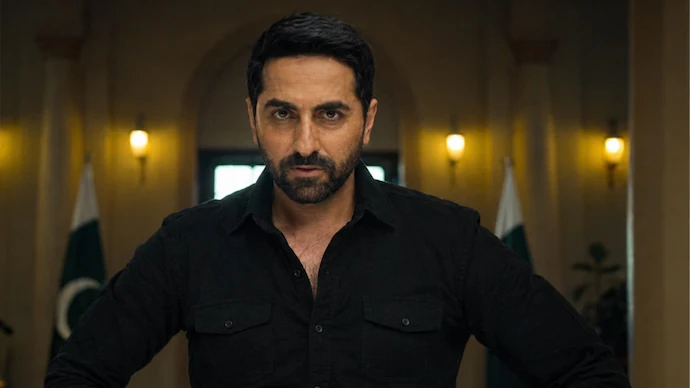
Udta Teer begins with an entertaining premise: a Pakistani spy embedded in India’s intelligence system loses his memory and accidentally dismantles the terror network he once served. Starring Ayushmann Khurrana, the film initially embraces the absurdity of its setup, delivering a spirited spy comedy built around mistaken identity, slapstick and the irony of accidental patriotism. However, as the story progresses, the comedy gives way to a patriotic thriller, leaving the film struggling to balance three competing identities.
The central idea offers plenty of comic potential. Bilal Ahmed, a Pakistani operative working undercover in India as Vikrant Thapar, suffers an accident that erases his memory. He wakes up believing he is a loyal Indian patriot, unknowingly turning against the organisation he was assigned to serve. The resulting confusion creates the film’s most promising source of humour: a spy network brought to the brink of collapse by one of its own agents, who no longer remembers which side he belongs to.
For a while, Udta Teer makes excellent use of this premise. Its first half is playful, irreverent and unafraid to embrace silliness. But the film eventually shifts towards a more conventional narrative of national pride, terrorism and heroic sacrifice. The transition weakens its comic rhythm and leaves its original idea struggling beneath the weight of patriotic spectacle.
Ayushmann Khurrana Anchors an Absurd Spy Comedy
Ayushmann Khurrana approaches the role of Bilal Ahmed with conviction, making the character’s sudden transformation from Pakistani spy to self-proclaimed Indian patriot the engine of the comedy. His performance helps sustain the absurdity of a man who begins dismantling his own network without understanding that he has switched sides.
The humour works best when the film allows this contradiction to speak for itself. Bilal’s mistaken loyalties create a situation in which the intelligence network’s downfall comes not from sophisticated counter-espionage or extraordinary strategic brilliance, but from an accident that changes the central character’s understanding of his own identity.
This reversal gives Udta Teer a distinctive comic hook. Spy films typically build suspense around secret identities, double agents and elaborate plans. Here, the same conventions become a source of farce because the operative at the centre of the conspiracy no longer understands his own role in it.
The first half displays a willingness to stretch the joke and explore the consequences of Bilal’s confusion. Rather than treating espionage as an entirely serious business, the film finds humour in the bureaucratic and operational chaos created by a spy who suddenly becomes an obstacle to his own mission.
Mukul Dev and Suhail Nayyar Strengthen the Comedy
The supporting cast contributes significantly to the film’s liveliest stretches. The late Mukul Dev is a scene-stealer as a jihadi character caught between terrorist responsibilities and matrimonial aspirations. The contrast between his violent professional role and his personal concerns supplies the kind of incongruity that the film’s early comedy handles most effectively.
Suhail Nayyar is equally entertaining as a fellow Pakistani operative who struggles to understand his colleague’s unexpected change of allegiance. His growing exasperation provides an audience-friendly perspective on the unfolding absurdity. While Bilal believes he is doing the right thing, those who know his actual identity are left dealing with the consequences.
The dynamic between the characters gives the premise room to develop beyond a single memory-loss gag. Every attempt to make sense of Bilal’s behaviour reinforces the central irony: the network is being undermined by someone who no longer remembers that he belongs to it.
The comedy is broad and occasionally juvenile, but it often succeeds because the actors commit to the film’s deliberately ridiculous world. The humour does not always depend on subtle writing. At its best, it comes from the confidence with which the characters treat an inherently absurd situation as if it were entirely normal.
Old Hindi Songs Add to the Film’s Comic Rhythm
Another effective element is the use of familiar Hindi songs to reinforce the humour. When deployed at the right moments, the music adds an extra layer of irony and helps the film maintain its playful energy.
The approach recalls the anarchic spirit of The Naked Gun franchise, where the joke often lies in the contrast between the seriousness of a situation and the ridiculous behaviour unfolding within it. Udta Teer similarly finds opportunities to puncture the conventions of the spy genre by treating its own excesses as material for comedy.
Not every gag lands. Rahul Bose, playing an Indian agent, is repeatedly subjected to undignified slapstick, including a sequence involving a corpse in a morgue and another in which he dances while confined to a hospital bed. These moments push the physical comedy towards the deliberately exaggerated, sometimes at the expense of the character.
Bose, however, commits to the material. His willingness to participate in the film’s more ridiculous situations helps prevent the humour from collapsing entirely, even when the writing leans too heavily on embarrassment and physical mishaps.
Why Udta Teer’s Second Half Loses Momentum
The film’s biggest problem emerges in the second half, when the spy spoof begins transforming into a patriotic thriller. The change in tone is not inherently unworkable. A comedy about an undercover operative who accidentally turns against his own network could plausibly develop into a more serious story about the consequences of his new loyalties.
The difficulty is that Udta Teer does not build a sufficiently convincing bridge between these two modes. Instead of allowing the comedy to evolve naturally, the screenplay increasingly abandons the qualities that made the opening section distinctive.
Bilal’s newfound nationalism leads him to foil a terror strike on the Ram Mandir. Chants of “Jai Shri Ram”, a “Jai Hind” anthem and repeated declarations that “mulk se badhkar kuch nahi”, meaning the nation comes first, become central to the film’s emotional and dramatic presentation.
These elements move the narrative towards familiar patriotic spectacle. The shift changes not only the tone but also the way the film expects audiences to respond to its central character. The earlier humour arose from the gap between Bilal’s actual identity and his mistaken beliefs. The later narrative increasingly asks viewers to accept his patriotic transformation as the basis for a more conventional heroic story.
The problem is not simply that the film becomes more serious. It is that its competing intentions do not come together convincingly. The comedy, espionage plot and patriotic drama begin to feel like separate films competing for control of the same story.
Sara Ali Khan’s Character Fails to Add Emotional Depth
Sara Ali Khan’s character does little to resolve the narrative imbalance. The role is underwritten, and her presence feels more like a structural requirement than an organic part of the story.
The film attempts to incorporate her character into its emotional stakes, but those efforts never fully take hold. The relationship does not develop enough depth to provide a compelling counterweight to the escalating espionage and patriotic elements.
In a story undergoing such a significant tonal shift, a well-developed emotional thread could have helped connect the comic first half with the more serious second half. Instead, the character remains insufficiently integrated into the narrative, leaving another part of the film feeling disconnected from its central premise.
This weakness reinforces the impression that the screenplay is trying to satisfy several different storytelling requirements without giving each one the development it needs. The result is a film that has interesting ingredients but struggles to combine them into a coherent whole.
A Spy Spoof That Becomes the Spectacle It Initially Parodies
One of the film’s most revealing ironies is that it gradually becomes the kind of spy spectacle it initially appears to parody. The early sections find humour in espionage conventions, using slapstick and absurdity to undermine the seriousness associated with secret missions and national-security threats.
As the story progresses, however, the film increasingly relies on patriotic declarations and familiar action-thriller beats. The satirical distance narrows, and the narrative begins to embrace the conventions it once seemed eager to mock.
The difference is that Udta Teer is often more successful at generating laughs through physical comedy and exaggerated situations than at building genuine suspense. Its initial premise promises a distinctive take on the spy genre, but the later developments pull it towards a more conventional dramatic framework.
The result is a loss of identity. A spoof needs a consistent understanding of what it is satirising, while a thriller needs tension, credible stakes and a narrative that builds towards its central conflict. Udta Teer shows flashes of both approaches but does not sustain either one with enough consistency.
Another Attempt by Ayushmann Khurrana to Break the Formula
Despite its shortcomings, the film’s ambition deserves recognition. Ayushmann Khurrana has repeatedly taken on projects that attempt to move beyond conventional mainstream storytelling. The review draws comparisons with Andhadhun (2018), Article 15 (2019), Chandigarh Kare Aashiqui (2021) and An Action Hero (2022), films associated with different ways of challenging familiar genre expectations.
Udta Teer follows a similar impulse by starting with an unusual premise and attempting to reshape the spy genre around it. The idea of a memory-lost operative accidentally destroying his own network is strong enough to support a distinctive comedy, particularly when the film focuses on the consequences of his mistaken identity.
The gamble becomes less successful when the screenplay attempts to accommodate a patriotic thriller and a mainstream action film alongside the spoof. Rather than deepening the original concept, the additional directions dilute its impact.
The film’s most inventive idea is ultimately buried beneath this confusion. Its ambition to combine comedy, espionage and nationalistic drama is evident, but ambition alone cannot guarantee that different genres will work together. The screenplay needs to make the transitions feel earned and ensure that each new direction strengthens rather than replaces the original premise.
Udta Teer Review: Final Verdict
Udta Teer begins with a clever comic idea and a cast willing to embrace its absurdity. Ayushmann Khurrana anchors the story, while Mukul Dev and Suhail Nayyar contribute some of its most entertaining moments. The use of old Hindi songs and the film’s willingness to indulge in broad slapstick help the first half establish a distinctive rhythm.
But the second half struggles to preserve that identity. As the spy spoof gives way to patriotic spectacle, the film loses the balance needed to make its different ambitions work together. Sara Ali Khan’s underwritten role adds little emotional weight, while the increasingly familiar dramatic elements weaken the originality of the opening premise.
The central irony is that Bilal’s accidental transformation gives him a clear sense of purpose, even as the film loses sight of its own. Udta Teer wants to be a spoof, a spy thriller and a nationalist drama at the same time. In attempting to hit all three targets, it fails to hit any of them consistently.
There is a more inventive film buried inside this one: a sharp, irreverent comedy about a spy who unknowingly dismantles the very organisation he serves. Unfortunately, that film never fully emerges from beneath the spectacle that replaces it.
For breaking news and live news updates, like us on Facebook or follow us on Twitter and Instagram. Read more on Latest India on thefoxdaily.com.






COMMENTS 0