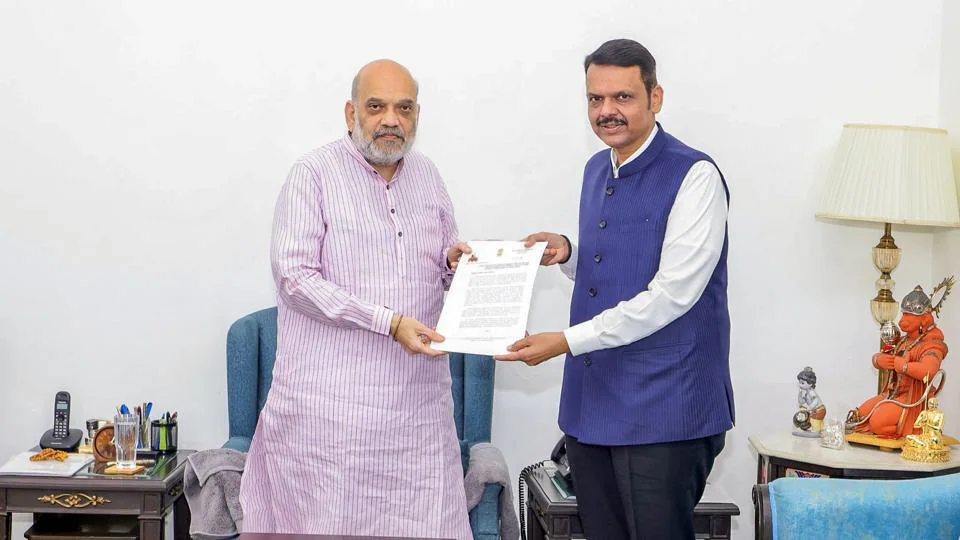
Maharashtra Chief Minister Devendra Fadnavis has pressed the Centre for an early decision on the state’s demand for ₹31,000 crore in drought relief, raising the issue during a late-night meeting with Union Home Minister Amit Shah in Pune on Sunday.
State government officials said Fadnavis requested the maximum possible assistance under the National Disaster Response Fund (NDRF) to help Farmers affected by widespread crop losses. The proposed financial support is expected to cover agricultural damage, fodder cultivation and irrigation-related requirements in drought-hit areas.
The meeting comes after Maharashtra completed its assessment of agricultural losses and submitted a memorandum seeking central assistance. An inter-ministerial team appointed by the Union government had also visited affected districts and submitted its findings.
With drought declared across a large part of the state, the Maharashtra government is seeking an early release of funds to support rural households and help farmers manage the financial consequences of the agricultural losses.
304 Talukas Declared Drought-Affected in Maharashtra
The scale of the agricultural damage is one of the main reasons behind Maharashtra’s demand for substantial central assistance. According to the state government’s assessment, drought has been declared in 304 of the state’s 358 talukas.
The government estimated that crops across approximately 14.15 million hectares had suffered losses exceeding 33%. The affected agricultural area is part of the state’s total cultivated area of 16.6 million hectares, spread across 37,496 villages.
The figures highlight the extent of the challenge facing the state’s agricultural sector. Crop losses of this scale can affect farmers’ incomes, reduce the availability of fodder and create additional pressure on rural economies that depend heavily on Agriculture.
For farmers, the consequences of drought can extend beyond a single harvest. Lower agricultural output can make it difficult to repay loans, meet household expenses and arrange resources for the next sowing season. Reduced fodder availability can also increase the cost of maintaining livestock, adding another burden for rural families.
The state government’s request for ₹31,000 crore is aimed at addressing several of these pressures through financial assistance and measures supporting agricultural recovery.
How the Maharashtra Government’s ₹31,000 Crore Relief Demand Progressed
Fadnavis had previously raised the drought-relief demand during a meeting with Amit Shah in New Delhi in October. Following that discussion, an inter-ministerial team of central government officials visited drought-affected districts to assess the situation on the ground.
The central team examined the damage and subsequently submitted its report. Meanwhile, the Maharashtra government completed its own assessment and forwarded a memorandum to the Centre outlining the extent of agricultural losses and the assistance required.
Sunday’s meeting in Pune was therefore an important follow-up to the earlier discussions. With the assessment process completed, Fadnavis sought an early decision on the financial package rather than allowing the request to remain pending.
A state government official said the chief minister had urged Shah to ensure that Maharashtra received the maximum possible assistance under the NDRF.
However, the Centre’s final decision on the amount and timing of the assistance had not been announced at the time of the meeting. The state’s demand of ₹31,000 crore should therefore be understood as a request, not an approved relief allocation.
Why Early Drought Assistance Is Important for Farmers
Timely financial assistance can be particularly important in drought-affected regions because agricultural losses often create several interconnected problems. Farmers may face reduced crop yields, higher input costs and limited resources to prepare their fields for the next agricultural cycle.
Compensation can help affected households manage immediate financial difficulties and reduce the pressure created by lost agricultural income. It can also support the restoration of farming activities where water availability and other resources have been severely affected.
The Maharashtra government’s request also includes support for fodder cultivation. This is significant because drought can reduce the availability of green fodder and increase dependence on purchased feed. Livestock owners may consequently face higher maintenance costs at a time when their agricultural earnings are already under pressure.
Irrigation projects form another important part of the state’s request. Better water availability can help reduce the vulnerability of farming communities to irregular rainfall and prolonged dry conditions. Investments in irrigation can also support agricultural activity beyond the immediate period of drought, although the benefits depend on project implementation and local water resources.
Fadnavis and Shah Also Discuss NCP Merger Speculation
Apart from the drought-relief demand, the meeting between Fadnavis and Shah is understood to have covered recent political developments involving the two factions of the Nationalist Congress Party (NCP).
Speculation about a possible reunification of the NCP factions has attracted attention in Maharashtra’s political circles. However, the precise nature of the discussion between the two leaders was not immediately clear.
Fadnavis has maintained that he was not aware of any formal merger discussions between the factions. He has also argued that the BJP, as a partner in the ruling Mahayuti alliance, would have been informed if any such negotiations were taking place.
The chief minister met NCP president Sunetra Pawar on Saturday. Speaking to reporters afterwards, he said he would have been made aware of any genuine merger discussions involving the two groups.
Fadnavis reiterated that even preliminary talks would have been communicated to the BJP because of its position as a coalition partner in the state government.
What Fadnavis Said About a Possible NCP Reunification
Fadnavis rejected suggestions that a merger between the two NCP factions was being discussed without the BJP’s knowledge.
He said: “I would like to reiterate that if any discussion regarding a merger between the two factions were underway, they would certainly have informed us (BJP) as well, since we are partners in the government. Even if any preliminary discussions had taken place, we would certainly have been kept in the loop.”
His remarks underline the political significance of any possible reunification. The two NCP factions have operated separately, and a merger could affect political calculations within Maharashtra’s ruling alliance as well as the opposition.
However, Fadnavis’s comments did not amount to confirmation that merger negotiations had taken place. He maintained that the BJP had not received information about any such discussions.
Supriya Sule Rules Out Merger Talks After Ajit Pawar’s Death
NCP-SP working president Supriya Sule has also rejected suggestions that her party is currently negotiating a merger with the other NCP faction.
Sule said discussions about reunification had taken place when her brother, former Maharashtra deputy chief minister Ajit Pawar, was alive. According to her, those conversations involved not only her but also senior leaders from her party.
She said that a date had even been fixed during the earlier discussions. However, following Ajit Pawar’s death, she and her party decided to end the reunification process.
“Ajit dada had discussions on the merger not just with me but also with all the senior leaders of our party… Even a date had been fixed. But the day my brother passed away, my party and I, in my own conscience, put a full stop to the issue of reunification. Since then, we have never made any statement on the matter,” Sule said.
Her statement offers a different account of the merger speculation, acknowledging that discussions had taken place in the past while rejecting the suggestion that they are continuing now.
The issue remains politically sensitive because any change in the relationship between the NCP factions could have consequences for Maharashtra’s coalition politics. For now, however, both Fadnavis and Sule have indicated that there is no confirmed ongoing merger process.
Gokul Cooperative Milk Union Controversy Also Discussed
Fadnavis is also understood to have briefed Shah on the political reaction to amendments to the Maharashtra Cooperative Societies Act. The changes have attracted criticism in connection with the election of a Mahayuti candidate as chairman of the Kolhapur District Cooperative Milk Producers’ Union, popularly known as Gokul.
Gokul is an influential cooperative institution in Maharashtra’s dairy sector. Its leadership and elections carry political importance because cooperative organisations have traditionally played a significant role in the state’s rural economy and local political networks.
The controversy surrounding the amendment has therefore become another issue for the state government to manage. The discussion with Shah indicates that Fadnavis sought to brief the Union Home Minister on the political backlash and its possible implications.
Details of the specific concerns raised during the meeting were not immediately available. The government has also not publicly outlined any decision taken by Shah regarding the controversy.
Infrastructure Projects and Local Opposition Feature in Talks
The two leaders are also understood to have discussed resistance to several infrastructure projects in Maharashtra. These included the pumped storage power project in Karjat and the proposed Vadhavan port.
Large infrastructure projects can face opposition from local communities and other stakeholders over land acquisition, environmental concerns, rehabilitation and their potential impact on livelihoods. The discussions reportedly included concerns about resistance to development initiatives and tree felling associated with such projects.
Karjat Pumped Storage Power Project
Pumped storage projects are designed to help balance electricity supply and demand. They generally use surplus electricity to pump water to an elevated reservoir and release it through turbines when additional power is required.
Such projects can support the integration of renewable energy into the electricity grid by providing a way to store energy and make it available when production from sources such as solar and wind declines.
However, their development can involve significant land requirements and changes to local landscapes. These issues can create concerns among residents and environmental groups, particularly when construction affects forests, water resources or agricultural land.
Vadhavan Port and Development Concerns
The proposed Vadhavan port is another major infrastructure project that has faced public debate. Its development is expected to strengthen maritime infrastructure and expand cargo-handling capacity, but concerns over environmental impact, land use and local livelihoods have remained part of the discussion.
Opposition to large projects can create delays and complicate implementation. Governments must balance infrastructure and economic objectives with environmental safeguards and the concerns of communities likely to be affected.
Fadnavis and Shah’s reported discussion of these projects suggests that resistance to development initiatives is also on the state government’s agenda, alongside the immediate demand for drought assistance.
Multiple Challenges on Maharashtra Government’s Agenda
The meeting brought together several issues facing the Maharashtra government, from agricultural distress to coalition politics and infrastructure development.
The demand for ₹31,000 crore in drought assistance remains the most immediate economic concern because of the reported crop losses across 304 talukas. Farmers in affected areas need support to manage lost income, livestock-related expenses and the challenges of preparing for future cultivation.
At the same time, the discussion about the NCP factions highlights the political uncertainty surrounding the state’s coalition arrangements. The controversy over the Gokul cooperative and resistance to infrastructure projects add further pressure on the administration.
Shah’s visit to Pune provided an opportunity for Fadnavis to raise these matters directly with a senior Union government leader. However, no final decisions on the drought package, NCP merger speculation or infrastructure-related concerns were announced following the meeting.
What Happens Next in Maharashtra’s Drought Relief Demand?
The next major development will be the Centre’s decision on Maharashtra’s request for financial assistance. The state has completed its assessment and submitted a memorandum, while the inter-ministerial team has also delivered its report.
These steps provide the basis for the Union government to consider the scale of assistance that can be extended under the NDRF framework. The final allocation, however, will depend on the Centre’s assessment and applicable disaster-relief procedures.
For farmers, the timing of the decision will be important. Delays in assistance can make it harder for affected households to manage immediate losses and prepare for the next agricultural season.
Fadnavis’s latest appeal to Shah reflects the Maharashtra government’s effort to secure an early response to the crisis. With more than 300 talukas declared drought-affected and millions of hectares of farmland reporting significant crop damage, the state is seeking substantial central support to help its agricultural communities recover.
For breaking news and live news updates, like us on Facebook or follow us on Twitter and Instagram. Read more on Latest India on thefoxdaily.com.






COMMENTS 0