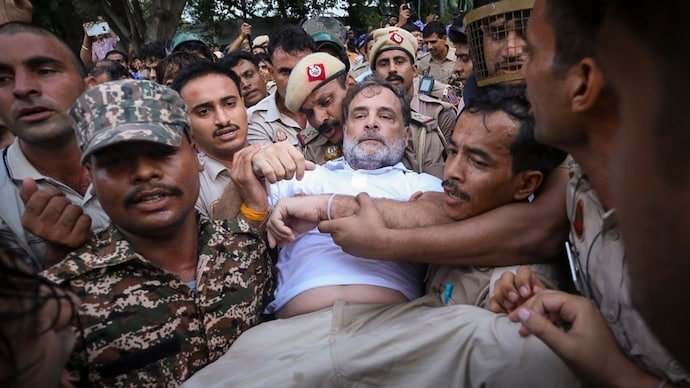
Indian Politics has always been driven by more than speeches and election manifestos. Images, symbolism, and public perception often shape political narratives as much as Policy debates. The dramatic scenes involving Leader of the Opposition Rahul Gandhi during a protest near Prime Minister Narendra Modi‘s official residence became one of the most talked-about political moments of the week.
The protest, organised by the Congress over the issue of alleged examination paper leaks and the treatment of protesting students, resulted in Rahul Gandhi and several senior party leaders being detained by Delhi Police. Television channels, newspapers, and social media were quickly flooded with visuals showing Rahul Gandhi being removed by security personnel, with visible injuries and blood on his face and clothes.
Beyond the immediate confrontation, the incident triggered larger questions about democratic protest, freedom of political expression, public accountability, and the growing importance of visual storytelling in modern Indian politics.
What Happened During the Protest?
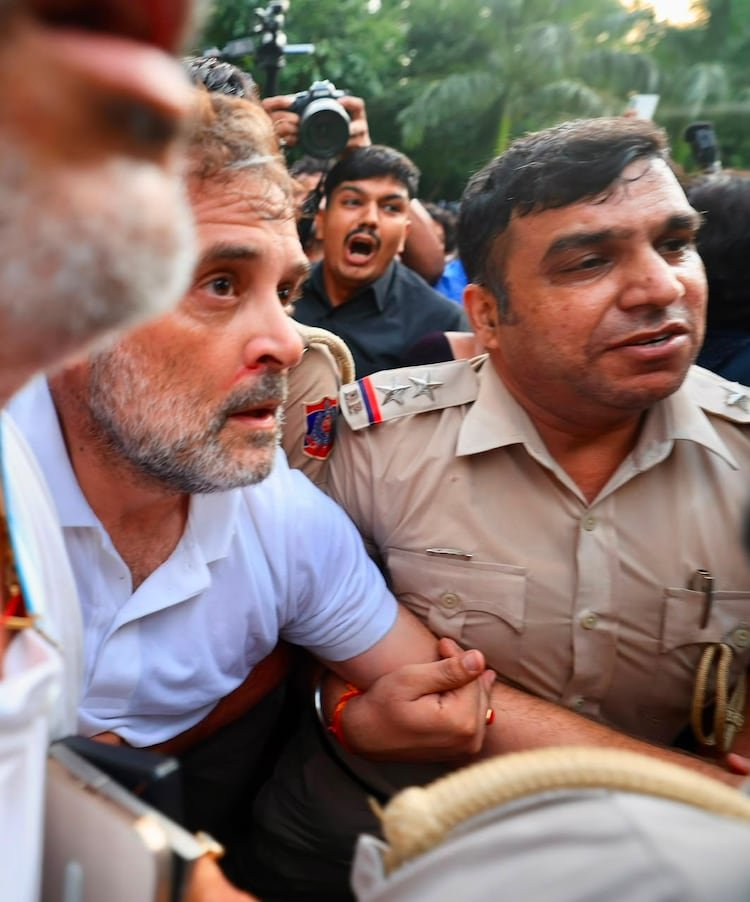
Congress leaders assembled to protest what they described as the government’s failure to adequately address repeated allegations of examination paper leaks and irregularities affecting students across the country. The party also criticised police action against young protesters WHO had been demonstrating over the same issue.
The protest eventually moved toward the Prime Minister’s official residence, a heavily secured zone where demonstrations are subject to strict security restrictions. Delhi Police stopped the march, leading to a confrontation between protesters and security personnel.
Rahul Gandhi, Priyanka Gandhi, and several senior Congress leaders were detained during the operation. Visuals circulated widely showing Rahul Gandhi being physically escorted away after sustaining a nose injury during the commotion.
Why the Protest Focused on Exam Paper Leaks
The issue of examination paper leaks has become a major concern for students and parents across India. Competitive examinations are gateways to government jobs, university admissions, and professional careers. Any compromise in examination integrity directly affects millions of aspirants who spend years preparing.
Students have repeatedly demanded:
- Transparent investigations into alleged paper leak networks.
- Strict punishment for organised cheating rackets.
- Re-examinations where necessary.
- Improved cybersecurity for digital examination systems.
- Greater accountability from examination authorities.
Several examinations conducted over recent years have faced allegations ranging from leaked question papers to organised cheating syndicates, making examination integrity an important national policy issue rather than merely an administrative concern.
Why the Images Became Bigger Than the Protest
Modern political communication increasingly revolves around visual narratives. A single photograph often communicates emotion more effectively than lengthy political speeches.
The images of Rahul Gandhi with visible injuries immediately became the defining symbol of the day’s events. Supporters argued the visuals reflected excessive use of force against a peaceful opposition protest, while government supporters questioned the decision to stage a demonstration near one of India’s most sensitive security zones.
Regardless of political opinion, the photographs shifted public discussion from procedural questions about permissions and security to broader debates over democratic dissent and the rights of opposition leaders.
Political Optics: Why Symbolism Matters
Political strategists frequently describe elections as battles of perception. Voters rarely remember every parliamentary debate, but memorable visuals often remain in public memory for years.
Throughout democratic history, photographs have influenced political conversations by creating emotional connections with citizens. Images of protests, arrests, public speeches, and moments of confrontation often become defining political symbols.
For opposition parties, such moments can reinforce narratives about accountability, resistance, or government overreach. For governments, managing both security concerns and public perception becomes equally important.
Understanding the Congress Strategy
The Congress has consistently attempted to position itself as a political voice for students, unemployed youth, and those demanding examination reforms. The party has frequently criticised the government over allegations involving recruitment examinations and competitive tests.
By leading a high-profile protest, Congress sought to:
- Highlight student grievances at the national level.
- Demand greater accountability from the central government.
- Project Rahul Gandhi as the principal face of the campaign.
- Shift public discussion from procedural issues to student concerns.
- Maintain visibility on an issue affecting millions of young voters.
Whether the strategy ultimately succeeds depends on how voters interpret both the protest and the government’s response.
The Government’s Security Perspective
The Prime Minister’s residence lies within one of the country’s most heavily protected security zones. Access to the area is tightly regulated due to National Security considerations.
Authorities have maintained that security protocols require immediate intervention whenever demonstrations approach restricted locations. From the government’s perspective, enforcing security regulations remains essential regardless of the political affiliation of those involved.
This creates a recurring challenge in democratic governance: balancing the constitutional right to peaceful protest with the responsibility to protect high-security institutions.
Timeline of Key Developments
| Stage | Development |
|---|---|
| Student protests | Students raise concerns over alleged paper leaks and examination irregularities. |
| Congress campaign | The party intensifies criticism of the government’s handling of examination issues. |
| March toward PM residence | Congress leaders proceed toward the Prime Minister’s official residence. |
| Police intervention | Delhi Police stop the march and detain several leaders. |
| Visuals circulate nationwide | Images of Rahul Gandhi’s detention dominate television and social media discussions. |
| Political reactions | Both ruling and opposition parties defend their respective positions. |
Why Exam Integrity Has Become a National Issue
India conducts one of the world’s largest examination systems every year. Millions of candidates compete for limited seats in universities, public sector jobs, and government services.
Even isolated allegations of paper leaks can have significant consequences:
- Loss of public trust.
- Delayed recruitment processes.
- Financial losses for candidates.
- Mental stress among students.
- Litigation and administrative delays.
Repeated controversies have increased demands for stronger digital security, improved surveillance, encrypted question paper distribution, and stricter criminal penalties against organised cheating networks.
Government Measures to Improve Examination Security
In recent years, governments and examination authorities have introduced multiple measures aimed at reducing paper leak risks, including:
- Encrypted digital question paper transmission.
- Biometric candidate verification.
- AI-assisted monitoring during online examinations.
- Stronger cybersecurity protocols.
- Special investigation teams to probe organised leak networks.
- Legislative measures targeting examination malpractice.
Implementation quality, however, continues to vary between different recruiting agencies and examination boards.
How Social Media Amplified the Incident
The protest illustrates how political communication has evolved in the digital era. Television broadcasts no longer determine the entire news cycle. Videos shared across social media platforms often reach millions within minutes.
Supporters, critics, journalists, and political commentators rapidly circulated competing interpretations of the same footage. Some highlighted the physical confrontation, while others focused on questions regarding security protocols and protest permissions.
This rapid spread of visual content demonstrates how political narratives now develop simultaneously across multiple digital platforms rather than through traditional news coverage alone.
Comparison: Policy Debate vs Political Symbolism
| Policy Debate | Political Symbolism |
|---|---|
| Focuses on examination reforms. | Focuses on powerful public images. |
| Driven by facts, legislation, and administration. | Driven by emotion and public perception. |
| Long-term institutional impact. | Immediate media attention. |
| Requires sustained discussion. | Can reshape narratives within hours. |
What This Means for Indian Politics
The episode reflects a broader shift in Indian political communication. Opposition parties increasingly rely on symbolic demonstrations to draw attention to governance issues, while governments face the dual challenge of maintaining security without appearing overly restrictive.
The effectiveness of such protests is measured not only by policy outcomes but also by their ability to influence public conversation.
For Congress, the protest reinforced its campaign around youth and employment issues. For the BJP-led government, the challenge remains responding substantively to examination concerns while defending administrative decisions.
The Bigger Issue Beyond Politics
While political parties debate responsibility, students remain primarily concerned about examination fairness. Their expectations are straightforward:
- Secure examinations.
- Transparent investigations.
- Timely recruitment.
- Merit-based selection.
- Confidence that years of preparation will not be undermined by organised malpractice.
Ultimately, public trust in examination systems depends less on political rhetoric and more on effective institutional reforms.
Expert Insight: Why Political Images Often Outlast Political Speeches
Political scientists have long observed that memorable images frequently shape collective memory more effectively than detailed policy discussions. A dramatic photograph can become a lasting symbol because it captures emotion, conflict, and narrative in a single frame.
However, lasting political success usually depends on converting symbolic moments into sustained public engagement and measurable policy outcomes. Without follow-up action, even the most powerful political imagery gradually loses influence.
Future Outlook
The debate over examination integrity is unlikely to fade soon. As recruitment examinations continue to involve millions of candidates annually, demands for stronger safeguards are expected to grow.
Parliamentary discussions, judicial oversight, administrative reforms, and technological improvements will all play important roles in restoring confidence in India’s examination ecosystem.
Politically, the incident is likely to remain part of the broader contest over youth issues, governance, and accountability. Whether it changes electoral dynamics will depend on how effectively each political party addresses the substantive concerns behind the protest rather than the symbolism alone.
Conclusion
The confrontation outside the Prime Minister’s residence became much more than a routine political protest. It evolved into a national conversation about democratic dissent, examination reforms, public accountability, and the growing influence of political imagery in shaping public opinion.
For the Congress, the visuals strengthened its messaging around student concerns and Opposition Politics. For the government, they highlighted the continuing challenge of balancing security responsibilities with democratic freedoms. Yet beyond the headlines and political narratives, the central issue remains unchanged: millions of Indian students expect a fair, transparent, and trustworthy examination system. Ultimately, meaningful reforms not memorable photographs will determine whether public confidence is restored.
For breaking news and live news updates, like us on Facebook or follow us on Twitter and Instagram. Read more on Latest India on thefoxdaily.com.




COMMENTS 0