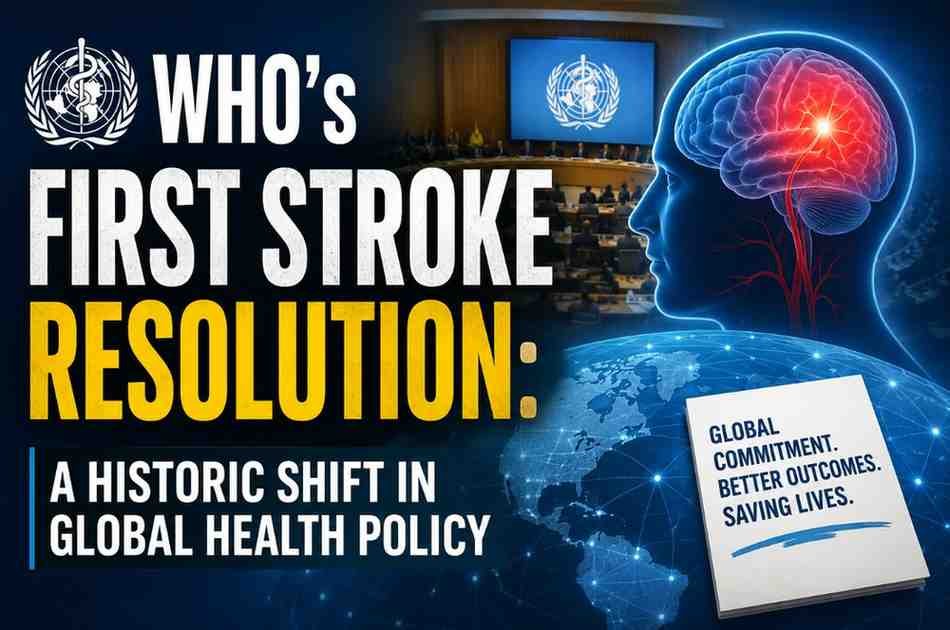
On 22 May 2026, something quietly historic happened inside the Palais des Nations in Geneva. The 79th World Health Assembly the supreme decision making body of the World Health Organization passed its first ever dedicated resolution on stroke. The resolution, titled “Reducing the burden of stroke: strengthening prevention, acute care, rehabilitation and health system readiness,” was proposed by Egypt and co sponsored by Chile, Georgia, Palestine, Paraguay, and Tunisia. After more than two decades of persistent lobbying by neurologists, patient advocates, and public health specialists, stroke has finally been recognised as a distinct Global Health emergency by the world’s most powerful health governance body.
This is not a minor bureaucratic milestone. For a disease that kills 7 million people every year, causes disability in tens of millions more, and costs the global economy hundreds of billions of dollars annually, the absence of a WHO level resolution had been a glaring policy gap. Now, that gap has been closed and the implications stretch from hospital emergency departments in Lagos to rehabilitation centres in Lima.
What Exactly Is the Stroke Crisis? The Numbers Tell a Devastating Story
To understand why this resolution matters so deeply, you need to understand the scale of what stroke does to the world every single year. Stroke is not merely a “brain attack” that happens to elderly patients. It is one of the most efficient killers and disablers on the planet, striking across age groups, income levels, and geographies.
In 2021 alone, stroke accounted for an estimated 93.8 million cases globally, including 11.9 million new strokes. It ranked as the third leading cause of both death and disability worldwide. Over the past 20 years, the lifetime risk of having a stroke has increased by a staggering 50%, with current projections placing the lifetime risk at 1 in 4 adults. That is not a niche medical statistic it is a number that touches nearly every family on Earth.
Stroke causes approximately 7 million deaths and 145 million disability-adjusted life years (DALYs) annually. There are currently more than 94 million stroke survivors alive, many of them living with complex, long-term disabilities and cardiovascular comorbidities that require sustained medical attention. Without coordinated global intervention, stroke deaths are projected to rise by 50% by 2050, with global economic costs expected to reach US$1.6 trillion.
| Indicator | Current Figure |
|---|---|
| Annual stroke deaths | ~7 million |
| New stroke cases per year | 11.9 million |
| Total global stroke cases (2021) | 93.8 million |
| Stroke survivors worldwide | 94+ million |
| Disability-adjusted life years lost | 145 million per year |
| Lifetime stroke risk (adult) | 1 in 4 |
| Share of stroke deaths in LMICs | ~87% |
| Projected economic cost by 2050 | US$1.6 trillion |
Perhaps the most sobering figure of all: approximately 87% of all stroke deaths occur in low and middle-income countries (LMICs) the same countries that typically have the least access to neurologists, stroke units, clot busting drugs, and rehabilitation services. This is not just a medical crisis. It is a crisis of equity.
Why Did It Take This Long? A Brief History of Stroke Being Left Behind
Stroke’s absence from the WHO’s formal resolution agenda is, in retrospect, difficult to explain. Cancer, HIV/AIDS, tuberculosis, malaria all of these conditions have had sustained, dedicated global policy frameworks for decades. Stroke, despite ranking alongside the biggest killers, has historically been bundled under the broader umbrella of non-communicable diseases (NCDs) without its own targeted action mandate at the highest policy level.
The World Stroke Organization (WSO), founded in 2006, declared stroke a public health emergency as early as 2010. The UN addressed NCDs as a collective category in a landmark General Assembly declaration in 2011 only the second time in UN history that a medical topic had received that platform. The WHO’s Global Action Plan for NCDs (2013–2020) included stroke as part of the cardiovascular disease cluster, but it never named or targeted stroke independently.
This lack of specificity mattered enormously in practice. Funding streams, national action plans, and healthcare infrastructure investment tend to follow exactly what gets named in international resolutions. When stroke is lumped in generically with “cardiovascular diseases,” governments can technically claim compliance while investing primarily in heart disease programmes that may do little to address the distinct requirements of stroke care things like stroke units, rapid neuroimaging, thrombolysis access, and specialised rehabilitation.
For years, neurologists and stroke specialists made the argument to WHO and member states that stroke deserved its own resolution. The WSO’s Global Stroke Action Coalition and partner organisations like the World Heart Federation continued that push persistently, ensuring that critical language about stroke was embedded wherever possible in adjacent resolutions including, notably, a 2025 WHO resolution on medical imaging capacity, which included specific text on the role of imaging in acute stroke treatment.
The tipping point came with the growing recognition that stroke’s burden was not declining it was accelerating, particularly in the developing world.
What the Resolution Actually Calls For
The WHA79 stroke resolution is not a vague statement of concern. It is a structured policy document built around a continuum of care across six interconnected pillars:
- Population level prevention targeting modifiable risk factors including hypertension, diabetes, smoking, high-salt diets, and air pollution, all of which are known to directly increase stroke risk
- Primary care readiness and risk factor control ensuring that first contact healthcare services can identify and manage patients at elevated stroke risk before a stroke occurs
- Emergency and acute care calling for the designation of stroke-ready emergency facilities, and expanding access to evidence-based interventions including intravenous thrombolysis (clot-busting drugs) and mechanical thrombectomy (surgical clot removal)
- Rehabilitation and long term support addressing the reality that surviving a stroke is often just the beginning of a long, resource intensive recovery journey
- Registries and surveillance building the data infrastructure needed to monitor outcomes and identify where care gaps are most severe
- Financing, equity and health-system integration the most ambitious pillar, calling for stroke to be integrated into national universal health coverage plans
The resolution also urges member states to establish national stroke action plans and designate stroke units within hospitals, both of which are proven, cost-effective interventions that remain absent from most health systems in the developing world.
The Treatment Gap: The Insight Most Coverage Is Missing
Most news coverage of this resolution focuses on the historic “first ever” nature of the vote. What gets far less attention is the specific nature of the treatment gap that makes this resolution so urgent and why closing it requires more than just political will.
Consider thrombolysis. Administering a clot-dissolving drug (tPA) within the first few hours of an ischaemic stroke can dramatically reduce death and disability. It is not an experimental therapy it has been standard of care in high-income countries for decades. Yet in many LMICs, the thrombolysis rate hovers below 1% of eligible stroke patients. Egypt, which notably proposed the WHA resolution, famously raised its own national thrombolysis rate from under 1% to 12.3% through a targeted corrective programme a remarkable achievement, but one that still illustrates how far behind baseline even a committed middle-income country starts.
Mechanical thrombectomy the gold standard intervention for large vessel occlusion strokes is even more inaccessible. It requires interventional neuroradiologists, specialised catheters, and advanced imaging infrastructure that simply does not exist in most of the world’s hospitals. The irony is that the five landmark trials published in the New England Journal of Medicine in 2015, which proved thrombectomy’s efficacy, created a two-tier global system: high-income countries that could act on the evidence, and everyone else who could not.
There is also a notable gender dimension to the treatment gap. Research has consistently shown that women have significantly lower odds of receiving thrombolytic treatment for acute stroke than men despite evidence suggesting women may benefit more from it. Women also tend to experience poorer functional recovery and higher post stroke mortality, partly due to older age at stroke onset and pre-stroke dependency. A global resolution that centres equity has the potential to bring these disparities into national policy conversations for the first time.
Why This Resolution Matters Beyond the Headline
A WHO resolution does not automatically fund hospitals or train neurologists. Critics of international health diplomacy are right to note that resolutions can become shelved documents if not backed by sustained political and financial commitment. So why should we take this one seriously?
The answer lies in what a formal resolution actually does to the policy environment around a disease. First, it creates an accountability mechanism. Member states that vote for the resolution are now on the record committing to national action plans. WHO can and will monitor progress and report back to future World Health Assemblies. Second, it unlocks funding pathways. Multilateral development banks, donor governments, and private foundations use WHO priority designations to guide where global health financing flows. Stroke’s formal recognition makes it far easier for health ministries in LMICs to make the case domestically for stroke infrastructure investment. Third, it changes the conversation in medical schools and health faculties around the world. Stroke neurology, long seen as a specialty without a global advocacy home, now has one.
There is also the economic argument, which has historically been underused in stroke advocacy. Research shows that for every US$1 spent on preventing stroke and cardiovascular disease, the estimated return on investment is US$10.90. The global stroke diagnostics and therapeutics market was valued at over US$32 billion in 2021 and is projected to exceed US$65 billion by 2030. These are not the numbers of a neglected disease they are the numbers of a disease the world has systematically chosen to underinvest in at the policy level, until now.
What Happens Next: A Cautious Optimism
The passage of the WHA79 stroke resolution marks the end of a long beginning not the beginning of the end of the stroke burden. The real work now falls to member states, national health ministries, neurological societies, and patient advocacy organisations to translate the text of a Geneva resolution into functioning stroke systems on the ground.
Several things will determine whether this resolution lives up to its promise. The first is whether high-income countries provide concrete financial and technical support to help LMICs build the infrastructure the resolution calls for. Calling on low-income countries to establish stroke units without resourcing that ambition is an exercise in aspirational paperwork. The second is whether stroke gets a dedicated line in universal health coverage packages, rather than being absorbed into generic cardiovascular allocations. The third is whether the surveillance and registry pillar arguably the least glamorous but most essential component gets sufficient investment, because you cannot improve what you cannot measure.
What can be said with confidence is that the trajectory of global stroke policy shifted on 22 May 2026. After being overlooked by the world’s most influential health governance body for its entire history, stroke now sits alongside HIV, tuberculosis, and non-communicable disease clusters as a named, mandated, and monitored global health priority. For the 15 million people who will have a stroke somewhere in the world this year, that shift was long, long overdue.
Conclusion: A Turning Point, Not a Finish Line
The first ever WHO resolution on stroke is a landmark that deserves to be understood in its full context not as a moment of celebration, but as a moment of reckoning. The numbers have always been there. The science of prevention, acute treatment, and rehabilitation has advanced enormously. What has been missing is the political architecture to mobilise the world around a disease that affects one in four of us.
That architecture now exists.The question is what member states, health systems, and the international community choose to build with it. If the history of global health has taught us anything, it is that formal recognition is necessary but never sufficient. Stroke’s moment has come. The window to act is open. What the next decade looks like for the world’s 94 million stroke survivors and the tens of millions who will join them will depend entirely on whether that window stays open long enough for real change to walk through it.
For breaking news and live news updates, like us on Facebook or follow us on Twitter and Instagram. Read more on Latest Health on thefoxdaily.com.




COMMENTS 0